
Telemachus Myth Meaning & Symbolism
A son's perilous journey to find his lost father, confronting usurpers and his own uncertainty to claim his rightful place in the world.
The Tale of Telemachus
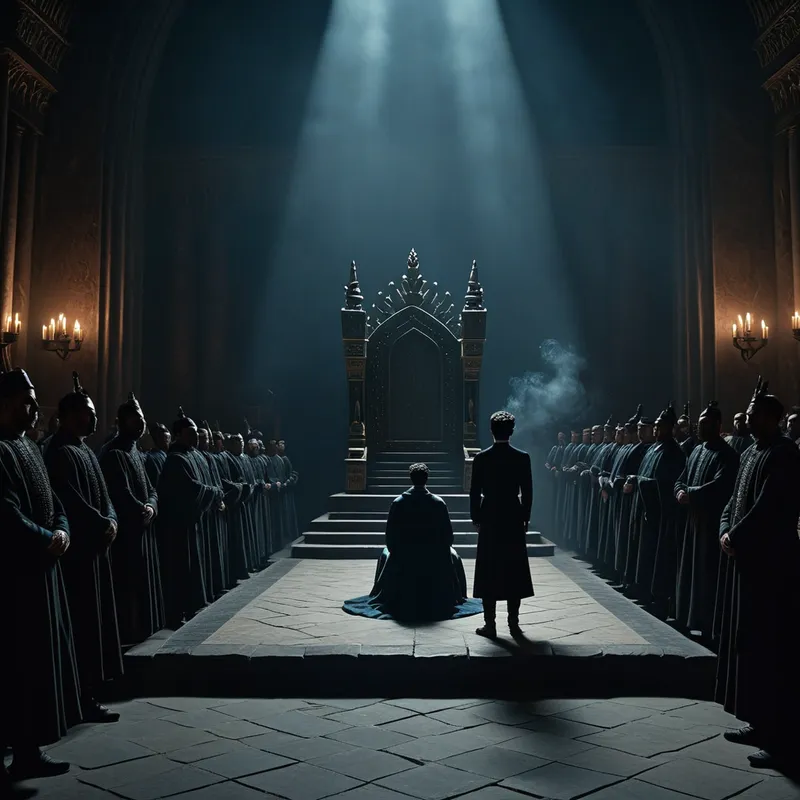
Listen, and hear a tale not of a god’s wrath or a monster’s fury, but of a quieter, more human fire—the smoldering ache of a house without its king. The hearth of Odysseus was cold. For twenty years, the great hall of Ithaca echoed not with the laughter of its lord, but with the clamor of strangers. They were the Suitors, princes from neighboring isles who descended like vultures, claiming the absent king was dead. They devoured his wealth, drank his wine, and besieged his wife, Penelope, demanding she choose a new husband from among them.
And in the center of this storm sat Telemachus, the son. He was no longer a child clinging to his mother’s robes, yet not a man who could command the hall. He moved through his own home as a ghost, his voice a whisper against the roar of their feasting. His inheritance was being consumed before his eyes; his future, a throne promised to another. A deep, formless sorrow lived in his chest—the sorrow of a son who knows his father only as a legend, a name sung by bards, a shadow that grew longer with each setting sun.
Then, a stranger came to the shore. He wore the guise of an old friend of Odysseus, but his eyes held the grey light of distant seas. This was Athena, patron of cunning heroes. She found Telemachus on the beach, staring at the horizon. “You are Odysseus’s son,” she said, her voice not unkind. “Where is your father’s fire? His courage? It is time to stop being a boy in a man’s hall. Go. Seek word of him. Sail to sandy Pylos and golden Sparta. Let the world hear that the son of Odysseus lives and demands answers.”
A spark, long buried, caught flame. For the first time, Telemachus spoke not as a petitioner, but as a prince. He stood in the hall, his voice cutting through the stale air. “You have eaten my father’s substance long enough. I go on a journey. When I return, may the gods deal with you as you deserve.” The Suitors laughed, but their laughter was uneasy. The ghost had found its tongue.
The sea voyage was his baptism. Salt spray washed away the dust of helplessness. In Pylos and Sparta, he stood before kings, asking his questions with a new-found grace. He heard tales of his father’s glory and his suffering. He learned that to be a son is not to wait, but to seek. He learned that the world is vast, and a man’s name is carried by his own deeds as much as by his father’s.
He returned to Ithaca not as the boy who left, but as a man walking towards his fate. The final test awaited. In the disguised presence of his own father—now a beggar in his own hall—Telemachus helped string the great bow of Odysseus, an act of strength and symbolic claim. Together, father and son, reunited in purpose, cleansed the hall with terrible, necessary justice. The journey to find the father ended with the son standing shoulder-to-shoulder with him, no longer a seeker, but an heir proven.
Cultural Origins & Context
This story forms the opening four books of Homer’s epic, the Odyssey, often called the “Telemachy.” Composed in the 8th century BCE, it was performed orally by bards for aristocratic audiences in a world emerging from its own “Dark Age.” The tale functioned as a foundational narrative of Greek aristocratic identity. It was not merely an adventure prelude, but a crucial social script.
In a culture where lineage, honor (time), and inheritance were the bedrock of social order, Telemachus’s plight was a nightmare scenario: the potential collapse of the patriarchal household (oikos). His successful journey modeled the proper transition from youth (kouros) to manhood, a transition dependent on public action, seeking the counsel of elders, and avenging insults to the household. The story reassured its listeners that order could be restored, that rightful lineage would prevail over chaotic usurpation, and that the gods—specifically Athena as a divine guide—sanctioned and aided this process of legitimate maturation.
Symbolic Architecture
The myth of Telemachus is not a story of slaying monsters, but of slaying the inner dragon of passivity. It is the archetypal blueprint for the psychological journey from a state of defined-by-others to a state of self-definition.
The search for the father is, at its core, the search for the internalized principle of authority, structure, and purpose. One must voyage out to find what is, in truth, waiting to be realized within.
Telemachus in his father’s hall represents the ego in a state of identification. He is “the son of Odysseus,” a role suffocated by external forces (the Suitors as manifestations of chaotic, consumptive impulses and social pressure). His home is no longer a container for growth but a prison of stasis. Athena’s intervention symbolizes the first stirring of the Self—an inner call to consciousness that feels like divine inspiration. The voyage is the necessary separation from the mother-complex (Penelope and the besieged home) and the familiar, stagnant identity.
The Suitors are a potent symbol of the psychic parasites that thrive in the absence of conscious authority. They are unchecked desires, opportunistic thoughts, and societal expectations that consume one’s vital energy (the estate) when the central governing principle (the father/king) is absent.
The Dreamer’s Resonance
When this myth stirs in the modern unconscious, it often manifests in dreams of searching within a vast, unfamiliar, or decaying house; of missing a crucial vehicle (ship, bus, plane); or of being surrounded by mocking, faceless crowds while trying to speak. The somatic sensation is one of constriction in the chest—a literal “heavy heart”—and a paralysis of will.
To dream of Telemachus is to experience the psyche’s signal that one’s psychological inheritance is being held hostage. The “Suitors” may appear as draining relationships, a career that consumes without fulfilling, or internalized critics that feast on self-doubt. The dreamer is in the “hall of Ithaca,” aware of a deeper potential (the lost father/king) but unable to access it, feeling usurped in their own life. The dream calls for the “voyage”—a conscious, often frightening act of seeking new perspectives, mentors, or knowledge that can help re-establish an inner authority.

Alchemical Translation
The alchemy of the Telemachus myth is the transformation of potential into actuality, of son into sovereign. It maps the early, crucial stages of individuation.
The process begins with the nigredo, the blackening: the dark despair and confusion in the corrupted hall. This is the necessary recognition of the problem, the death of the old, passive identity. Athena’s counsel initiates the albedo, the whitening: the clarifying journey across the “sea of the unconscious” to gather the scattered fragments of the father-principle—stories, wisdom, and models of action from Nestor and Menelaus (representing different aspects of mature kingship).
The reunion with the father is not a regression to childish obedience, but a coniunctio, a sacred marriage of the developed ego (Telemachus) with the rediscovered inner authority (Odysseus). Together, they perform the necessary violence of liberation.
The stringing of the bow is the ultimate symbol of this integration. It is the claiming of one’s own unique strength and destiny (the bow that only Odysseus can string), but now with the conscious assent and aid of the next generation of the self. The cleansing of the hall is the rubedo, the reddening: the full, empowered embodiment of the renewed Self, capable of establishing order, setting boundaries, and claiming one’s rightful psychic territory. One no longer seeks the father; one has integrated him, and in doing so, has become the conscious ruler of one’s own inner kingdom.
Associated Symbols
Explore related symbols from the CaleaDream lexicon: