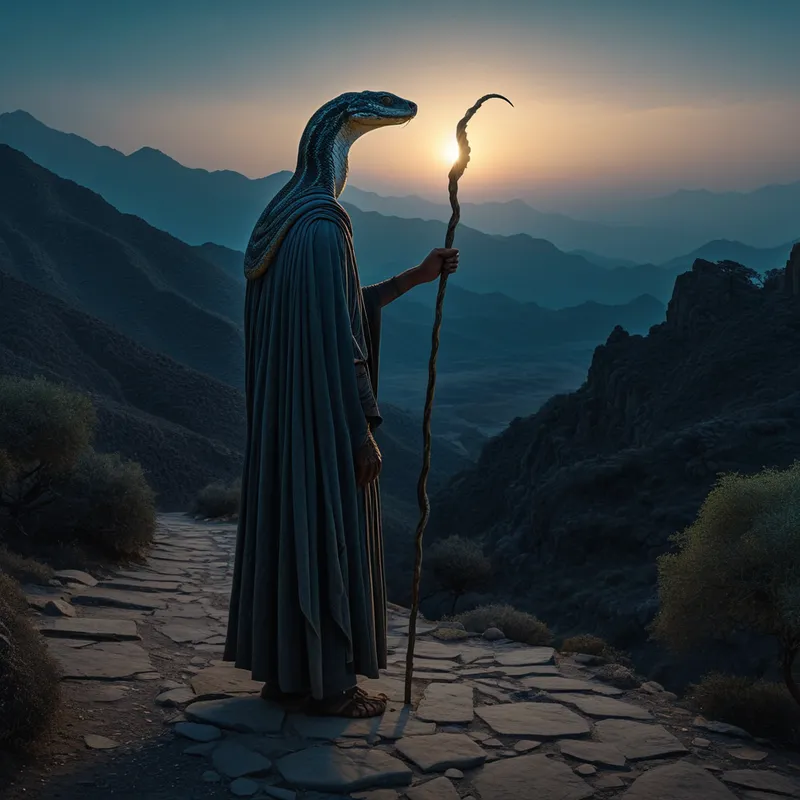
Teiresias Myth Meaning & Symbolism
A blind seer, transformed into a woman and back again, who sees the truth the gods cannot bear to hear, embodying the union of opposites.
The Tale of Teiresias
Hear now the tale of the one who saw too much, the man who was a woman, the blind one who beheld all. In the highlands near Thebes, where the mountain springs whisper secrets to the stones, walked a young man named Teiresias. His eyes were sharp, his step was sure, but fate coils in the grass, waiting to strike.
One day, on a path dappled with the light and shadow of the high noon sun, he came upon a sight that stilled his blood. Two great serpents, sacred to the earth, were locked in the sacred knot of coupling. Whether from youthful impiety or a shock he could not name, his staff came down upon them, striking the female. In that instant, a silence deeper than any tomb fell upon the glade. The air shimmered, not with heat, but with power. The world did not shake; it transformed. His very flesh rebelled against his bones, melting and reforming. Where a man had stood, a woman now stood, her skin humming with a forgotten memory. For seven long years, Teiresias lived this life, walking in a body not his own, learning its rhythms, its burdens, its sacred truths.
Then, on the selfsame path, beneath the same watching cypress trees, the vision appeared again: the twin serpents, entwined. And again, the staff fell, this time striking the male. The shimmering power returned, the great wheel of form turning once more. He returned to the shape of a man, but he was no longer the youth who had left. He carried two lifetimes within one skin.
This double knowledge drew the attention of the gods themselves. On Olympus, in a hall of cloud and nectar, a quarrel arose. Zeus, in his booming laughter, claimed women found greater pleasure in the act of love. Hera, in her cold fury, swore it was men. They turned to the only mortal who could know both sides of the mystery: Teiresias, called from his Theban home.
He stood before the divine court, the air thick with ozone and ire. “Speak,” commanded Zeus. And Teiresias, who had known the touch of both sun and moon upon his soul, spoke the measured truth: “If the pleasure of love were divided into ten parts, woman enjoys nine, and man only one.” A truth of the flesh, spoken in the hall of spirits. Hera’s wrath was swift and terrible. Not for the truth, but for the telling of it—for revealing a secret of her domain. Her blinding light, not of illumination but of vengeance, flashed forth. The world of color and form fled from Teiresias forever, leaving him in eternal night.
But from Zeus, a different compensation flowed. For the sight taken, a greater sight was given. The king of gods breathed into the seer’s darkness the gift of prophecy, the understanding of the bird languages, and a life stretched to seven generations. Thus, the blind man became the one who sees, the counselor to kings and heroes, the voice of fate who would speak the unbearable truth to Oedipus and guide the wandering Odysseus through the shadows of the underworld.
Cultural Origins & Context
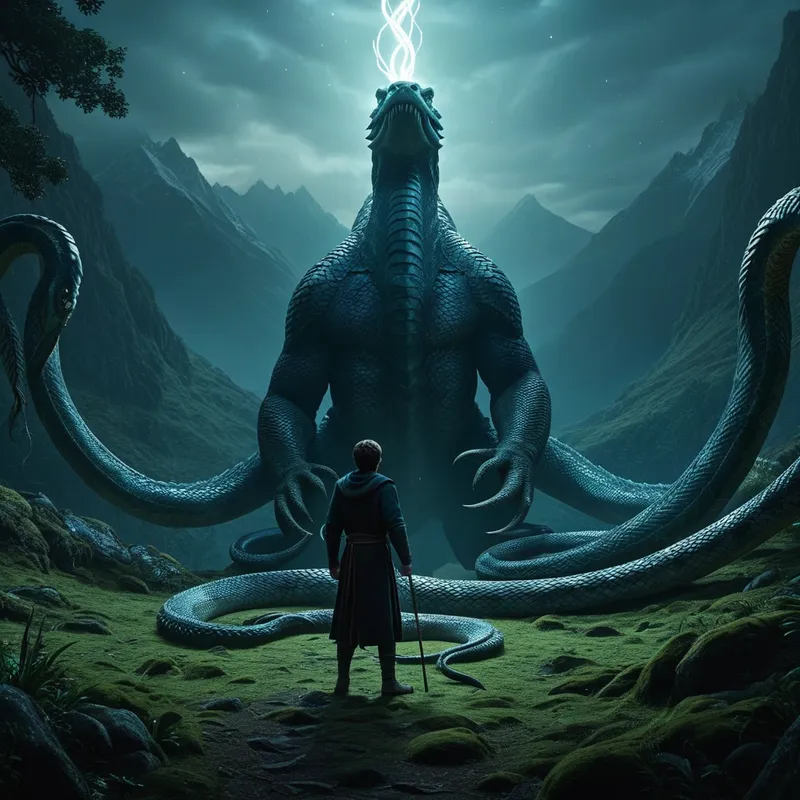
The myth of Teiresias is not a single, fixed story but a resonant pattern woven through the epic tapestry of Greek tradition. His figure appears across centuries, from the archaic verses of the Odyssey to the classical tragedies of Sophocles and Euripides. This longevity speaks to his deep cultural function. He was not a hero of action, but a hero of knowledge.
In a culture where oracles and seers were the vital interface between the human and divine realms, Teiresias represented the ultimate authority of such figures. His blindness was not a mark of weakness, but the prerequisite for his power—a cultural symbol that true vision is inward, not outward. His stories were told by bards at feasts and enacted in Athenian theaters, serving as profound reminders of the limits of human perception and the terrible cost of divine truths. He was a societal anchor point for exploring themes of fate versus free will, the nature of truth, and the boundaries of gender and experience, all from the safe, mythic distance of a legendary past.
Symbolic Architecture
Teiresias is the living emblem of the union of opposites, the walking coniunctio oppositorum. His biography is a map of radical integration.
The serpent is the symbol of transformation, and to strike it is to invoke the very change one fears. Teiresias did not seek his metamorphosis; he stumbled into it through an act of unconscious violence against nature’s duality. His punishment became his initiation.
The seven years spent as a woman are not a curse but a deep immersion into the “other,” a compulsory education in the totality of human experience. This makes him the complete witness, the only one qualified to answer the gods’ debate because he embodies the question. His blinding by Hera symbolizes a critical psychological truth: certain kinds of knowledge obliterate ordinary consciousness. The literal sight that engages with the superficial world of appearances must be sacrificed to gain the inner sight that perceives patterns, causes, and fates.
He becomes the archetypal Senex figure, not through age alone, but through the weight of integrated experience. His staff is no longer a walking aid but the axis mundi, connecting the underworld (where he advises Odysseus), the earthly realm (where he advises Theban kings), and the divine realm (where he testified).
The Dreamer’s Resonance
When the pattern of Teiresias stirs in the modern unconscious, it often signals a profound confrontation with duality and a crisis of perception. To dream of being blinded, yet suddenly understanding everything, points to a painful but necessary shift from identifying with the ego’s narrow viewpoint to accessing a deeper, more intuitive wisdom. The ego “sees” its world vanish, which feels like a catastrophe, while the Self awakens to a broader knowing.
Dreams of gender transformation or of encountering entwined serpents may not be about literal gender identity, but about the psyche forcing an integration of neglected opposites: the logical with the intuitive, the active with the receptive, the assertive with the nurturing. The dreamer may be resisting a truth about themselves or their life, a truth that, like the verdict Teiresias gave to the gods, is simple, factual, and utterly devastating to the current self-image. The somatic feeling is often one of profound disorientation followed by a strange, calm clarity—the body sensing the seismic shift before the mind can comprehend it.

Alchemical Translation
The myth of Teiresias is a perfect allegory for the alchemical process of individuation. The initial state (the young man) is one of unconscious wholeness, which is shattered by the confrontation with the primal pair (the serpents). This is the nigredo, the blackening, the dissolution of the old form.
The seven years lived as a woman represent the albedo, the whitening—a lengthy, purifying immersion in the contra-sexual other, the anima. One must live in this state, not just observe it, to be transformed.
The return to male form is not a regression, but an integration; he is now a man who contains the lived experience of the feminine. This is a stage of citrinitas, a yellowing or dawning awareness of the new synthesis. The final and most critical operation is the blinding on Olympus: the rubedo, the reddening. This is the sacrificial death of the ego’s orientation to the outer world. The conscious mind is humbled and darkened so that the light of the Self, the inner oracle, can speak.
For the modern individual, the Teiresian journey asks: What duality within you demands recognition? What comfortable “sight” must you surrender to see a deeper truth? It is not about becoming a prophet, but about achieving the seer’s stance: the hard-won, compassionate objectivity that comes from having been, in the most intimate way, both self and other. The goal is to lean on the staff of one’s own complex history, blind to superficial judgments, yet able to navigate the shadowy paths of one’s own fate with a hard-earned, unflinching vision.
Associated Symbols
Explore related symbols from the CaleaDream lexicon: