Tears of the Danaides Myth Meaning & Symbolism
Forty-nine sisters, condemned for murder, eternally pour water into a broken vessel in the Underworld, embodying futile labor and the psyche's unfinished tasks.
The Tale of the Tears of the Danaides
Hear now a tale not of Olympus’s bright peaks, but of the sunless realm below, where the sighs of the dead are the only wind. It begins not with a god’s whim, but with a king’s fear. Danaus, twin to Aegyptus, fled across the wine-dark sea with his fifty daughters, the Danaides. Their flight was a desperate scrawl against [the horizon](/myths/the-horizon “Myth from Various culture.”/), for Aegyptus commanded his fifty sons to pursue, to claim their cousins as brides by force, to weave two branches of a fractured family tree into a single, choking vine.
In Argos, the daughters found sanctuary, but not peace. The sons came, an armada of demand. Danaus, his heart a nest of vipers, saw only the extinction of his line. To each daughter, he gave a keen-edged dagger, hidden in the folds of their wedding veils. “When the marriage torches gutter and the bridegroom sleeps,” he whispered, “let his blood be your dowry.”
The wedding feast was a macabre pantomime. Forty-nine daughters obeyed their father’s terrible decree. As one, in the silent, oil-lit chambers, they became Erinyes in bridal garb. One alone, Hypermnestra, looked upon her husband Lynceus and saw not a foe, but a man. She stayed her hand, and in that act of mercy, planted a seed of a future kingly line.
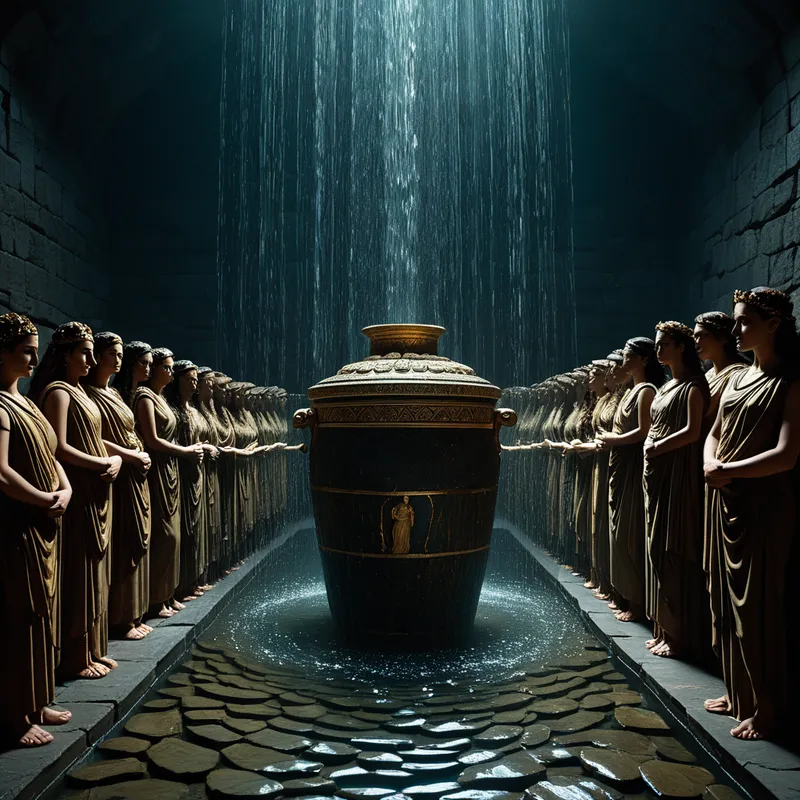
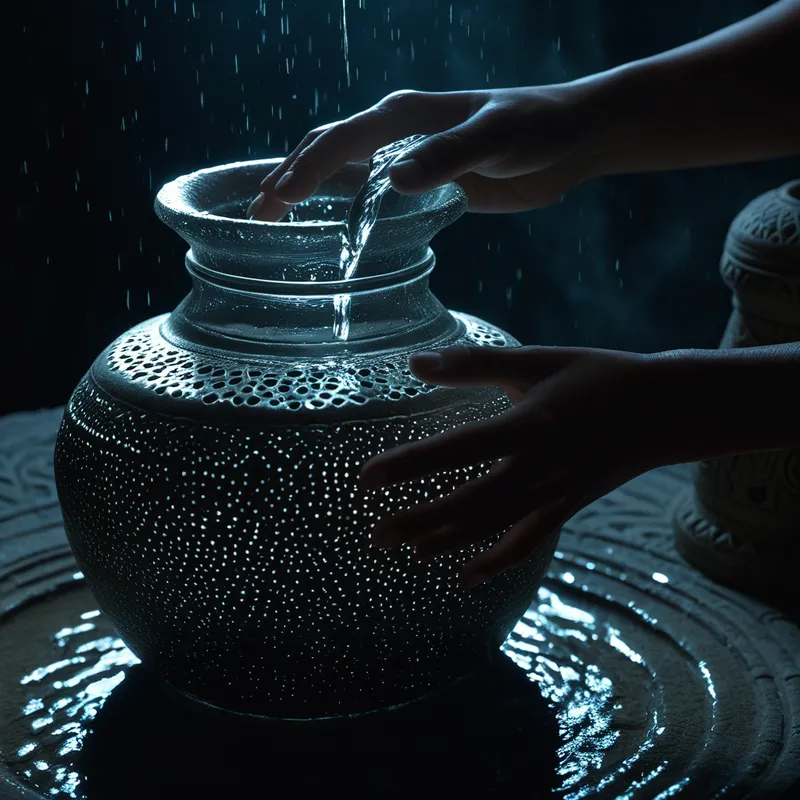
But for the forty-nine, the price was levied not by mortal law, but by divine. After their mortal lives ended, they were cast into the gloom of [Hades](/myths/hades “Myth from Greek culture.”/). There, the stern judges of the dead pronounced their sentence. Their task was simple, endless, and exquisite in its futility. Each was given a great pithos, a jar to carry the waters of memory, of guilt, of the life they had cut short. They must descend to a spring, fill their jars, and carry them back to pour into a vast, communal vessel. But this vessel, like their souls, was broken—cracked, perforated, sieve-like. The [water](/myths/water “Myth from Chinese culture.”/), clear and cold, would rush in with a hopeful sound, only to sigh out instantly into the barren dust of [the Underworld](/myths/the-underworld “Myth from Greek culture.”/). An eternal labor without progress, without purpose, without end. The splash of their endless tears became the only rhythm in that corner of eternity, a liquid echo of a crime that could never be washed clean.
Cultural Origins & Context
This haunting myth reaches us primarily through the later summaries of lost works, most notably the epic Danais and, crucially, the Roman poet Ovid in his [Metamorphoses](/myths/metamorphoses “Myth from Greek culture.”/). It was a tale known to the tragedians, a dark counterpart to tales of heroic labor like those of [Heracles](/myths/heracles “Myth from Greek culture.”/). Its societal function was multifaceted. On one level, it served as a dire warning about the cosmic consequences of kin-slaying and the violation of [xenia](/myths/xenia “Myth from Greek culture.”/) (hospitality), as the murders occurred under the guise of a wedding. It reinforced the supreme authority of the father (patria potestas) while also questioning its limits when it demanded atrocity.
Furthermore, the myth explained a natural phenomenon. [The Danaides](/myths/the-danaides “Myth from Greek culture.”/) were sometimes associated with the Lernaean Springs or other water sources in Argos, their eternal labor a poetic etiology for [the way](/myths/the-way “Myth from Taoist culture.”/) water seems to vanish into the porous earth. The story was a cultural container for profound anxieties about wasted effort, unpayable debt, and the inescapable nature of blood guilt, themes that resonated deeply in the Greek [psyche](/myths/psyche “Myth from Greek culture.”/), which was deeply concerned with ritual purity and the appeasement of the dead.
Symbolic Architecture
The myth is a masterful map of a specific psychic catastrophe. The forty-nine Danaides represent the part of [the self](/myths/the-self “Myth from Jungian culture.”/) compelled into a horrific [action](/symbols/action “Symbol: Action in dreams represents the drive for agency, motivation, and the ability to take control of situations in waking life.”/) by a tyrannical, fear-based [authority](/symbols/authority “Symbol: A symbol representing power structures, rules, and control, often reflecting one’s relationship with societal or personal governance.”/) (Danaus as the negative [father](/symbols/father “Symbol: The father figure in dreams often symbolizes authority, protection, guidance, and the quest for approval or validation.”/) complex). Their [crime](/symbols/crime “Symbol: Crime in dreams often symbolizes guilt, inner conflict, or societal rules that are being challenged or broken.”/) is not just murder, but the murder of potential union—the killing of the “other” (the sons/husbands) who represents [difference](/symbols/difference “Symbol: Difference symbolizes diversity, change, and the contrast between ideas or people.”/), [relationship](/symbols/relationship “Symbol: A representation of connections we have with others in our lives, often reflecting our emotional state.”/), and [life](/symbols/life “Symbol: The symbol of ‘Life’ represents a journey of growth, interconnectedness, and existential meaning, encompassing both the joys and challenges that define human experience.”/) outside the closed, paranoid [system](/symbols/system “Symbol: A system represents structure, organization, and interrelated components functioning together, often reflecting personal or social order.”/) of the paternal mandate.
The punishment is the perfect mirror of the crime: having cut short a life’s potential, they are now condemned to an action that can never reach fulfillment. The leaky vessel is the soul itself, damaged by its own actions, incapable of holding the waters of experience, emotion, or meaning.
The [water](/symbols/water “Symbol: Water symbolizes the subconscious mind, emotions, and the flow of life, representing both cleansing and creation.”/) they carry is the essence of life, [memory](/symbols/memory “Symbol: Memory symbolizes the past, lessons learned, and the narratives we construct about our identities.”/), and feeling. Its constant [loss](/symbols/loss “Symbol: Loss often symbolizes change, grief, and transformation in dreams, representing the emotional or psychological detachment from something or someone significant.”/) symbolizes depression, [dissociation](/symbols/dissociation “Symbol: A psychological separation from one’s thoughts, feelings, or identity, often experienced as a journey away from the self during trauma or stress.”/), and the sense that one’s efforts, one’s very emotional life, are pointless and drain away into [nothingness](/symbols/nothingness “Symbol: A profound emptiness or void, often representing existential anxiety, spiritual seeking, or emotional numbness in dreams.”/). It is the [archetypal image](/symbols/archetypal-image “Symbol: A universal, primordial symbol from the collective unconscious that transcends individual experience and carries profound spiritual or mythic meaning.”/) of the vas perpetuum—the perpetual, fruitless [task](/symbols/task “Symbol: A task represents responsibilities, duties, or challenges one faces.”/). Hypermnestra stands apart as the [symbol](/symbols/symbol “Symbol: A symbol can represent an idea, concept, or belief, serving as a powerful tool for communication and understanding.”/) of the redeeming function: the [capacity](/symbols/capacity “Symbol: A measure of one’s potential, limits, or ability to contain, process, or achieve something, often reflecting self-assessment or external demands.”/) for [empathy](/symbols/empathy “Symbol: The capacity to understand and share the feelings of others, often manifesting as emotional resonance or intuitive connection in dreams.”/) and relatedness that breaks the cycle of blind obedience and violence, allowing for a new psychic [lineage](/symbols/lineage “Symbol: Represents ancestral heritage, family connections, and the transmission of traits, values, and responsibilities across generations.”/) to begin.
The Dreamer’s Resonance
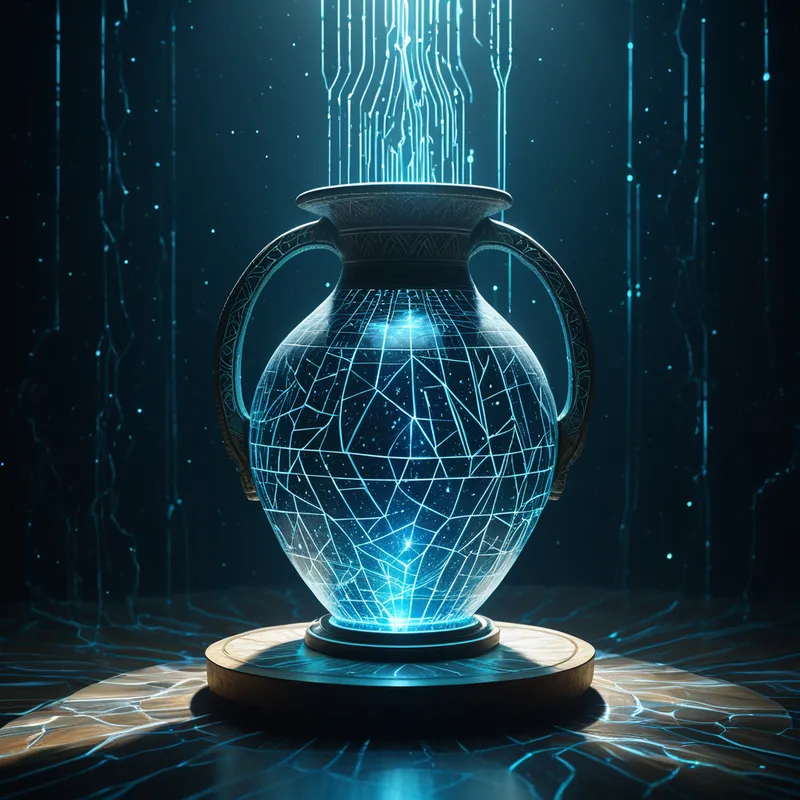
When this myth stirs in the modern unconscious, it rarely appears as ancient maidens with jars. Instead, the dreamer becomes the Danaid. They dream of being at work, filing endless papers that instantly vanish; of trying to send an urgent message on a phone with a shattered screen; of running on a treadmill that leads nowhere while carrying a bucket full of holes. The somatic sensation is one of profound exhaustion, weight, and frustration, coupled with a chilling numbness—the emotional water cannot be retained.
This dream pattern signals that the psyche is grappling with a “leaky vessel” complex. The individual is likely engaged in life tasks or relational patterns that feel fundamentally futile, draining their energy without providing nourishment or progress. It often points to a deep-seated sense of guilt or shame (the “crime”) that has damaged [the ego](/myths/the-ego “Myth from Jungian culture.”/)’s capacity to integrate experiences. The dream is a stark portrait of burnout, spiritual anemia, and the soul’s cry against actions that are all labor and no fruit.

Alchemical Translation
The alchemical journey modeled here is not one of fiery [triumph](/myths/triumph “Myth from Roman culture.”/), but of the slow, painful recognition of [the vessel](/myths/the-vessel “Myth from Alchemical culture.”/)’s condition. The first step is seeing the leak. The individual must confront the pattern of futile labor in their life—the relationships where love drains away, the projects that never cohere, the emotions they cannot hold. This is the descent into Hades, the acknowledgment of the psychic sentence.
The second, crucial step is the Hypermnestra moment: the conscious choice to disobey the inner “Danaus”—the internalized voice demanding perfection, punishing productivity, or enforcing isolation. It is the decision to spare connection, to choose mercy for oneself and another, even if it breaks a familial or internal commandment.
The transmutation occurs not by fixing the old, broken vessel through more effort, but by becoming the vessel that can hold. The endless pouring is the purification. The repeated, failed action, when made conscious, wears away the ego’s resistance until it surrenders its identification with the task. In that surrender, the psyche may discover that the water was never meant to fill the jar, but to flow through it, cleansing the very cracks it cannot seal.
Redemption, as hinted in the myth’s later variants where some Danaides are eventually freed, comes not from completing the impossible task, but from the transformative endurance of it. The soul learns that its worth is not in the water retained, but in the posture of carrying, in the enduring of the condition, until the punishment becomes a meditation, and the tears themselves become the new, unexpected vessel.
Associated Symbols
Explore related symbols from the CaleaDream lexicon: