Te Kore Te Po Te Ao Myth Meaning & Symbolism
The Maori cosmogony of emergence: from the Nothingness, through the Night, into the World of Light, a sacred process of becoming.
The Tale of Te Kore Te Po Te Ao
In the beginning, there was not a beginning. There was no time, no space, no up, no down. There was only Te Kore. It was not an empty place, but a profound and fertile absence, a womb of all possibility where nothing existed, yet everything slept. It was the great potential, humming with a silence so deep it was a kind of sound.
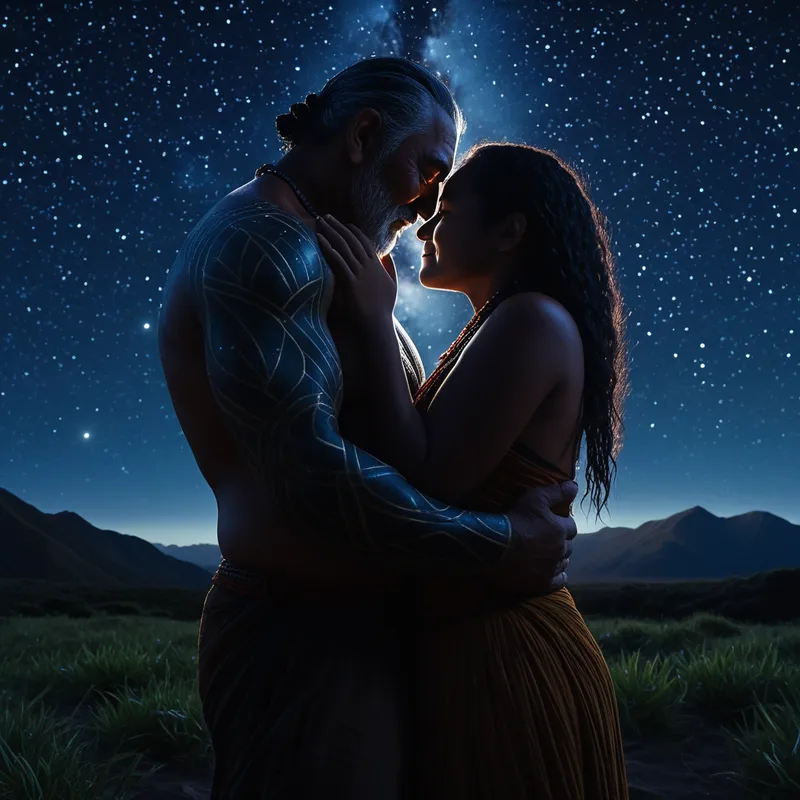
From this Te Kore, there emerged Te Po. Not a single night, but a succession of them, deep and long. Te Po was the realm of becoming, where things took shape in the dark. Here, in the warm, pressing dark, the first thoughts coalesced. The primal parents, [Ranginui](/myths/ranginui “Myth from Maori culture.”/) and Papatūānuku, came into being, locked in a tight and loving embrace. Their union was so complete that no light could exist between them. The world was a closed seed, dark and full of life.
Within that world, between the flesh of the sky and the body of the earth, their children were born. They were the atua, the gods: Tāne Mahuta, Tangaroa, Rongo, [Tūmatauenga](/myths/tmatauenga “Myth from Maori culture.”/), and others. They lived in perpetual darkness, cramped and restless. They could not stand, they could not see. They knew only the sound of their parents’ breathing and the feel of the pressing dark. This was their entire universe, a world of Te Po.
A longing grew among them. A yearning for space, for light, for differentiation. They debated in whispers what should be done. Some proposed killing their parents. But Tāne Mahuta had a different thought. He would not destroy, but separate. He would create space for life to flourish.
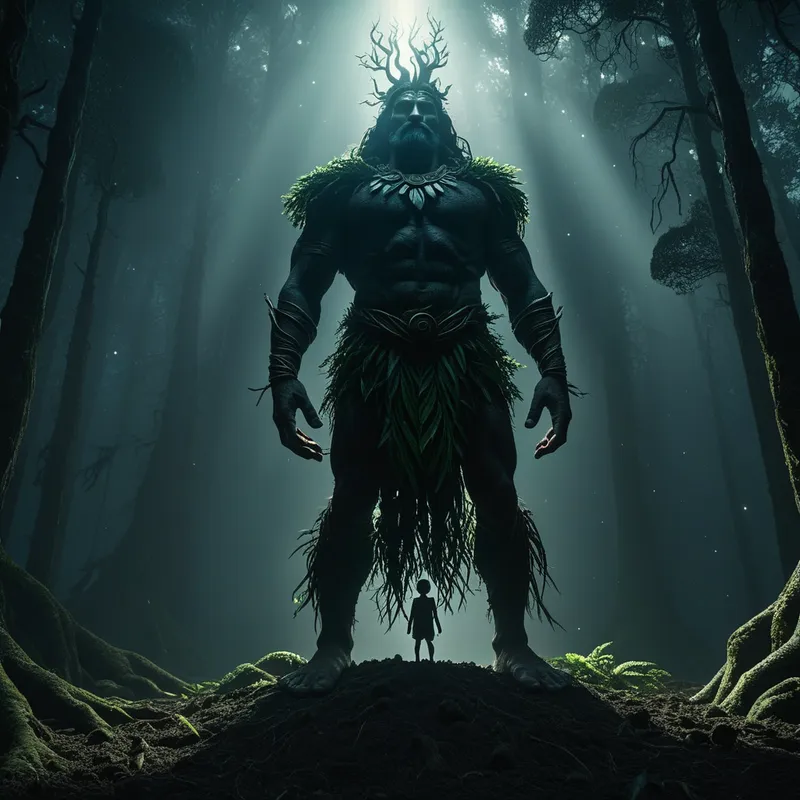
The children positioned themselves. Tāne Mahuta placed his head upon his mother, Papatūānuku, and his feet against his father, Ranginui. He began to push. He pushed with the slow, relentless strength of a growing tree. The muscles of the world strained. The sinews of the cosmos groaned. For a long, agonizing time, nothing yielded. Then, with a sound like the first thunder, a crack appeared. A sliver of something new—a piercing, painful, beautiful light.
Ranginui was forced upwards, weeping tears that became the rain and dew. Papatūānuku remained below, her body now the soil, forests, and mountains. Their eternal embrace was broken. And into the space between them rushed Te Ao Mārama—the World of Light. The children, now free, tumbled into this new realm. They looked upon each other for the first time. They saw the vast sky and the solid earth. The long night of Te Po had given birth to the day of Te Ao. The process was complete: from the Nothingness, through the Night, into the World of Light.
Cultural Origins & Context
This cosmogony is the foundational narrative of Māori culture, belonging to the whakapapa (genealogical) tradition. It was not a mere story for entertainment, but a sacred template for understanding existence, recited by tohunga (priestly experts) during rituals of birth, death, and initiation. Its transmission was oral, precise, and performed, ensuring the spiritual and intellectual lineage remained unbroken.
The recitation of the progression from Te Kore through Te Po to Te Ao served multiple vital functions. It established a cosmological order, connecting every person and thing back to the primal source. It provided a model for all creative acts—whether carving a canoe, building a meeting house, or conceiving a child—each seen as a microcosm of the original separation and emergence. Most importantly, it embedded a non-linear, cyclical view of time where death was a return to Te Po, a necessary phase in the continuum of being.
Symbolic Architecture
The myth presents a profound three-stage psychic [architecture](/symbols/architecture “Symbol: Architecture in dreams often signifies structure, stability, and the framing of personal identity or life’s journey.”/). Te Kore is the unconscious potential prior to thought, the unformed Self. It is not [emptiness](/symbols/emptiness “Symbol: Emptiness signifies a profound sense of void or lack in one’s life, often related to existential fears, loss, or spiritual quest.”/), but pure latency.
To know Te Kore is to confront the fertile ground of being before the first idea has taken root. It is the psyche in its pre-personal, infinite state.
Te Po represents the [womb](/symbols/womb “Symbol: A symbol of origin, potential, and profound transformation, representing the beginning of life’s journey and the unconscious source of creation.”/) of the unconscious where contents—instincts, archetypes, complexes—take form. It is the stage of [incubation](/symbols/incubation “Symbol: A period of internal development, rest, or hidden growth before emergence, often associated with healing, creativity, or transformation.”/), conflict, and [gestation](/symbols/gestation “Symbol: A period of development and preparation before a significant birth or emergence, symbolizing potential, transformation, and the journey toward manifestation.”/). The cramped gods are the nascent aspects of the psyche struggling for [consciousness](/symbols/consciousness “Symbol: Consciousness represents the state of awareness and perception, encompassing thoughts, feelings, and experiences.”/). The embrace of the parents symbolizes the original, undifferentiated state of the psyche, where opposites are united but unconscious. The longing for light is the ego’s [dawn](/symbols/dawn “Symbol: The first light of day, symbolizing new beginnings, hope, and the transition from darkness to illumination.”/), the urge toward consciousness and individuation.
Te Ao Mārama is the achieved state of conscious [awareness](/symbols/awareness “Symbol: Conscious perception of self, surroundings, or internal states. Often signifies awakening, insight, or heightened sensitivity.”/) and differentiated order. The [separation](/symbols/separation “Symbol: A spiritual or mythic division between realms, states of being, or consciousness, often marking a transition or loss of connection.”/) is not a violent tragedy but a necessary act of creation, establishing the “[space](/symbols/space “Symbol: Dreaming of ‘Space’ often symbolizes the vastness of potential, personal freedom, or feelings of isolation and exploration in one’s life.”/)” in which psychological [life](/symbols/life “Symbol: The symbol of ‘Life’ represents a journey of growth, interconnectedness, and existential meaning, encompassing both the joys and challenges that define human experience.”/)—[perception](/symbols/perception “Symbol: The process of becoming aware of something through the senses. In dreams, it often represents how one interprets reality or internal states.”/), [relationship](/symbols/relationship “Symbol: A representation of connections we have with others in our lives, often reflecting our emotional state.”/), culture—can occur. The weeping parents signify the inherent [grief](/symbols/grief “Symbol: A profound emotional response to loss, often manifesting as deep sorrow, yearning, and a sense of emptiness.”/) in growth; every gain in consciousness involves a [separation](/symbols/separation “Symbol: A spiritual or mythic division between realms, states of being, or consciousness, often marking a transition or loss of connection.”/) from a prior state of unconscious unity.
The Dreamer’s Resonance
When this mythic pattern stirs in the modern dreamer, it signals a profound process of psychic (re)birth. Dreams of suffocating darkness, of being trapped in a tight, warm, but confining space, echo the children in Te Po. This is the somatic experience of a latent potential or a developing complex pressing for expression. The dream body feels the weight of what has not yet been born.
Dreams of immense, formless voids (Te Kore) can evoke awe or existential terror, reflecting a confrontation with the pre-egoic ground of being. Conversely, dreams featuring a sudden, blinding light breaking through darkness, or of successfully prying apart two massive, fused objects, directly mirror Tāne Mahuta’s act. These dreams often accompany life transitions—the end of a relationship, a career change, a spiritual awakening—where the old, unified “world” must be separated to create space for a new consciousness to live and breathe.
Alchemical Translation
For the individual, this myth maps the alchemical journey of individuation. We all begin in a personal Te Kore—the unformed potential of our innate Self. Our early life, our familial and cultural conditioning, is the embrace of Ranginui and Papatūānuku; it is necessary and nurturing, but ultimately, to become who we are, we must create distinction between what we inherited (the sky of father-principles) and what we embody (the earth of mother-principles).
The heroic work of psyche is not to dwell forever in the dark warmth of the unconscious, nor to flee into a harsh, disconnected light, but to perform the sacred separation that allows a world of meaning to exist between them.
The “children”—our talents, passions, and inner figures—remain cramped and conflicted until we, like Tāne Mahuta, take a stand. This is the ego’s role in service of the Self: to apply sustained, conscious effort to differentiate, to create inner space. The grief of the parents is felt as the necessary mourning for lost innocence and symbiotic unity. The resulting Te Ao is not a final state, but the illuminated field upon which the ongoing drama of a conscious life is played. It teaches that creation is a process of courageous separation, that light is born from engaging the tension of the dark, and that our world of meaning is built in the sacred space between opposites.
Associated Symbols
Explore related symbols from the CaleaDream lexicon:
- Void — The primal state of Te Kore, representing the formless potential and infinite possibility that precedes all existence and all thought.
- Darkness — The realm of Te Po, symbolizing the fertile unconscious, gestation, and the necessary period of formless development before emergence into consciousness.
- Light — The breakthrough of Te Ao Mārama, representing consciousness, awareness, clarity, and the illuminated world brought into being through separation.
- Separation — The critical act performed by Tāne Mahuta, modeling the essential psychological process of differentiating from primal unity to create space for individual identity and life.
- Mother — Papatūānuku, the Earth Mother, representing the grounding, nurturing, and tangible realm of the body, nature, and the unconscious foundation of being.
- Father — Ranginui, the Sky Father, representing the lofty, ordering, spiritual principles, thought, and the overarching structures of consciousness.
- Tree — Embodied by Tāne Mahuta, symbolizing the living force of growth that mediates between earth and sky, using slow, persistent strength to create new reality.
- Rain — The tears of Ranginui, symbolizing the grief inherent in creation and transformation, the emotional cost of growth that also nourishes new life.
- World — Te Ao, the realized cosmos, representing the structured, conscious reality that becomes possible only after the differentiation of opposites.
- Dream — The state of Te Po, a direct correlate to the dreaming psyche where forms gestate in the dark before emerging into the light of waking awareness.
- Root — The connection to Papatūānuku and Te Po, symbolizing the deep, often hidden, foundations in the unconscious from which all conscious life grows.
- Seed — The entire cosmos in its potential state within Te Kore and Te Po, containing the complete blueprint for the world that is to come.