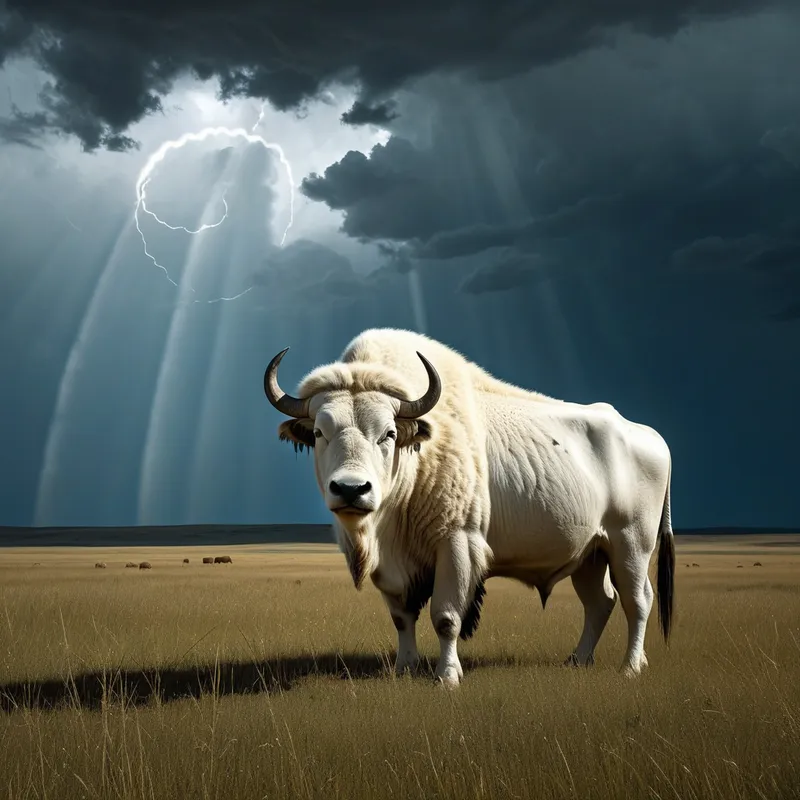
Tatanka Myth Meaning & Symbolism
A sacred story of the Buffalo People, whose sacrifice created the world, teaching reciprocity, humility, and the sacredness of all life.
The Tale of Tatanka
Listen. In the time before time, when the world was soft and new, the People walked a hard road. The sky was a pale, empty bowl. The earth was bare stone and dust. Hunger was a constant companion, a cold wind in the belly. The People were few, their steps slow, their eyes hollow with longing. They knew only scarcity, and their songs were whispers of want.
Then, from the west, where the sun sleeps, a sound began. It was not a sound of storm, but of the earth itself turning in its sleep. A deep, resonant thunder, rhythmic as a great heartbeat. The ground trembled. The People looked up from their meager fires.
Over the rise they came. Not as animals come, but as a land itself on the move. Tatanka. The Buffalo People. A living, breathing mountain range of fur and muscle and horn. Thousands upon thousands, their dark eyes holding the wisdom of the ages, their breath steaming in the dawn air like the prayers of the world. They moved with a purpose that was neither fear nor anger, but a solemn, knowing grace.
At their head walked the great chief of the Buffalo, a being of immense size, his coat the color of winter snow, his horns curling like the crescent moon. He stopped before the frail human camp. The silence that fell was absolute, heavier than any noise. The White Buffalo’s gaze swept over the People, seeing their thin limbs, their desperate hope.
He spoke, and his voice was the rumble of stone deep in the earth. “You see us and think only of meat and hide, of warmth for your bodies. You are children of need. But we are not merely food. We are your relatives. From our bodies will come your life, and from your respect will come our return.”
Then, the White Buffalo did not charge. He knelt. He laid his massive head upon the earth. And as the People watched, breath caught in their throats, the herd followed. One by one, the great Tatanka lay down upon the barren ground. And as they lay down, they began to change.
Their great bodies sank into the earth, melting into the soil. From their flesh rose the rolling, grassy hills of the Pȟežíšuta. Their bones became the ridges and buttes that break the wind. Their thick fur became the forests that cling to riverbanks. Their blood flowed out, becoming the clear, rushing streams and the life-giving rivers. Their eyes, closing for the last time, became pools of dark, still water that reflect the stars.
From the place where the White Buffalo’s heart touched the earth, the first sacred pipe, the Čhaŋnúŋpa, grew, its bowl of red stone, its stem of wood. And where the herd had passed, the earth was no longer barren. It was alive. Timpsila pushed through the soil. Berry bushes grew thick. And the grasses waved, a sea of green and gold, holding within them the promise of future herds, the children of the sacrifice.
The People were no longer alone on a hard road. They stood in the midst of a world given. The thunder of the hooves was gone, replaced by the wind in the grass—a softer, everlasting echo of the gift.
Cultural Origins & Context
This story is not a fable of the distant past, but a living, breathing map of reality for the Lakȟóta. It was and is told by elders, the wičháša wakȟáŋ (holy men) and storytellers, not as entertainment, but as foundational instruction. Its transmission is an act of cultural respiration, passing on the understanding of a covenant.
The myth served a profound societal function: it encoded the principles of an entire sustainable economy and spiritual ecology. It explained the origin of the buffalo-hunting way of life, not as a act of conquest, but as a sacred participation in a cycle begun by the Buffalo People themselves. The hunt was framed as a continuation of that original sacrifice, requiring rituals of gratitude, prayers for the animal’s spirit, and the meticulous use of every part of the body—horn, hoof, hide, and meat. To waste any part was to insult the gift and break the sacred relationship. The myth established Mitákuye Oyás’iŋ—the idea that all life is related—as the core law of existence.
Symbolic Architecture
At its heart, the myth of Tatanka is a profound narrative of divine immanence. The sacred is not abstract or distant; it becomes the very substance of the physical world through an act of willing sacrifice.
The world is not a given; it is a gift, born from a conscious act of self-offering. To live is to consume that sacrifice, and ethics begin with the memory of that meal.
The Ptehíŋčala Sáŋ (White Buffalo Calf) is not merely an animal, but the archetypal cosmogonic deity. Its body is the literal architecture of the Lakota world. This transforms the buffalo from prey into progenitor, from resource into relative. Psychologically, Tatanka represents the ultimate Provider—the aspect of the cosmos that sustains physical life. It symbolizes the deep, often unconscious, foundation of our existence: the body of the Earth that feeds, clothes, and shelters us.
The myth’s power lies in its inversion of the “hero’s journey.” The heroic act here is not one of acquisition, but of surrender. The Buffalo People’s triumph is their dissolution into the landscape, their identity redistributed to create an ecosystem. This models a psyche where the ego does not seek to conquer and hoard, but to contribute and become part of a greater, nourishing whole.
The Dreamer’s Resonance
When this myth stirs in the modern dreamer, it often signals a profound somatic and psychological process related to foundation, sustenance, and gratitude. To dream of a buffalo, especially one that is calm, approaching, or lying down, can indicate the psyche’s attempt to re-establish a relationship with what fundamentally nourishes it.
This may manifest during life phases of extreme “scarcity consciousness”—burnout, financial anxiety, or a feeling of existential barrenness. The dream is not promising a material windfall, but introducing the archetype of the Provider. The somatic sensation might be one of deep, grounding warmth in the belly, a release of chronic anxiety held in the gut. Psychologically, the dream asks: What is the true source of your sustenance? Have you forgotten the sacrifice that makes your life possible? It confronts our modern tendency to see resources as anonymous commodities, inviting a return to a mindset of sacred reciprocity. A dream of a herd dissolving into the landscape might parallel a necessary dissolution of rigid personal identity to become part of a nourishing community or purpose.

Alchemical Translation
For the individual seeking wholeness, the Tatanka myth models the alchemical stage of nigredo followed by a generative albedo. The process is one of psychic transmutation through sacred sacrifice.
The initial state is the “barren earth” of the ego-centric psyche: isolated, hungry, perceiving the world only in terms of what it can extract. The arrival of Tatanka represents the eruption of a profound, nourishing content from the Self—the total, archetypal psyche—into conscious awareness. This content (perhaps a talent, a deep emotional capacity, or a call to service) is initially seen only as something to “consume” for personal gain.
Individuation requires the sacrifice of the part for the whole of the personality. The ego must learn to lay itself down like the White Buffalo, so that its energy can become the fertile ground for a richer, more connected life.
The alchemical work is the “laying down” of the Buffalo. This is the conscious, willing sacrifice of a possessive attitude. It is the decision to take one’s own life force—one’s time, energy, love, or creativity—and offer it not for personal aggrandizement, but to become part of a “landscape” that nourishes others. The professional who mentors instead of competes, the artist who creates to feed the communal soul, the individual who tends relationships and community—all are performing this Tatanka transmutation.
The result is not annihilation, but proliferation. The sacrificed energy does not vanish; it transforms into the enduring features of one’s life world: stable relationships (the hills), flowing inspiration (the rivers), and the capacity to sustain oneself and others (the abundant plants). The sacred pipe that grows from the heart is the symbol of the newly forged connection between the spiritual (the sky) and the earthly (the soil) within the individual—a conduit for meaning. One becomes, in a sense, both the recipient of the gift and the continuing embodiment of the giver, living in a state of mindful, grateful reciprocity with the very source of one’s being.
Associated Symbols
Explore related symbols from the CaleaDream lexicon: