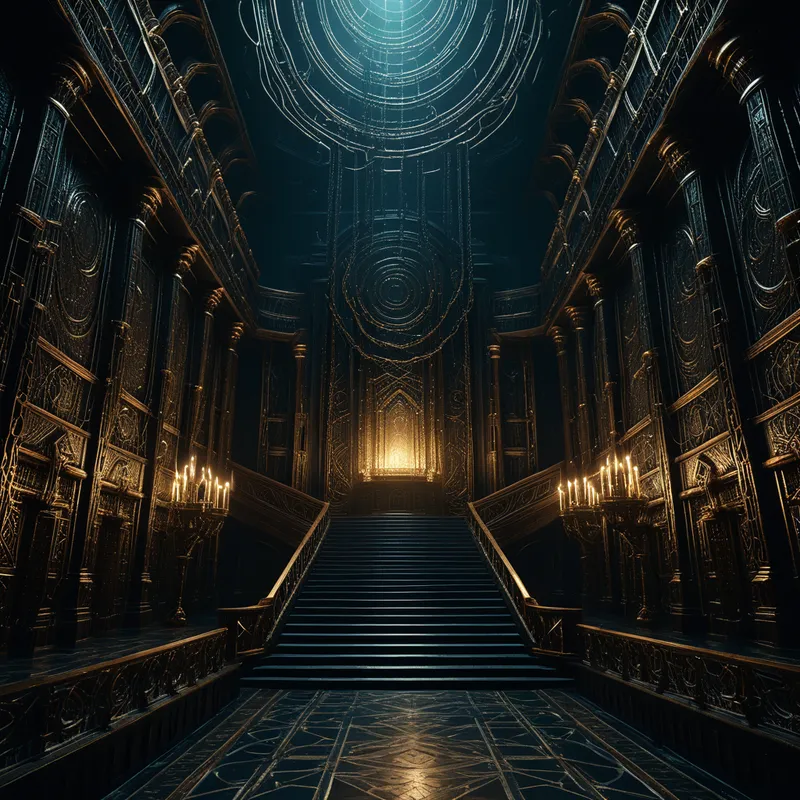
Tartarus Myth Meaning & Symbolism
The myth of Tartarus, the primordial abyss of punishment and containment, embodies the deepest shadow, the repressed unconscious, and the terrifying ground of being.
The Tale of Tartarus
Before [the world](/myths/the-world “Myth from Tarot culture.”/) was a world, there was a yawning chasm. It was not a place, but the absence of all place, a hunger in the belly of creation. This was Tartarus, as far beneath [the earth](/myths/the-earth “Myth from Hindu culture.”/) as the earth is beneath [the sky](/myths/the-sky “Myth from Persian culture.”/). Its walls were forged of unbreakable bronze, and its roots drank from the well of Chaos itself.
In the first war, when the young gods, the Olympians, rose against their parents, the Titans, the cosmos shook with their fury. Thunderbolts forged in the heart of Zeus split the sky, and the earth, Gaia, groaned. When victory was finally seized, a terrible question remained: what to do with the defeated Titans, beings of such immense, primal power that their mere presence could unmake the new order?
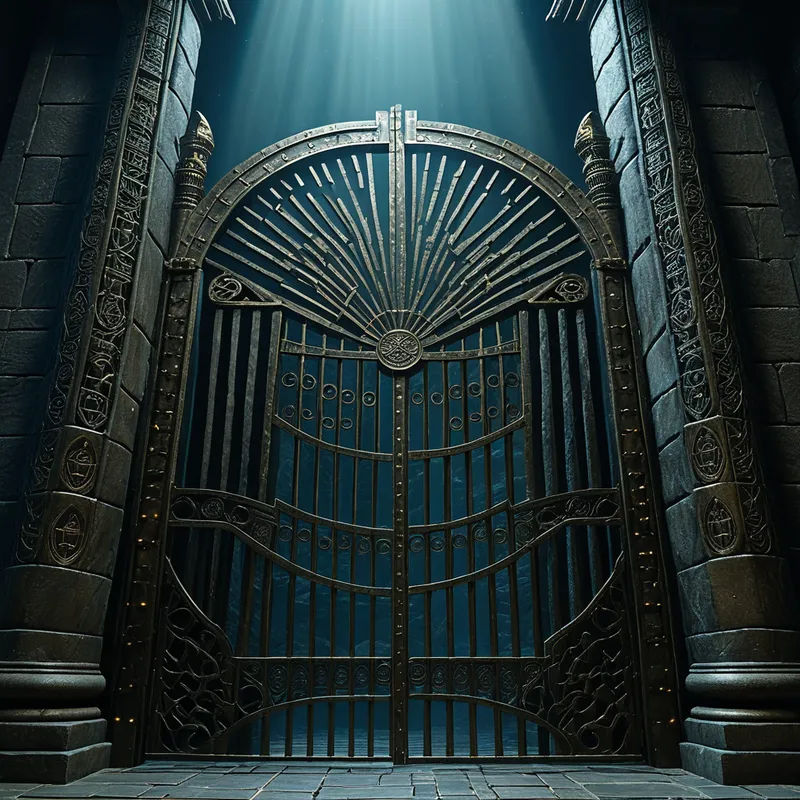
The answer lay in the deep. Down, past the misty realm of [Hades](/myths/hades “Myth from Greek culture.”/), past the mournful fields of Asphodel, into a darkness so profound it swallowed sound and hope. Here, [Hephaestus](/myths/hephaestus “Myth from Global/Universal culture.”/) built gates of adamant, and the hundred-handed giants, the Hekatonkheires, were set as eternal, vigilant wardens. One by one, the raging Titans—[Oceanus](/myths/oceanus “Myth from Greek culture.”/), Hyperion, Iapetus—were cast down, bound in chains of mystic metal, and hurled into [the abyss](/myths/the-abyss “Myth from Kabbalistic culture.”/). Their fall seemed to last an age, their roars of defiance fading into a silence thicker than stone. Tartarus received them, not as a prison, but as a womb of oblivion.
Later, other great rebels met this fate. The mighty [Prometheus](/myths/prometheus “Myth from Greek culture.”/), for his compassion, was chained to a rock at its fringes, where an eagle feasted on his ever-regenerating liver. The king [Tantalus](/myths/tantalus “Myth from Greek culture.”/) stood in a pool that receded when he thirsted, beneath fruit-laden branches that drew away when he hungered, forever in sight of relief he could never grasp. Here too was [Sisyphus](/myths/sisyphus “Myth from Greek culture.”/), his muscles cracking with the weight of a stone that forever rolled back, the dust of his futile labor the only testament to his existence. Tartarus was not merely a pit; it was a cosmic principle, the final, absolute answer to any force that threatened the sovereign order of Zeus. It was the basement of reality, where the things the cosmos could not digest were sent to be forgotten, yet their presence there held up the very floor of the world.
Cultural Origins & Context
The concept of Tartarus is woven into the earliest strands of Greek thought, appearing in Hesiod’s Theogony (c. 700 BCE) as one of the primordial entities born from Chaos, alongside Gaia and Eros. This places it not as an invention of later theology, but as a foundational piece of the Greek cosmological map. It was passed down through epic poetry and ritual, a necessary part of the story that explained how the stable, knowable world of the Olympians came to be. Its function was societal and psychological: it established a divine jurisprudence. The absolute, terrifying punishment of Tartarus served as the ultimate deterrent, reinforcing the cosmic and, by extension, social hierarchy. It answered the human need for a final [justice](/myths/justice “Myth from Tarot culture.”/), a place where the ultimate transgressors—those who challenged the gods themselves—faced a consequence so absolute it bordered on ontological annihilation. It was the guarantee of order, the dark foundation upon which [the polis](/myths/the-polis “Myth from Greek culture.”/) and its laws were implicitly built.
Symbolic Architecture
Tartarus is the ultimate [symbol](/symbols/symbol “Symbol: A symbol can represent an idea, concept, or belief, serving as a powerful tool for communication and understanding.”/) of the repressed. It is not personal hell, but the collective, archetypal [basement](/symbols/basement “Symbol: The basement in dreams often symbolizes the unconscious mind, where hidden fears, repressed memories, and unacknowledged aspects of the self reside.”/) of the [psyche](/myths/psyche “Myth from Greek culture.”/). It represents everything the conscious ego and the ruling order (the Olympian [consciousness](/symbols/consciousness “Symbol: Consciousness represents the state of awareness and perception, encompassing thoughts, feelings, and experiences.”/)) must exclude to maintain its [identity](/symbols/identity “Symbol: Identity represents the sense of self, encompassing personal beliefs, cultural background, and social roles.”/) and [stability](/symbols/stability “Symbol: A state of firmness, balance, and resistance to change, often represented by solid objects, foundations, or steady tools.”/).
Tartarus is the psychological ground of being, the necessary shadow whose containment makes consciousness possible. To ignore it is to build your house on a forgotten fault line.
[The Titans](/myths/the-titans “Myth from Greek culture.”/) symbolize the raw, untamed, and often tyrannical forces of [nature](/symbols/nature “Symbol: Nature symbolizes growth, connectivity, and the primal forces of existence.”/) and the unconscious—the instinctual drives, the parental complexes, the sheer psychic power that precedes the civilized self. Their imprisonment is the necessary, yet perilous, act of consciousness defining itself against something. The famous inmates—Prometheus, Sisyphus, Tantalus—represent specific archetypes of rebellion: the benefactor who defies [authority](/symbols/authority “Symbol: A symbol representing power structures, rules, and control, often reflecting one’s relationship with societal or personal governance.”/) for a greater good, the [trickster](/symbols/trickster “Symbol: A boundary-crossing archetype representing chaos, transformation, and the subversion of norms through cunning and humor.”/) who cheats [death](/symbols/death “Symbol: Symbolizes transformation, endings, and new beginnings; often associated with fear of the unknown.”/), the [host](/symbols/host “Symbol: The symbol of a ‘host’ often represents nurturing, hospitality, or the willingness to offer support and guidance to others.”/) who violates sacred trust. Their eternal, symbolic punishments are not mere cruelty, but vivid depictions of unresolved, fixated psychological states: the [agony](/symbols/agony “Symbol: Intense physical or emotional suffering, often representing unresolved pain, internal conflict, or profound transformation.”/) of perpetual sacrifice, the hell of meaningless repetition, the [torment](/symbols/torment “Symbol: A state of intense physical or mental suffering, often representing unresolved inner conflict, guilt, or psychological distress.”/) of unsatisfied desire.
Architecturally, Tartarus is the inverted counterpart to [Olympus](/symbols/olympus “Symbol: In Greek mythology, Mount Olympus is the divine home of the gods, representing ultimate power, perfection, and spiritual transcendence.”/). If [Olympus](/symbols/olympus “Symbol: In Greek mythology, Mount Olympus is the divine home of the gods, representing ultimate power, perfection, and spiritual transcendence.”/) is the [pinnacle](/symbols/pinnacle “Symbol: The highest point or peak, representing achievement, culmination, or spiritual transcendence.”/) of light, order, and conscious [achievement](/symbols/achievement “Symbol: Symbolizes success, mastery, or reaching a goal, often reflecting personal validation, social recognition, or overcoming challenges.”/), Tartarus is the [nadir](/symbols/nadir “Symbol: The lowest point in the celestial sphere, representing profound spiritual descent, transformation, and the darkest moment before renewal.”/) of darkness, [chaos](/symbols/chaos “Symbol: In Arts & Music, chaos represents raw creative potential, uncontrolled expression, and the breakdown of order to forge new artistic forms.”/), and repressed potential. Yet, they are interdependent. One cannot exist without the other. The stability of the [heights](/symbols/heights “Symbol: Represents ambition, fear, or spiritual elevation. Often symbolizes life challenges or a desire for perspective.”/) is purchased by the containment of the [depths](/symbols/depths “Symbol: Represents the subconscious, hidden emotions, or foundational aspects of the self, often linked to primal fears or profound truths.”/).
The Dreamer’s Resonance
When the pattern of Tartarus emerges in modern dreams, it rarely appears as a classical mythological scene. Instead, the dreamer encounters its architecture and its function. One may dream of a forgotten basement in their childhood home, packed with monstrous, sealed trunks that vibrate with a low hum. They may find themselves in a vast, underground parking garage that descends level after level into absolute blackness, with the elevator refusing to return. They may be tasked with guarding a terrible secret in a locked room, feeling its presence straining against the door.
Somatically, this dream process often accompanies feelings of profound dread, weight, and compression—a literal heaviness in the chest or limbs. Psychologically, it signals an encounter with deeply repressed material: a foundational trauma, a buried aspect of the personality deemed too shameful or powerful to acknowledge, or a “Titanic” complex (like a dominant parental influence) that the conscious ego has imprisoned but not integrated. The dream is an indication that the “wardens” (defense mechanisms) are fatigued, and the contents of the personal Tartarus are demanding recognition. The process is one of confronting the very foundations of one’s psychic structure, which is inherently terrifying, as it feels like the floor of [the self](/myths/the-self “Myth from Jungian culture.”/) is dissolving.
Alchemical Translation
The alchemical journey of individuation does not bypass Tartarus; it requires a descent into it. The myth models the perilous but essential process of [nigredo](/myths/nigredo “Myth from Alchemical culture.”/), the blackening, where the conscious personality is dissolved in the encounter with [the shadow](/myths/the-shadow “Myth from Jungian culture.”/). The goal is not to release the Titans to wreak havoc anew, nor to remain forever in the abyss. The goal is transmutation.
The alchemical fire is not found on Olympus, but in the depths of Tartarus. The prima materia for transformation is the very thing we have bound and cast away.
This involves several stages. First, one must consciously approach the “bronze gates”—to willingly turn toward the repressed, against all instinct. Second, one must “parley with the wardens”—to examine and understand the defense mechanisms that have kept this material locked away. Third, and most crucially, one must face the bound Titan. This is not a battle, but a recognition. The question to the chained giant is: “What power of mine do you hold?” The rage of the Titan is untamed creative fire; the cunning of Sisyphus is relentless perseverance; the foresight of Prometheus is transformative intelligence.
To integrate this is to perform a sacred recycling. The psychic energy bound in eternal, torturous repetition is liberated and brought into the service of the whole self. The foundation of the personality is no longer a hidden prison of shame and fear, but a reclaimed source of primal strength. The individual who has made this descent does not become a Titan, nor an Olympian god, but something more whole: a human who has met the deepest darkness of their own origin and, in doing so, has found the unshakable ground of their own being. The abyss, once only a place of punishment, is revealed as the original source.
Associated Symbols
Explore related symbols from the CaleaDream lexicon: