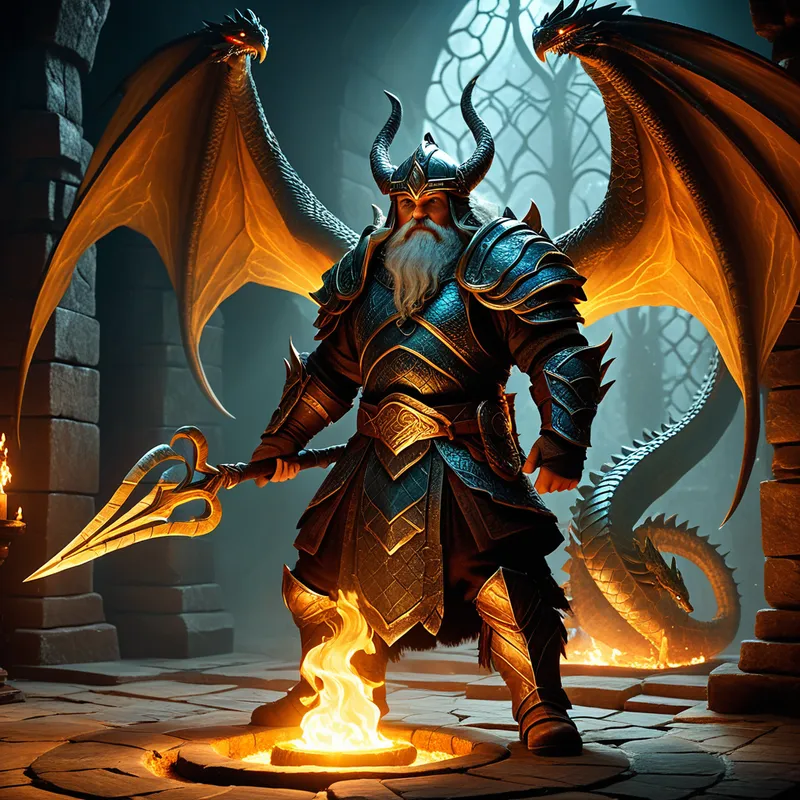
Tarnhelm Myth Meaning & Symbolism
A magical helmet forged by dwarves, granting the wearer the power to change shape and become invisible, revealing the fluid nature of identity and reality.
The Tale of Tarnhelm
Listen, and hear the tale of a thing not born of sun or soil, but of deep earth and deeper cunning. In the cold, echoing halls beneath the mountains, where the only light is the forge-fire’s hungry glare, the brothers Brokkr and Sindri toiled. Their hammers fell in a rhythm older than the gods, beating not just metal, but possibility itself into form. They were challenged, you see, by the trickster Loki, whose silver tongue wagered their very heads. To win, they had to craft wonders beyond compare.
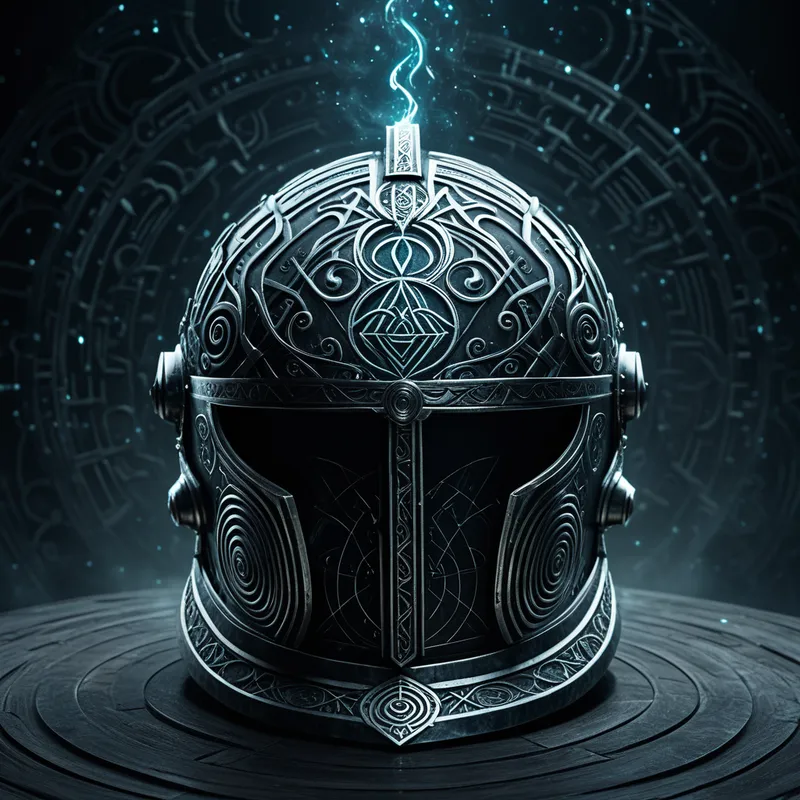
And so they did. From the belly of the earth, they drew forth a boar with bristles of gold that shone like the sun on water. They shaped a ring of red gold that bred eight more of its kind every ninth night. But the third wonder… the third was the most subtle, the most perilous. It was a helmet, wrought of the greyest iron and the darkest thought. They called it the Tarnhelm. When placed upon a head, the world would forget the wearer. They could walk as a whisper, a ghost among men. Or they could will their flesh and bone to flow, to become the slithering serpent, the soaring eagle, the lumbering bear. It was not a change of clothes, but a change of soul-stuff, a lie made solid.
This helmet of shifting selves passed from hand to hand, always leaving a stain of fate. It came to the dwarf Andvari, hoarded with his gold in a riverbed. It was stolen from him by Loki’s greed, part of a cursed ransom for a slain god. And so it flowed into the stream of sorrow that was the treasure of the Volsungs.
It came to Reginn, the smith, whose heart was a narrow, jealous place. He gave it to his foster-son, the hero Sigurd, along with a sword reforged from shards. “Use it,” Reginn whispered, his eyes gleaming with a purpose not his own. “Use it to slay my brother, who sits upon the gold as a dragon.”
And so Sigurd went to the Gnitaheath, a place where the very air tasted of poison and greed. There, in a trench dug across the dragon’s path, he waited, the Tarnhelm cool upon his brow. He did not become invisible. He became the earth itself, a patient, deadly part of the landscape. When the great worm Fafnir came, a mountain of scaled avarice, he did not see the man. He felt only the bite of a god-forged blade in his belly. The dragon’s blood, hot and potent, spilled into the trench, and Sigurd, wearing the helmet of transformation, was baptized in the very essence of the power he had slain. The Tarnhelm had not made him a beast; it had made him the perfect hunter, the absolute instrument of a fate written in gold and blood.

Cultural Origins & Context
The Tarnhelm is not a relic of common folklore, but a jewel of high narrative, preserved primarily in the Poetic Edda and the later Prose Edda of Snorri Sturluson. Its tale is woven into the grand, tragic tapestry of the Volsunga Saga, a cycle of stories recited in the halls of chieftains and kings. This was the mythology of the ruling class, of skalds who sang of lineage, fate (ørlög), and the immense, often catastrophic, consequences of power and choice.
The helmet’s origin with the dwarven smiths is critical. In the Norse worldview, dwarves were beings of the underground, associated with stone, metal, and the hidden potential of the earth. They were master crafters, not creators from nothing. They shaped what already existed into forms of immense power and often terrible beauty. The Tarnhelm, therefore, is not divine magic but crafted magic—a technology of the unseen. Its function served a society deeply concerned with honor, reputation (orðstír), and public identity. The Tarnhelm represents the terrifying opposite: the complete negation of that social self, and the ability to adopt any other. It was a narrative device that explored the limits of identity in a world where one’s name and deeds were everything.
Symbolic Architecture
The Tarnhelm is the ultimate symbol of psychic fluidity. It is not merely a tool for disguise, but an instrument that alters the very substance of being. Its primary powers—invisibility and shape-shifting—map directly onto two fundamental human psychological conditions: the desire to withdraw from the collective gaze, and the capacity for adaptation, for becoming what circumstance demands.
To wear the Tarnhelm is to step outside the story others have written for you, and to write your own in a language of pure potential and pure deception.
Invisibility represents the retreat of the ego into the unconscious. It is the state of the introvert, the observer, the one who operates from the shadows. In myth, this is the power of the spy, the assassin, the one who learns secrets. Psychologically, it speaks to our need for privacy, for a self that exists apart from its social performance. Yet, this withdrawal carries the risk of dissociation, of becoming a ghost in one’s own life.
Shape-shifting is a more profound alchemy. It is the ability of the psyche to reorganize itself, to call upon different archetypal energies—the fierce bear of aggression, the cunning fox of intellect, the soaring eagle of spirit. This is the essence of adaptability and survival. However, the myth warns that this power is perilous. To change form too often, or for ignoble ends, is to risk losing the core, the authentic self. One may forget how to change back. Fafnir, who began as a dwarf, desired the dragon’s power so completely he became the dragon, consumed by the very greed he sought to possess.
The Dreamer’s Resonance
When the motif of the Tarnhelm appears in modern dreams, it signals a profound somatic and psychological process of identity negotiation. The dreamer is not simply “in disguise”; they are experientially becoming something else.
A dream of sudden, effortless invisibility often arises during periods of burnout or social overwhelm. The somatic feeling is one of lightness, of pressure lifting, but also of chilling isolation. The psyche is forcing a retreat, declaring, “I must disappear to survive.” It is a corrective, if extreme, move toward self-preservation.
Dreams of involuntary shape-shifting—where one’s body morphs into an animal or another person without control—are more unsettling. They point to a fragmentation of the self, where different complexes or sub-personalities are vying for dominance. The dreamer may feel they are “not themselves” in waking life, acting in ways that feel alien. The somatic experience is often one of panic, disorientation, or a strange, fluid numbness. This is the psyche’s dramatic portrayal of an identity crisis, where the cohesive “I” has been temporarily dissolved, and the raw archetypal potentials of the unconscious are surging forth, seeking a new integration.
Alchemical Translation
The journey of the Tarnhelm through the myth—from its forging to its use by Sigurd—models the individuation process, the alchemical work of transforming the base lead of the fragmented ego into the integrated gold of the Self.
The forging represents the initial, often painful, realization that the persona—the mask we show the world—is just that: a crafted object. It is not our totality. This disillusionment is the fire of the dwarf-forge, necessary to melt down our rigid self-concepts. The helmet itself is the symbol of this newfound, terrifying freedom: the ego’s capacity to detach from fixed roles.
The true magic of the Tarnhelm is not in becoming other, but in the conscious choice to return to oneself, having learned the other’s nature.
Sigurd’s use of the helmet is the instructive phase. He does not use it to escape his fate, but to fulfill it with supreme focus. He uses invisibility not for cowardice, but for perfect alignment with his purpose (slaying the dragon). He later uses shape-shifting to gain wisdom, such as when he takes the form of Brynhild’s husband to pass through her ring of fire. Here, the Tarnhelm’s power is in service to the heroic journey, not an escape from it.
For the modern individual, the alchemical translation is this: we all possess an inner Tarnhelm. We can withdraw (invisibility) to reflect, to heal, to listen to the inner voice away from the crowd’s noise. We can adapt (shape-shift) to meet life’s challenges, accessing our inner warrior, lover, sage, or caregiver as needed. The individuation task is to become the conscious wielder of this helmet, not its possessed victim. We must learn, like Sigurd, to use these powers in service of slaying our own “dragons” of unconsciousness—our greed, our fear, our rigidities—and to ultimately know ourselves so truly that we can wear any mask without ever losing the face beneath. The goal is not to remain invisible or forever changed, but to return from the transformation, whole and more than you were before.
Associated Symbols
Explore related symbols from the CaleaDream lexicon: