
TARDIS Myth Meaning & Symbolism
A blue box, a traveler, and a journey beyond time. The myth of the TARDIS is a story of infinite inner space and the paradox of home.
The Tale of TARDIS
Listen. In the time before time was a river, in the age when the stars were young and sang their first songs, there existed a people of great wisdom and sorrow. They were the Time Lords, and they walked the spiral of eternity as others walk a garden path. But they grew weary, and proud, and bound themselves to watching, never touching. From their citadel, they forged vessels—not of wood or steel, but of frozen moments and solidified intention. These were the TARDISes, capsules to sail the vortex of time itself.
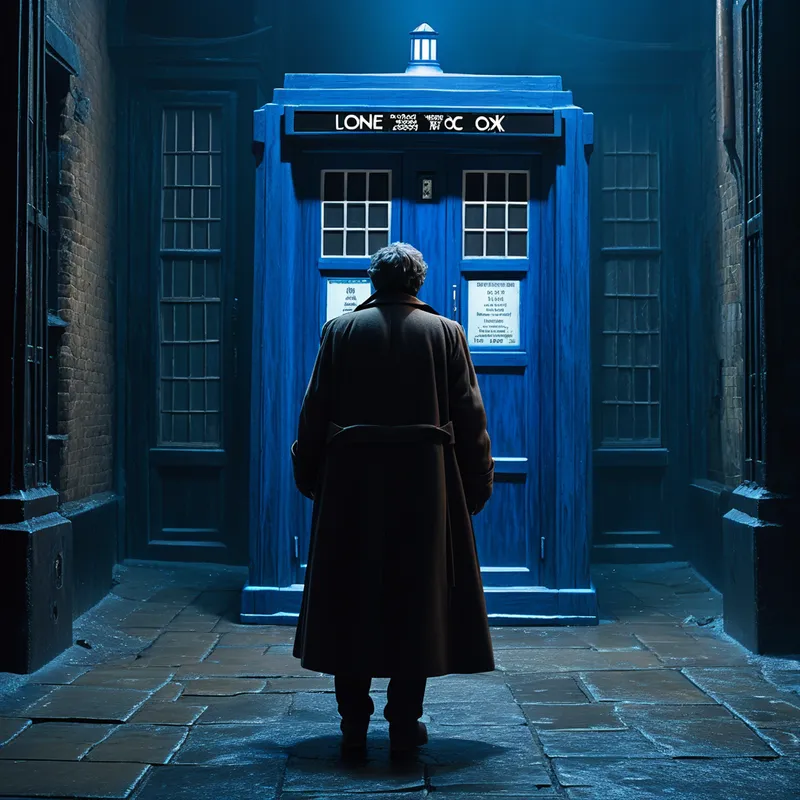
Yet one such vessel was different. It was old, even then. A Type 40, a model forgotten. Its exterior was fixed by a faulty chameleon circuit into the humble, blue-shelled form of a 20th-century Earth police public call box. A shell of authority and aid, frozen in a single, simple shape. Within, however, lay a different truth—an infinity. A cavern of impossible dimensions, a heart of glowing, humming crystal, corridors that led to swimming pools and libraries, to deserts and ice planets, all contained within a space smaller than a small room. It was a secret universe in a cabinet, a womb of worlds.
This particular TARDIS did not find a master among the solemn, observing Time Lords. Instead, it found a thief. A rebel, an exile, a being of boundless curiosity and profound loneliness who called himself The Doctor. He did not command the ship; he fled with it. And in that act of theft began the greatest partnership. The TARDIS was not a mere vehicle; it was a companion, a guide, willful and mysterious. It would take him not always where he wanted to go, but often where he needed to be.
Together, they sailed the storm of history. The groaning, wheezing sound of its materialization became a herald—sometimes of salvation, sometimes of terrifying change. They faced Daleks in their genesis, Cybermen rising from tomb-worlds, and cracks in the skin of reality itself. The blue box became a beacon in the dark. It was a door that opened onto any when, any where. A fixed point of safety in an ocean of flux. The conflict was the universe’s entropy, its cruelty, its indifference. The resolution was never final, but always present in the next journey, the next opened door, the next soul saved because a strange blue box appeared in a corner of their reality, offering a way out, or a way in.
Cultural Origins & Context
This myth was born not around ancient fires, but in the flickering glow of cathode-ray tubes in post-war Britain. It is a foundational narrative of the “Doctor Who” tradition, first told in 1963. Its tellers were writers, producers, and designers operating under severe budgetary constraints, which birthed the TARDIS’s iconic, static exterior. This limitation became the myth’s greatest strength.
The myth was passed down episodically, serially, across decades and through the regenerations of its central figure. It is a modern, living folklore, shaped by generations of “showrunners,” writers, and a global fandom that dissects, debates, and expands its lore. Its societal function is multifaceted: it served as a weekly adventure for children, a sophisticated allegory for adults, and a resilient framework for exploring historical events, scientific concepts, and deep ethical questions. In a culture increasingly aware of its place in a vast cosmos and a long history, the TARDIS myth provided a relatable vehicle—literally and figuratively—for confronting infinity. It democratized time travel, making it not the domain of cold scientists but of a madman in a box.
Symbolic Architecture
The TARDIS is the ultimate symbol of the greater-inside-than-out. It is the psyche itself.
The exterior is the persona, the mask we show the world—fixed, familiar, perhaps even mundane or bureaucratic (the police box). The interior is the boundless, often chaotic, and wondrous totality of the unconscious and the conscious self combined.
It represents the paradox of containment: how the infinite can reside within the finite, how all potential can be seeded in a single, humble moment or object. The faulty chameleon circuit is a profound psychological truth: we are often stuck in one mode of being, one self-image, even as our inner world screams with multiplicity. The TARDIS doesn’t just travel in space and time; it navigates the landscape of possibility and meaning. Its piloted yet willful nature symbolizes the relationship between the ego (The Doctor) and the Self (the TARDIS as a vessel of the totality). The ego may hold the key and steer, but the deeper Self knows the destination.
The central artifact, the Time Rotor, is the axis mundi, the world pillar around which all journeys revolve. Its rise and fall is the breath of the universe.
The Dreamer’s Resonance
To dream of the TARDIS is to dream of a threshold. The dreamer stands before the blue doors, key in hand or not. The somatic feeling is one of profound anticipation, a tightening in the chest—the awe of the infinite pressing against the shell of the familiar.
If the dreamer enters, they are navigating the labyrinth of their own unconscious. Endless corridors may speak to a feeling of being lost within oneself, while finding a specific, perfect room (a library, a garden) indicates the discovery of an inner resource or a forgotten aspect of the self. The wheezing, groaning sound is the sound of the psyche reconfiguring, a deep restructuring of internal reality. If the TARDIS is broken or failing, it reflects a sense that one’s inner world—one’s capacity for growth, change, or refuge—is damaged or inaccessible. To dream of being trapped outside the TARDIS, pounding on its doors, is to feel exiled from one’s own depth, from one’s sense of home and potential.
Alchemical Translation
The myth of the TARDIS models the alchemical process of individuation—the journey to become the paradoxical, integrated Self. The fixed blue shell is the prima materia, the leaden, ordinary starting point of the personality we believe ourselves to be.
The alchemical work is to discover that this leaden shell contains the gold of an entire universe. The “fault” in the circuit is the necessary flaw, the wound or limitation that initiates the quest.
The Doctor’s act of “stealing” the TARDIS is the ego’s daring decision to engage with the unconscious, to flee the sterile, ordered citadel of conformity (the Time Lords’ passive observation) for the risky, active journey of self-discovery. The voyages through time and space are the confrontations with the personal and collective unconscious—meeting one’s “monsters” (shadow aspects) and “companions” (anima/animus figures) across the landscape of one’s own history and potential futures.
The ultimate transmutation is the realization that the traveler and the vessel are not separate. The TARDIS is often said to be “alive” and bonded to The Doctor. In psychic terms, this is the achievement of wholeness: the ego no longer merely pilots the Self but is in symbiotic communion with it. One becomes, simultaneously, the humble blue box and the infinite universe within. One becomes both the fixed point in time and the traveler who transcends it. Home is no longer a place you come from, but a reality you carry with you, bigger on the inside than anyone could possibly imagine.
Associated Symbols
Explore related symbols from the CaleaDream lexicon: