
Tapas Myth Meaning & Symbolism
The primordial heat of creation and austerity, where focused will becomes a cosmic force, forging gods, worlds, and the soul's ultimate potential.
The Tale of Tapas
In the beginning, there was neither existence nor non-existence. There was only the One, Brahman, alone in the fathomless, silent dark. And within that One, a desire stirred—the first desire, the desire to become. This was not a whim, but a profound, cosmic yearning, a gravitational pull towards manifestation. From this desire arose Heat.
This was no ordinary fire. It was Tapas. It was the friction of potential becoming actual, the fierce, focused energy of creation itself. The One turned its awareness inward, concentrating all its boundless being into a single, incandescent point. The universe was not born from an explosion, but from an implosion of will.
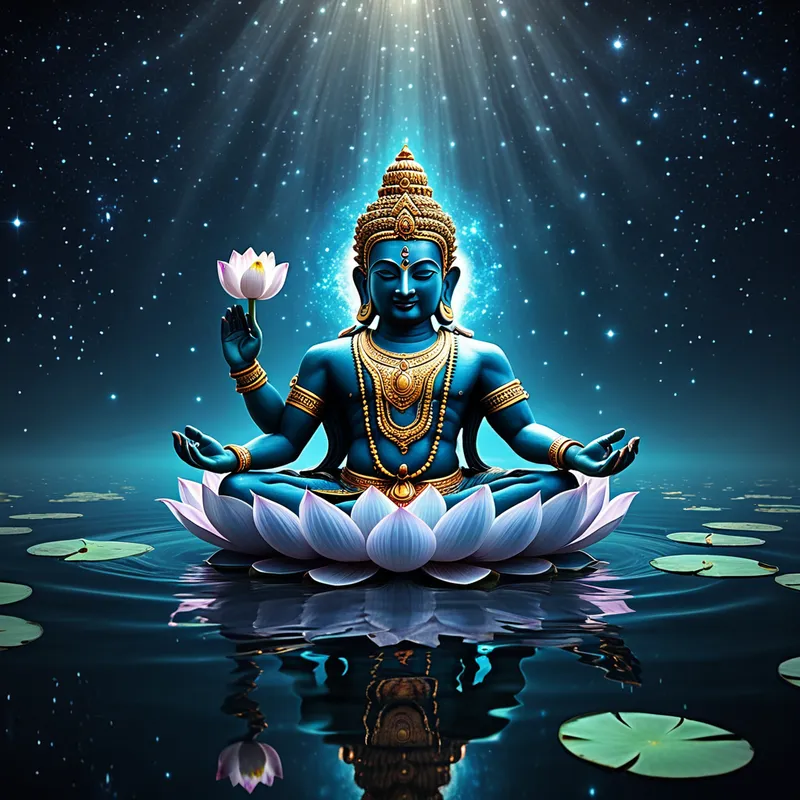
From this primordial Tapas, the waters were born—Apah, the womb of possibility. And upon those infinite, dark waters, a golden seed floated, warmed by the residual heat of that first concentration. The seed split, and from it arose Hrishikesha, who is Vishnu, resting upon the coils of the endless serpent Ananta-Shesha. He slept, and in his sleep, the dream of a universe began to form.
From his navel, a stem of light pierced the waters. It grew, and blossomed into a lotus of a thousand petals, radiant as a thousand suns. And within that lotus, seated upon its very heart, was Brahma, the architect of forms. He looked upon the void and the waters, and he too began his work not with action, but with Tapas. He sat in the lotus, and he concentrated. He gathered the scattered rays of cosmic mind into a lens of unbearable focus. For what is a creator without the disciplined heat to forge his visions?
And so it has been, through the great cycles of time. When the world falls into shadow and the gods themselves grow weak, they do not rush to battle. They descend to the roots of the world, to the silent places beneath mountains and at the sources of forgotten rivers. There, they assume a seat upon the earth—a seat of grass and resolve. They still their breath. They withdraw their senses from the world of ten thousand distractions. They fix their entire being, every thought, every ounce of life-force, upon a single point of intention. This is Tapas.
The air around them stills. Ants build mounds over their unmoving limbs. Birds nest in their matted hair. Seasons pass. Their bodies wither, becoming mere frameworks of bone and will. But inside, a furnace roars. A heat builds that is not of the sun, but of the soul concentrated into a laser. This heat becomes a power, a currency so potent it bends the fabric of reality. It forces the hand of fate. It compels the universe to answer. With this earned, sacred heat, the rishi or the god can then create: a new weapon, a boon, a revelation, a world, or their own supreme liberation.
Cultural Origins & Context
The concept of Tapas is woven into the very oldest strands of Hindu thought, appearing in the Rig Veda itself. It belongs not to a single story, but is the foundational engine of countless myths. It was the currency of the sages, the rishis, who were the original myth-makers and knowledge-holders. These stories were passed down through the oral tradition of the guru-shishya parampara, where the disciplined student (shishya), through service and focus, would "heat" themselves to become a worthy vessel for the teacher's (guru's) wisdom.
Societally, Tapas modeled the ultimate source of power. It taught that true authority does not come from birthright or physical strength alone, but from earned spiritual capital. A king who performed the Rajasuya Yagna was engaging in a form of ritual Tapas. More profoundly, it democratized divinity. It proposed that through supreme self-discipline, even a mortal could accumulate the power to challenge the gods, as seen in myths where ascetics like Bhagiratha or Durvasa shake the heavens. Its function was to illustrate that the cosmos operates on a law of energetic exchange: intense, focused effort generates transformative potential.
Symbolic Architecture
At its core, Tapas is the archetypal principle of psychic compression leading to eruption. It is the alchemy of turning diffuse potential into potent actuality.
Tapas is the universe's method of becoming more itself. It is the friction where possibility is ground into reality.
The "heat" is symbolic of concentrated consciousness. When our awareness is scattered—across desires, fears, distractions—our life-force is lukewarm and ineffective. Tapas is the voluntary, often painful, process of withdrawing that energy from external objects and focusing it inward upon a single aim. The withering of the body in the myths represents the necessary "burning off" of the superficial, the egoic, and the perishable. What remains is the essential, diamond-like core of will.
The seated ascetic is a symbol of the axis mundi, the world-pillar. He becomes the still point around which the chaotic energies of the psyche (and by extension, the cosmos) must reorganize. His unmoving posture is not passive; it is an act of immense dynamic tension, like a coiled spring or a bow fully drawn. The "boon" he receives is not a gift from an external god, but the inevitable manifestation of his own unified psyche projected onto reality. The god who "grants" the boon is often a personification of the cosmic law itself, compelled to yield to such focused intensity.
The Dreamer's Resonance
When the pattern of Tapas appears in modern dreams, it rarely manifests as a literal sage in a forest. Instead, it appears as a profound somatic and psychological process of contained intensity.
You may dream of being in a small, very hot room (a sauna, a boiler room) and finding you must stay, to endure the heat until a door opens. You might dream of holding a coal or a small, shining star in your bare hands, feeling it burn, but knowing you must not drop it. You could dream of practicing a single, repetitive action with perfect focus—forging a sword, writing one sentence over and over, or holding a yoga pose until the muscles tremble. The setting is often stark, minimalist, and pressurized.
Psychologically, this dream pattern signals that the dreamer is in a crucial phase of inner consolidation. A diffuse life energy, perhaps spent on too many projects or drained by unresolved emotions, is being forcibly recollected. The "heat" is the discomfort of this process—the anxiety, the frustration, the loneliness of deep inner work. The dream is a somatic map of the psyche's incubation period. It confirms, "This pressure you feel is not meaningless suffering; it is the necessary friction for a transformation. Do not flee the heat. Contain it. Focus it."

Alchemical Translation
For the modern individual navigating the path of individuation—becoming a whole, integrated Self—Tapas provides the essential model for psychic transmutation. Our culture often seeks change through external acquisition or sudden inspiration. Tapas teaches that lasting creation comes from internal compression and disciplined endurance.
The first step is Pratyahara, the conscious withdrawal of psychic energy from the myriad distractions and compulsive patterns that define our ordinary consciousness. This is the "sitting down" of the ascetic. The second is Dharana, the fierce focusing of that gathered energy on a single content—a wound that needs healing, a creative vision, a core question of one's existence. This is the generation of heat.
The modern alchemy of Tapas is the transformation of neurosis into purpose, of trauma into wisdom, by the sustained application of conscious attention.
The "withering" is the often painful shedding of old identities, comforting narratives, and dependencies that cannot survive in this new, intense inner climate. This stage feels like a loss, a drying up. But it is the burning away of the dross. Finally, the "boon" is the eruption of the new: a profound insight, a healed relationship, a work of art, or simply the unshakable peace of self-mastery. This is not a reward from an external god, but the latent potential of the Self, finally catalyzed into being by the heat of one's own focused consciousness. In the end, the practitioner of Tapas does not receive a gift; they become the source of the gift itself.
Associated Symbols
Explore related symbols from the CaleaDream lexicon: