
Tanuki Myth Meaning & Symbolism
A myth of the shape-shifting Tanuki, a creature of forest and hearth who teaches the art of playful transformation and the abundance found in embracing one's nature.
The Tale of Tanuki
Listen, and let the scent of damp earth and cedar carry you back. In the deep mountains, where [the mist](/myths/the-mist “Myth from Celtic culture.”/) clings to the pines like a ghostly kimono, there lived a being of the borderlands. He was not a god of the high shrines, nor a demon of the burning hells. He was Tanuki, a creature of [the threshold](/myths/the-threshold “Myth from Folklore culture.”/).
By day, he might be a humble traveler, a monk with a shaved pate and a gentle smile, begging for a night’s shelter at a remote farmhouse. His eyes, dark pools of ancient mirth, would twinkle as the farmer’s wife offered him a bowl of millet and a place by the fire. By night, when [the hearth](/myths/the-hearth “Myth from Norse culture.”/) embers sighed their last, the transformation would begin. The humble monk’s form would soften, blur, and swell. Fur, thick and russet-brown, would sprout. A great, round belly would appear, and from his head would sprout the broad leaves of a fuki, a symbol of the wild, untamed earth he governed. In his paw, a flask of endless sake would materialize, and in the other, a promissory note from the gods themselves.
His magic was one of delightful deceit. With a slap on his prodigious belly—a drum that echoed like distant thunder—he could turn fallen leaves into gold coins, mossy stones into steaming rice cakes. He would transform himself into a forgotten bronze kettle, left by the hearth, only to sprout legs at midnight and dance a jig, his spout whistling a merry tune. He might become a beautiful woman to tease a lonely woodsman, or a fearsome tengu to scare greedy merchants from his forest domain.
But his greatest trick was one of hospitality. To the kind and the generous, he brought fortune. A poor farmer who shared his last cup of sake might wake to find his field inexplicably harvested, or a mysterious, perfectly crafted bridge spanning [the river](/myths/the-river “Myth from Buddhist culture.”/) near his home. To the cruel and the arrogant, he taught lessons in humility. The boastful [samurai](/myths/samurai “Myth from Japanese culture.”/) who mocked a beggar would find his prized sword replaced with a rotten daikon radish; the greedy landlord would chase a bag of gold coins only to watch them dissolve into a pile of autumn leaves as the sound of laughter echoed from the hollow of a great tree.
His world was not one of epic battles against dragons, but of intimate, transformative encounters at [the crossroads](/myths/the-crossroads “Myth from Celtic culture.”/) of the human and the wild. He was the spirit of the unexpected bounty, the laughter that breaks tension, the shape of [the thing](/myths/the-thing “Myth from Norse culture.”/) you did not know you needed until it appeared at your door.

Cultural Origins & Context
The Tanuki is a unique fusion of biological reality and folkloric imagination. The real Nyctereutes procyonoides is a canine native to East Asia, a shy, omnivorous creature of forest and field. Its elusive nature, masked face, and adaptability made it a perfect candidate for mythopoetic elaboration. The Tanuki’s mythic character evolved primarily in the medieval and Edo periods of Japan, flourishing not in the imperial courts but in the oral traditions of farmers, merchants, and travelers.
These stories were told as yōkai tales, shared around hearths and at roadside inns. They served multiple societal functions. On one level, they were simple entertainment, a source of wonder and laughter. On another, they were cautionary tales about hospitality, greed, and the perils of the unknown road. Most profoundly, they personified the unpredictable, generative, and sometimes frightening power of nature and commerce. In an agrarian society, the line between a bountiful harvest and ruin was thin; the Tanuki, with his ability to conjure wealth from nothing, embodied the hope for and the mystery of that abundance. His large scrotum, a frequent and humorous motif in statuary (maneki-tanuki), is less a vulgarity than a symbol of immense financial luck and expansiveness, stretching like leather to haul fortunes or even serve as a rain shelter.
Symbolic Architecture
The Tanuki is the archetypal [trickster](/symbols/trickster “Symbol: A boundary-crossing archetype representing chaos, transformation, and the subversion of norms through cunning and humor.”/), but of a peculiarly gentle, generative kind. His [symbolism](/symbols/symbolism “Symbol: The use of symbols to represent ideas or qualities, often conveying deeper meanings beyond literal interpretation. In dreams, it’s the language of the unconscious.”/) is an [architecture](/symbols/architecture “Symbol: Architecture in dreams often signifies structure, stability, and the framing of personal identity or life’s journey.”/) of [paradox](/symbols/paradox “Symbol: A contradictory yet true concept that challenges logic and perception, often representing unresolved tensions or profound truths.”/) and potential.
The true self is not a fixed statue, but a flowing river capable of wearing many banks.
His primary [symbol](/symbols/symbol “Symbol: A symbol can represent an idea, concept, or belief, serving as a powerful tool for communication and understanding.”/) is transformation. Unlike the fox or [kitsune](/symbols/kitsune “Symbol: The Kitsune is a mythical fox spirit from Japanese folklore, known for its wisdom, shape-shifting abilities, and role as a protector or trickster.”/), whose changes are often tied to seduction or malice, the Tanuki’s shape-shifting is frequently playful, pragmatic, or pedagogical. He represents the [psyche](/myths/psyche “Myth from Greek culture.”/)’s fluid [capacity](/symbols/capacity “Symbol: A measure of one’s potential, limits, or ability to contain, process, or achieve something, often reflecting self-assessment or external demands.”/) to adapt, to try on different roles and identities. He is the part of us that can be serious one [moment](/symbols/moment “Symbol: The symbol of a ‘moment’ embodies the significance of transient experiences that encapsulate emotional depth or pivotal transformations in life.”/) and silly the next, that can navigate different social worlds by changing its “[skin](/symbols/skin “Symbol: Skin symbolizes the boundary between the self and the world, representing identity, protection, and vulnerability.”/).”
His [abundance](/symbols/abundance “Symbol: A state of plentifulness or overflowing resources, often representing fulfillment, prosperity, or spiritual richness beyond material needs.”/) is not the guarded [wealth](/symbols/wealth “Symbol: Wealth in dreams often represents abundance, security, or inner resources, but can also symbolize burdens, anxieties, or moral/spiritual values.”/) of the [dragon](/symbols/dragon “Symbol: Dragons are potent symbols of power, wisdom, and transformation, often embodying the duality of creation and destruction.”/), but the circulating, trickling [wealth](/symbols/wealth “Symbol: Wealth in dreams often represents abundance, security, or inner resources, but can also symbolize burdens, anxieties, or moral/spiritual values.”/) of the ecosystem. His gold coins become leaves, his sake [flask](/symbols/flask “Symbol: A vessel for containing, mixing, or transforming substances, often representing potential, experimentation, or hidden knowledge.”/) is never empty. He symbolizes a [psychology](/symbols/psychology “Symbol: Psychology in dreams often represents the exploration of the self, the subconscious mind, and emotional conflicts.”/) of enough, where creativity and resourcefulness generate value from the seemingly mundane. His large belly and testicles are symbols of this fecundity—not of carnal desire, but of psychic and [material](/symbols/material “Symbol: Material signifies the tangible aspects of life, often representing physical resources, desires, and the physical world’s influence on our existence.”/) [fertility](/symbols/fertility “Symbol: Symbolizes creation, growth, and abundance, often representing new beginnings, potential, and life force.”/).
Finally, he embodies the liminal. He dwells not in the pure [wilderness](/symbols/wilderness “Symbol: Wilderness often symbolizes the untamed aspects of the self and the unconscious mind, representing a space for personal exploration and discovery.”/) nor the ordered [village](/symbols/village “Symbol: Symbolizes community, connection, and a reflection of one’s roots or origins.”/), but in the [space](/symbols/space “Symbol: Dreaming of ‘Space’ often symbolizes the vastness of potential, personal freedom, or feelings of isolation and exploration in one’s life.”/) between: the [forest](/symbols/forest “Symbol: The forest symbolizes a complex domain of the unconscious mind, representing both mystery and potential for personal growth.”/) edge, the roadside, the hearth—places of exchange and transition. He is the [guardian](/symbols/guardian “Symbol: A protector figure representing safety, authority, and guidance, often embodying parental, societal, or spiritual oversight.”/) of thresholds, reminding us that the most profound changes occur in these in-between states.
The Dreamer’s Resonance
To dream of a Tanuki is to dream of a psyche in a state of playful, yet potent, reorganization. The somatic feeling is often one of lightness, a bubbling laughter in the chest, or the strange, elastic sensation of one’s body being malleable.
Psychologically, such a dream suggests the dreamer is encountering their own inner trickster. This may manifest when one feels overly rigid, trapped in a single identity or life script. The Tanuki appears to mock that rigidity. He might turn a dream office into a carnival, or a stern authority figure into a dancing teapot. This is not destruction, but deconstruction—a breaking of psychic forms that have become too tight.
The dream may also point to hidden resources. A Tanuki offering a seemingly worthless item (a leaf, a pebble) is an invitation to see the latent potential in overlooked parts of [the self](/myths/the-self “Myth from Jungian culture.”/) or one’s situation. The struggle in the dream is often between [the ego](/myths/the-ego “Myth from Jungian culture.”/)’s desire for control and the unconscious’s desire for playful, shapeshifting expression. The resolution comes not from defeating the Tanuki, but from learning his game—from recognizing the humor and the possibility in the transformation.
Alchemical Translation
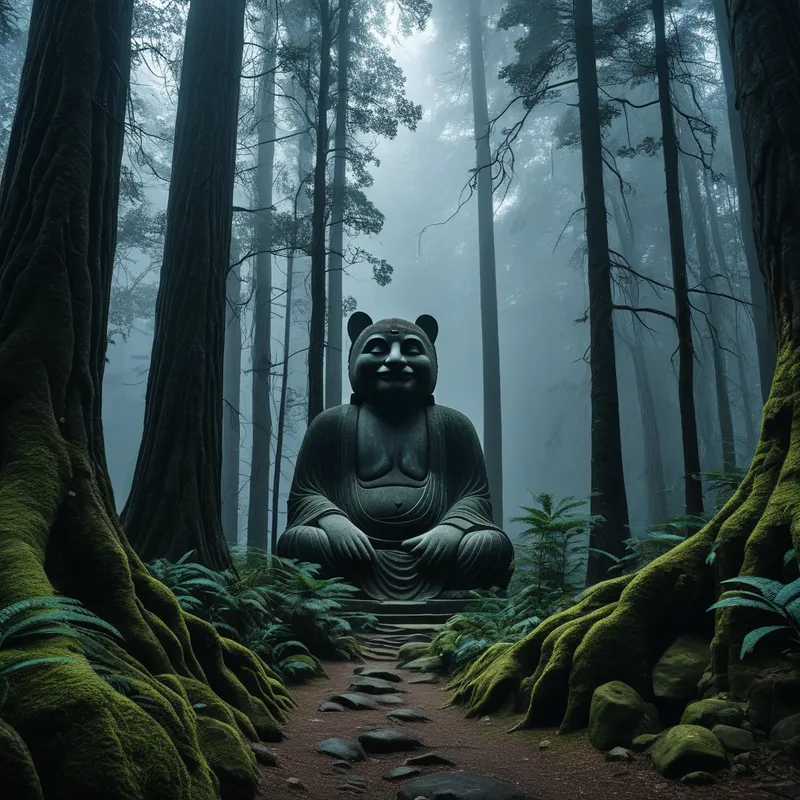
The Tanuki’s myth models a uniquely gentle path of individuation. His is not the hero’s journey of slaying monsters, but [the trickster](/myths/the-trickster “Myth from Various culture.”/)’s path of dissolving and re-constituting the self through play and paradox.
The first alchemical stage is Recognizing the Lead. This is the mundane, overlooked self—the shy [raccoon](/myths/raccoon “Myth from Native American culture.”/) dog of the forest, the part of us we consider ordinary or base. The Tanuki teaches us to slap this “leaden” belly, to acknowledge it with humor and affection. From this acceptance, not denial, transformation springs.
The core operation is The [Solve et Coagula](/myths/solve-et-coagula “Myth from Alchemical culture.”/) of Play. Solve: he dissolves fixed identities (the monk becomes a kettle). Coagula: he re-forms them into new, functional shapes (the kettle builds a bridge). For the modern individual, this translates to the courage to de-identify from rigid roles—the professional, the caregiver, the achiever—and to experiment with other ways of being. It is the alchemy of taking the “heavy” matter of our responsibilities and failures and, through the light touch of self-compassion and creativity, turning it into something useful, even delightful.
The ultimate treasure is not a golden statue, but the endlessly refilling cup of adaptability.
The final stage is Becoming the Liminal Vessel. The goal is not to become a fixed, “perfected” self, but to become like the Tanuki’s sake flask—a vessel comfortable with being empty and full, a container for the intoxicating spirit of life’s experiences, able to navigate the borders between inner and outer, conscious and unconscious, with a generous and mischievous heart. The [triumph](/myths/triumph “Myth from Roman culture.”/) is a psyche that finds abundance not in hoarding a single, “true” form, but in the graceful, generous capacity to be many things, to bring laughter to the threshold, and to always have a drop of sake to share for the weary traveler within.
Associated Symbols
Explore related symbols from the CaleaDream lexicon: