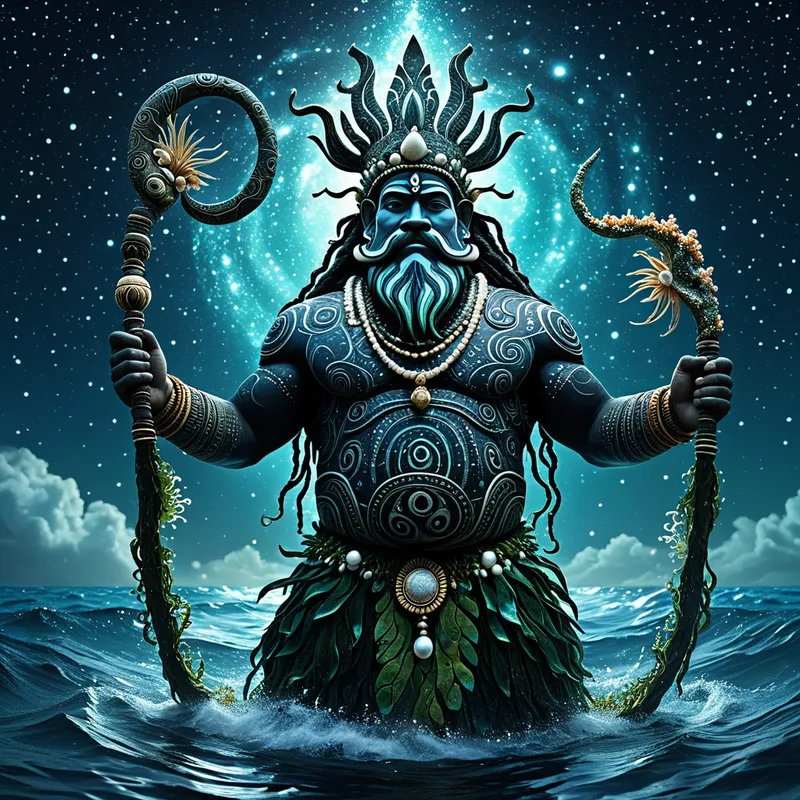
Tangaroa Myth Meaning & Symbolism
The story of Tangaroa, the primordial ocean god, whose separation from the sky birthed the world and whose depths hold the mysteries of life and psyche.
The Tale of Tangaroa
In the time before time, there was no light, no land, no life. There was only the endless, silent embrace of Po. And within Po, two great powers lay pressed together in a darkness so complete it was a kind of love: Rangi, [the Sky](/myths/the-sky “Myth from Persian culture.”/), and Papa, [the Earth](/myths/the-earth “Myth from Hindu culture.”/). Their union was absolute, a seamless whole. Between them, in that warm, dark, and cramped womb, their children were born.
But these were not helpless infants. They were gods, vast and potent, and they dwelt in perpetual night, curled and contorted, unable to stretch, to see, to breathe. The air was thick and stale. The only sound was the slow, heavy heartbeat of the cosmos itself. Among these children was Tangaroa, whose essence was the restless, salt-tinged potential of all waters. He felt the press of his father’s stone-hard chest and the soft, damp soil of his mother’s back. He felt his brothers—Tāne of the forests, Rongo of cultivated foods, Haumia of the fern-root, Tūmatauenga of fierce humankind—all tangled together in the suffocating dark.
A yearning grew in them, a desperate longing for space, for difference, for light. They debated in whispers that echoed in the tight chamber. Who would act? Who would dare break the sacred, terrible unity of their parents? Tūmatauenga, the warrior, roared for violence, to slash and sever. But the others knew such rage might destroy [the world](/myths/the-world “Myth from Tarot culture.”/) in its making. Then Tāne, the god of growing things, placed his feet upon Papa, his Earth Mother, and with a groan that shuddered through the very fabric of being, he pushed. He pushed with the relentless, upward striving of a great tree seeking the sun. Muscles of root and trunk strained. Stone grated against stone.
And then—a sound like the first crack in the shell of the universe. A sliver of unimaginable, piercing light speared the darkness. It was Ao. With a cry that was both agony and ecstasy, Rangi was forced upward, weeping tears that became the first rain and dew. Papa remained below, her body now exposed, aching and bare.
And Tangaroa? When the separation came, he did not cling to the land or the sky. He flowed into the space between. He was the first to rush into the vast, terrifying, glorious emptiness that now existed. His body became the ocean, filling the chasm, becoming the new frontier. He was no longer just a child in the dark; he was the boundless, teeming, profound sea. From his depths, the first fish and reptiles swam forth. He became the great surrounding, the salty blood of the world, forever kissing the shores of his mother Papa and reflecting the face of his father Rangi, yet forever separate, a realm entire unto himself.
Cultural Origins & Context
The myth of Tangaroa is not a single, fixed story but a foundational pattern woven throughout the Polynesian world, from Aotearoa (New Zealand) to Hawaiʻi (where he is known as [Kanaloa](/myths/kanaloa “Myth from Polynesian culture.”/)) to the Tahitian and Marquesan islands. It was the core narrative of the tohunga or kahuna, recited during sacred rituals, voyages, and times of creation or crisis. Its transmission was oral, a rhythmic, chant-like recitation of genealogy (whakapapa) that did not merely describe the past but actively situated the listener within the living cosmos.
Societally, this myth functioned as a cosmological map and a social contract. It explained the origin of the natural world—why the sky is high, why [the sea](/myths/the-sea “Myth from Greek culture.”/) is salt, why land and ocean are separate yet connected. For a people whose world was the vast Pacific, Tangaroa was not a distant symbol but an immediate, daily reality. He was the source of life (fish) and a terrifying force of chaos (storms). The myth justified the necessity of separation and difference as the prerequisite for life, mirroring the necessary separation of sacred (tapu) from common (noa) in social life. To understand Tangaroa was to understand one’s place in a universe born from relationship and necessary distance.
Symbolic Architecture
Tangaroa represents the archetypal principle of the primal, unconscious medium from which conscious [life](/symbols/life “Symbol: The symbol of ‘Life’ represents a journey of growth, interconnectedness, and existential meaning, encompassing both the joys and challenges that define human experience.”/) emerges. He is not the act of [separation](/symbols/separation “Symbol: A spiritual or mythic division between realms, states of being, or consciousness, often marking a transition or loss of connection.”/) itself (that is Tāne’s [role](/symbols/role “Symbol: The concept of ‘role’ in dreams often reflects one’s identity or how individuals perceive their place within various social structures.”/)), but the substance that fills and defines the [space](/symbols/space “Symbol: Dreaming of ‘Space’ often symbolizes the vastness of potential, personal freedom, or feelings of isolation and exploration in one’s life.”/) created by that separation.
The sea is the original, undifferentiated psyche—the source of all life and the keeper of all that is hidden, forgotten, or too vast to be contained by the land of ego.
In the crushing unity of Rangi and Papa, all potentials are trapped. Tangaroa, as the oceanic potential, cannot become the sea until there is a between. His transformation models the essential psychic [movement](/symbols/movement “Symbol: Movement symbolizes change, progress, and the dynamics of personal growth, reflecting an individual’s desire or need to transform their circumstances.”/) from enmeshment to individuation. He symbolizes the emotional and instinctual [body](/symbols/body “Symbol: The body in dreams often symbolizes the dreamer’s self-identity, personal health, and the relationship they have with their physical existence.”/) that must flow into the space created when we differentiate from our primal parental complexes. He is the [depth](/symbols/depth “Symbol: Represents profound layers of consciousness, hidden truths, or the unknown aspects of existence, often symbolizing introspection and existential exploration.”/) that appears when we create boundaries. Furthermore, as the [progenitor](/symbols/progenitor “Symbol: An ancestral originator or founder figure representing lineage, legacy, and the source of existence.”/) of fish and reptiles, he represents the ancient, evolutionary layers of the [psyche](/myths/psyche “Myth from Greek culture.”/)—the cold-blooded, instinctual, and often “[alien](/symbols/alien “Symbol: Represents the unknown, otherness, and the exploration of new ideas or experiences.”/)” life forms that dwell in our personal and [collective unconscious](/symbols/collective-unconscious “Symbol: The Collective Unconscious refers to the part of the unconscious mind shared among beings of the same species, embodying universal experiences and archetypes.”/).
The Dreamer’s Resonance
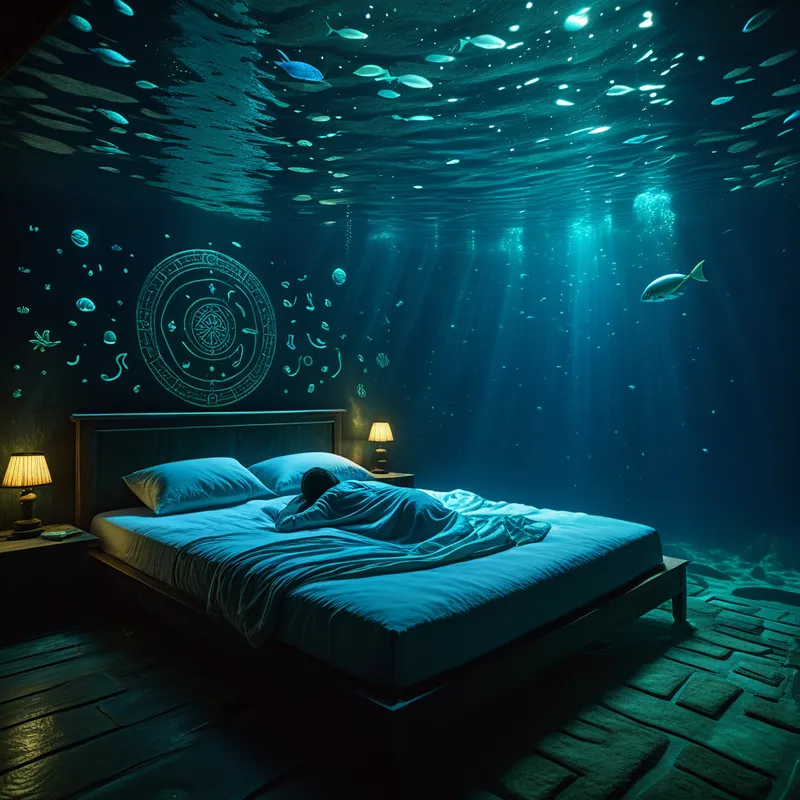
When the pattern of Tangaroa stirs in the modern dreamer, it often manifests as dreams of vast, deep, or mysterious waters. One may dream of being on a small boat in an endless ocean, of diving into abyssal trenches, or of a room in one’s house suddenly flooding with saltwater. Somatic sensations might include feelings of profound buoyancy or crushing pressure, the sound of one’s own heartbeat echoing as if underwater, or a strange taste of salt.
Psychologically, this signals a process of confronting the personal and collective unconscious. The dreamer is not necessarily “in crisis,” but they are at [the threshold](/myths/the-threshold “Myth from Folklore culture.”/) of a great internal space that has opened up, often following a necessary separation or differentiation in waking life (leaving a family system, ending a symbiotic relationship, a breakthrough in therapy). The waters are not yet threatening; they are potent and full of unseen life. The dreamer is being asked to acknowledge the sheer scale of their own inner world—the parts of [the self](/myths/the-self “Myth from Jungian culture.”/) that are ancient, autonomous, and not bound by the dry land of rational thought. It is a call to develop a relationship with depth itself.
Alchemical Translation
The alchemical journey mirrored in Tangaroa’s myth is the solution—the dissolving of old, rigid forms into a liquid state of potential. For the individual pursuing individuation, the initial, unconscious unity with the parental world (the clinging darkness of Rangi and Papa) must be broken. This is often a painful, guilt-inducing act of self-assertion (Tāne’s push). But the true work begins in the aftermath, in the flooded space.
The goal is not to drain the ocean, but to learn to sail upon it, to fish its depths, and to respect its storms.
The modern individual must become, like the Polynesian navigator, an expert in reading the signs of this inner sea. This involves allowing old certainties (the solid ground) to be surrounded and permeated by the emotional and instinctual truths represented by Tangaroa. It is the process of “salinating” the psyche—integrating the wisdom of the body, the tides of emotion, and the deep, ancestral memories that lie within us. The [triumph](/myths/triumph “Myth from Roman culture.”/) is not conquest over the deep, but the achievement of a dynamic equilibrium. One builds a “canoe” of consciousness (the differentiated ego) that is seaworthy, that can ride the waves of affect, draw sustenance (insight) from the depths, and ultimately, navigate by the reflected light of the heavens (spirit) upon the ever-changing surface of the self. In this way, the individual becomes a living microcosm of the myth: a conscious land (ego) bordered by and in constant, creative dialogue with a vast, life-giving, and powerful inner sea.
Associated Symbols
Explore related symbols from the CaleaDream lexicon: