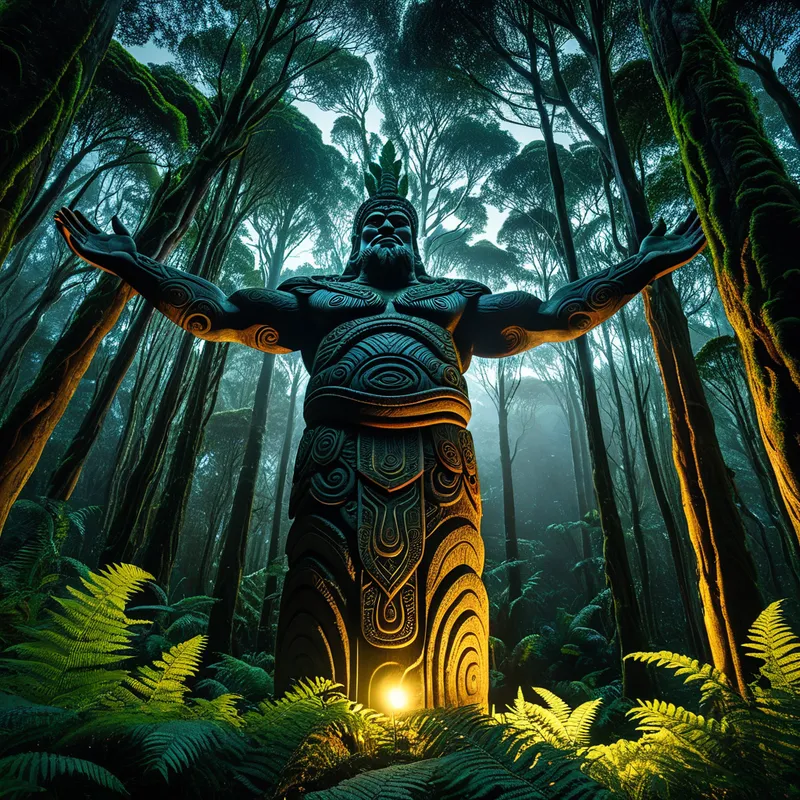
Tane Mahuta Myth Meaning & Symbolism
The story of the forest god who pushed apart his primordial parents, Rangi and Papa, to bring light, life, and consciousness into the world.
The Tale of Tane Mahuta
In the time before time, there was only closeness, and in that closeness, a profound ache. Rangi-nui, the sky, lay pressed tightly upon Papa-tū-ā-nuku, the earth. Their embrace was eternal, unyielding, and complete. In the damp, warm darkness between them, their children lived—a brood of powerful gods. But this was no nurturing womb; it was a cramped, twilight prison. No wind could stir, no light could pierce, no life could stand. The children existed in perpetual gloom, curled upon their mother’s body, crushed by their father’s weight, listening to the sound of their own stifled breath.
They were beings of immense potential, trapped in a world without form. There was Tangaroa of the restless seas, Rongo-mā-tāne of the silent seeds, Haumia-tiketike, and Tū-mata-uenga, whose fury simmered in the dark. And there was Tāne Mahuta. While his brothers debated and despaired, Tāne did not speak. He listened. He felt the ache for space not as a complaint, but as a calling. He felt the potential for life not as a dream, but as a demand.
One day, the murmuring of the gods rose to a desperate council. “We must separate them,” one said. “We must force our parents apart, so we may have light and space to be.” Each god, in turn, rose to attempt the impossible. Tangaroa pushed with the force of tidal waves, but the embrace did not loosen. Tū-mata-uenga hacked and fought with fury, but he could not cut the bonds of love. Each failed, retreating into the gloom, defeated.
Then, Tāne Mahuta stirred. He did not brace against his father or mother with violence. Instead, he turned his feet to the earth, his mother, and planted himself. He drew strength from her, feeling her solidity rise through him. He placed his broad shoulders against the chest of his father, the sky, and he began to push. Not with a god’s angry might, but with the slow, inexorable pressure of a growing tree. He pushed with the patience of a root seeking water, with the determination of a trunk reaching for the sun that did not yet exist.
The sound was a groan that shook the universe—the creak of ancient muscles, the tear of clinging vines, the shudder of a world being born. For days, for years, for epochs, Tāne pushed. His body stretched, becoming the first great tree, his feet driving deeper into Papa, his head pressing relentlessly against Rangi. And then, with a final, silent exertion, a crack appeared. A sliver of something new—not darkness, but a searing, painful, beautiful light. Te Ao Mārama, the World of Light, flooded in.
Rangi-nui, wounded and weeping, was forced upwards, his tears becoming the first rain and dew. Papa-tū-ā-nuku remained below, her body now a realm open to the sky. And Tāne Mahuta stood between them, the first pillar of the world, his body the forests that now clothed his mother, his head forever holding the vault of his father apart. In the new space, life rushed forth. The other gods found their domains. The long silence was broken by the first birdsong, as Tāne breathed life into the creatures of the air. The act of separation was complete. The world, at last, could begin.

Cultural Origins & Context
This cosmogonic narrative is the foundational story of the Māori world, belonging to the whakapapa and pūrākau traditions. It was not merely a story of “how things came to be,” but the sacred template for reality itself. Passed down through generations by tohunga and skilled orators, its recitation was an act of power and connection, reaffirming the relationship between the people, their land, and the cosmos.
The myth functioned as a societal anchor. It explained the natural order: why the sky is distant and rains, why the earth is fertile, and why the forest is the vital intermediary between the two. It established a moral and ecological framework; humans, as descendants of Tū-mata-uenga, live upon Papa, under Rangi, and are sustained by the realm of Tāne. Therefore, the forests (tapu places of Tāne) are to be respected as kin and sustainer. The story was told during significant rituals, at the birth of a child, or at the founding of a new community, weaving the individual and the tribe directly into this ongoing, living creation drama.
Symbolic Architecture
At its heart, the myth of Tāne Mahuta is not about a violent rebellion, but a necessary differentiation. It is the archetypal act of consciousness emerging from the unconscious.
The primal unity of Rangi and Papa represents the undifferentiated state—the blissful, unconscious union of opposites, where all potential exists but nothing can manifest. It is the womb, the dreamless sleep, the state before ego.
The children are the nascent psychic forces within this unity. The crushing darkness is the suffering of potential unrealized. Tāne’s act is the first movement of individuation. He does not destroy his parents; he creates space between them. This is the critical psychological movement: the separation of subject from object, self from other, light of awareness from the dark of the unknown.
Tāne Mahuta is the personified will towards consciousness. His method—rooting in the earth (the grounded, instinctual, material self) to push against the sky (the vast, spiritual, unknown self)—models the integrative process. He becomes the axis mundi, the world-tree, connecting heaven and earth within a single, living being.
His success brings Te Ao Mārama, which translates not just to “light” but to the “world of understanding and perception.” The tears of Rangi are the necessary cost—the grief that accompanies any separation, any growth away from primal unity. The myth validates that creation, consciousness, and life itself are born from a sacred, painful act of distinction.
The Dreamer's Resonance
When this myth stirs in the modern psyche, it often manifests in dreams of immense pressure, constriction, or being trapped between two forces. One may dream of being in a shrinking room, of pushing apart heavy stones, or of being a seed struggling to sprout through pavement. The somatic experience is one of deep, muscular tension—a feeling of needing to expand.
Psychologically, this signals a critical juncture in the dreamer’s life. The “primal parents” may represent an enmeshed family system, a stifling relationship, or an internal conflict between two overpowering aspects of the self (e.g., duty vs. desire, intellect vs. intuition). The dreamer is in the “darkness between,” where all elements of a new life are present but cannot move or breathe.
The emergence of the Tāne energy is the psyche’s instinct to create the necessary space for a new consciousness. It is not about defeating these forces, but about finding a way to stand between them, to hold the tension, and to allow for light and air. The dream may culminate in a feeling of immense relief, of first breath, or of seeing a distant light. It marks the beginning of a process of differentiation, where what was fused can now be seen in relationship.
Alchemical Translation
For the individual on the path of individuation, the myth of Tāne Mahuta provides a master blueprint for psychic transmutation. The alchemical prima materia is the undifferentiated, suffering state—the “stuckness” where one feels defined entirely by external pressures or internal conflicts.
The First Operation (Rooting): This is the nigredo, the blackening. One must, like Tāne, turn one’s feet to the earth. Psychologically, this means grounding in the body, in one’s instincts, and in concrete reality. It is an acceptance of one’s base, “earthy” nature—the Papa-aspect of the self. Without this rooted foundation, any push for growth will lack substance and collapse.
The Second Operation (Pushing): This is the albedo, the whitening, the work of separation. The individual places consciousness (the head) against the vast, overwhelming, spiritual, or unknown aspect (the Rangi-aspect—which could be the collective unconscious, a spiritual calling, or a daunting potential). The push is not an aggressive battle, but a sustained, patient, tree-like perseverance. It is the daily practice of setting boundaries, of speaking one’s truth, of making distinctions, of holding the tension between opposites without collapsing them.
The goal is not to vanquish the sky, but to create the sacred space where relationship is possible. The transformed psyche is not a unified blob, but a dynamic ecosystem where earth and sky, body and spirit, conscious and unconscious, can communicate across the space created by the enduring self.
The Third Operation (Manifesting): The result is Te Ao Mārama—the illuminated, conscious life. The tears (the grief of old forms dying) water the new ground. In this space, the other “gods” of the psyche—our creativity, our passions, our capacity for war and peace—can finally find their domain and flourish. The individual becomes the living axis, the Tāne-tree, through whom the energies of heaven and earth flow, creating a world within and without. The myth teaches that our greatest creative act is to become the space in which our own life can truly live.
Associated Symbols
Explore related symbols from the CaleaDream lexicon: