Talking Circle Myth Meaning & Symbolism
A sacred story where voices, carried by the wind, find a vessel of listening, transforming noise into the song of a unified community.
The Tale of Talking Circle
In the time before memory, when [the world](/myths/the-world “Myth from Tarot culture.”/) was raw sound, the people lived in a great disharmony. Their words were like stones, thrown in anger or clutched in fear. They spoke, but they did not hear. [The wind](/myths/the-wind “Myth from Various culture.”/) carried only fragments—a boast here, a grievance there, a child’s cry lost in the cacophony. The Wakan Tanka saw this, and the great silence that lived within all things grew heavy with sorrow.
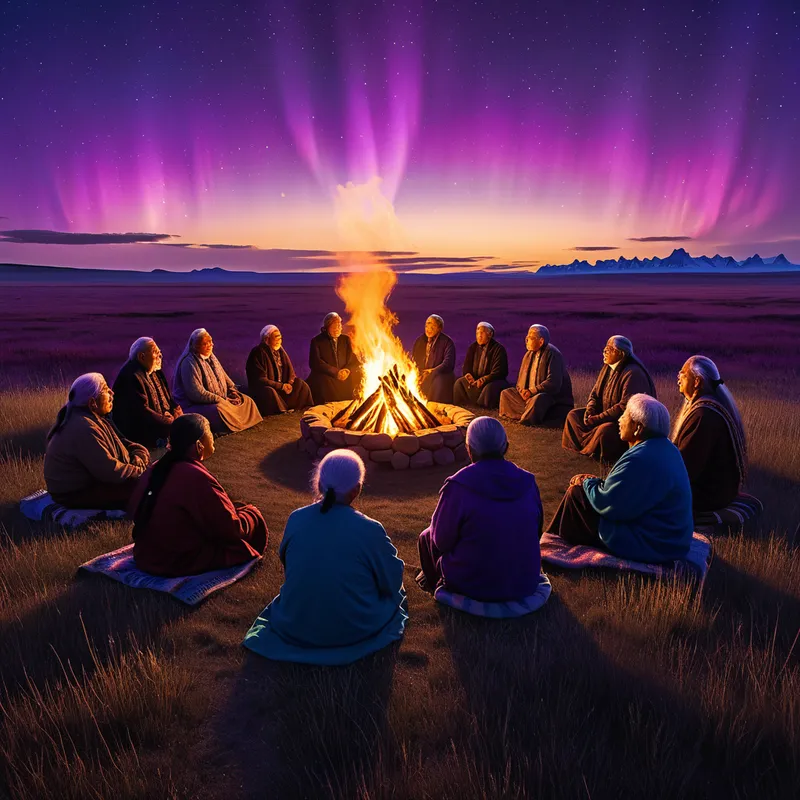
One day, as the people argued over hunting grounds, a strange stillness descended. From the four directions, the winds ceased. In that vacuum of sound, a single, clear note echoed, as if the heart of [the earth](/myths/the-earth “Myth from Hindu culture.”/) itself had spoken. It was the voice of The Great Mystery, not in words, but in a resonant feeling that settled in every chest. An elder, her face a map of seasons, felt it first. She turned from the conflict, walked to a flat clearing beneath the grandmother cottonwood, and simply sat upon the ground.
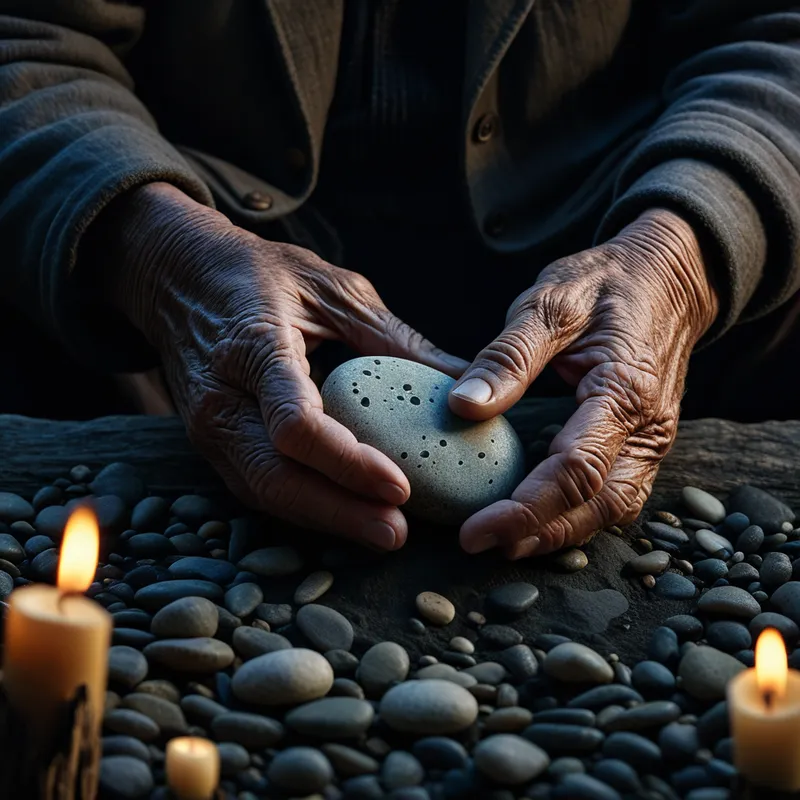
One by one, others were drawn. The angry hunter, his fist still clenched, sat. The grieving mother, her eyes hollow, sat. The proud youth, brimming with untested strength, sat. They formed a ring upon the earth, a circle with no beginning and no end. The elder took a smooth, [water](/myths/water “Myth from Chinese culture.”/)-worn stone from the creekbed. She held it to her heart, then her lips, and breathed upon it. “This,” she whispered, and her whisper carried to every ear, “is not a weapon. It is a heart that listens.”
She placed the stone in the lap of the person to her left. All waited. The wind began again, but softly, as a coaxing breath. The person with the stone—[the hunter](/myths/the-hunter “Myth from African culture.”/)—looked at it. He felt its cool weight, the memory of [the river](/myths/the-river “Myth from Buddhist culture.”/) in its curves. He did not speak of rights or wrongs. He spoke of the trembling fear he felt when the buffalo did not come, the shame of returning empty-handed to his family. His voice, once a shout, was a raw, quiet [thing](/myths/thing “Myth from Norse culture.”/). As he spoke, a single tear traced the dust on his cheek. When his breath was spent, he placed the stone before the next person.
And so it traveled. The mother spoke not of loss, but of the terrifying love that now had no home. The youth spoke of the dizzying abyss between boyhood and manhood. Each voice, once isolated noise, became a thread. The circle wove them. No one interrupted. No one debated. They listened with their whole bodies, hearing not just the words, but the breath between them, the tremor in the voice, the silence that held the unspoken. As the stone completed its journey, returning to the elder, the last of the sun’s light pooled in the center of their circle, not as a fire they built, but as a golden, shared warmth that had not been there before. They had not found an answer, but they had found the question held in common. And in that holding, the noise of the world outside the circle softened, becoming not a threat, but the distant song of crickets welcoming the night.
Cultural Origins & Context
The story of the Talking Circle is not a single, fixed myth from one nation, but a profound, living practice and foundational narrative shared across many Indigenous cultures of North America, including Lakota, Cherokee, Ojibwe, and others. It is a teaching story that encodes a core social technology. It was and is passed down not merely by telling, but by doing—each circle is a re-enactment of the myth, a ritual embodiment of its truth.
Elders and medicine keepers served as the guardians of this practice, facilitating circles for conflict resolution, healing ceremonies, vision-sharing, and communal decision-making. Its societal function was, and remains, fundamental: it is the loom upon which the fabric of community is woven and repaired. In a world view where the individual is an intrinsic part of a relational web, the Circle ensures that every strand is acknowledged, that every voice affects the whole pattern. It transforms a collection of “I”s into a collective “We,” grounded in respect, equality, and shared responsibility.
Symbolic Architecture
The myth’s power lies in its elegant, potent symbols. The Circle itself is the primary [symbol](/symbols/symbol “Symbol: A symbol can represent an idea, concept, or belief, serving as a powerful tool for communication and understanding.”/)—it is the [womb](/symbols/womb “Symbol: A symbol of origin, potential, and profound transformation, representing the beginning of life’s journey and the unconscious source of creation.”/) of [community](/symbols/community “Symbol: Community in dreams symbolizes connection, support, and the need for belonging.”/), the shape of the sun and [moon](/symbols/moon “Symbol: The Moon symbolizes intuition, emotional depth, and the cyclical nature of life, often reflecting the inner self and subconscious desires.”/), the cycle of [life](/symbols/life “Symbol: The symbol of ‘Life’ represents a journey of growth, interconnectedness, and existential meaning, encompassing both the joys and challenges that define human experience.”/), and the egalitarian [space](/symbols/space “Symbol: Dreaming of ‘Space’ often symbolizes the vastness of potential, personal freedom, or feelings of isolation and exploration in one’s life.”/) where all points on the circumference are equidistant from the sacred center. There is no head, no [hierarchy](/symbols/hierarchy “Symbol: A structured system of ranking or authority, often representing social order, power dynamics, and one’s position within groups or institutions.”/); only shared focus.
The circle does not seek to conquer difference, but to encompass it, making the perimeter of the self the meeting place of the other.
The Talking [Stone](/symbols/stone “Symbol: In dreams, a stone often symbolizes strength, stability, and permanence, but it may also represent emotional burdens or obstacles that need to be acknowledged and processed.”/) (or [feather](/symbols/feather “Symbol: A feather represents spiritual elevation, lightness, and the freedom of the spirit. It often symbolizes messages from the divine and connection to ancient wisdom.”/), or stick) is the alchemical [vessel](/symbols/vessel “Symbol: A container or structure that holds, transports, or protects something essential, representing the self, emotions, or life journey.”/). It is an object of [nature](/symbols/nature “Symbol: Nature symbolizes growth, connectivity, and the primal forces of existence.”/), transformed by intent into a sacred tool. It symbolizes the burden and the honor of [truth](/symbols/truth “Symbol: Truth represents authenticity, honesty, and the quest for knowledge beyond mere appearances.”/), the right to speak, and, more importantly, the [responsibility](/symbols/responsibility “Symbol: Responsibility in dreams often signifies the weight of duties and the expectations placed upon the dreamer.”/) to speak with [heart](/symbols/heart “Symbol: The heart symbolizes love, emotion, and the core of one’s existence, representing deep connections with others and self.”/) because one has been truly heard. It physically enforces [the law](/symbols/the-law “Symbol: Represents external rules, societal order, moral boundaries, and the tension between personal freedom and collective structure.”/) of deep listening.
The Wind represents the chaotic, unintegrated [psyche](/myths/psyche “Myth from Greek culture.”/)—the fragmented thoughts, emotions, and projections of the individualistic ego. The [Stillness](/symbols/stillness “Symbol: A profound absence of motion or sound, often representing inner peace, creative potential, or existential pause in artistic contexts.”/) that precedes the circle is the necessary [death](/symbols/death “Symbol: Symbolizes transformation, endings, and new beginnings; often associated with fear of the unknown.”/) of egoic [noise](/symbols/noise “Symbol: Noise in dreams signifies distraction, confusion, and the need for clarity amidst chaos.”/), the creation of a psychic container strong enough to hold [vulnerability](/symbols/vulnerability “Symbol: A state of emotional or physical exposure, often involving risk of harm, that reveals authentic self beneath protective layers.”/). The act of listening becomes an act of psychic [digestion](/symbols/digestion “Symbol: Represents processing, assimilation, and elimination of experiences, emotions, or information. Often symbolizes how we handle life’s challenges and absorb what nourishes us.”/), where the community metabolizes individual pain and joy into collective wisdom.
The Dreamer’s Resonance
When this myth pattern activates in the modern psyche, it often manifests in dreams of frustrated communication—shouting into voids, phones with no signal, or words that emerge as meaningless symbols. To dream of suddenly finding oneself in a silent, attentive circle, or of being handed a significant object with the implicit understanding it is one’s turn to speak, signals a profound somatic and psychological process.
This is the psyche’s move toward integration. The dreamer is likely experiencing inner fragmentation—warring subpersonalities (the inner critic, the wounded child, the ambitious achiever) that shout over each other. The dream-circle represents the nascent emergence of the Self as a unifying center, creating an inner council. The somatic sensation is often a release of tension in the chest and jaw, a literal and metaphorical “finding one’s voice” or “being heard” at a depth the waking life may not permit. It is an invitation to listen, with compassion, to the exiled parts of oneself.

Alchemical Translation
For the modern individual navigating a fragmented world, the Talking Circle models the complete process of psychic transmutation, or individuation. The initial state of chaotic conflict represents the unexamined life, where unconscious complexes project outwards, creating drama and discord.
The first alchemical stage ([nigredo](/myths/nigredo “Myth from Alchemical culture.”/)) is the voluntary descent into the stillness—the conscious decision to cease outer blaming and turn inward. This is the dark night where one confronts the inner noise. Picking up the “talking stone” for oneself is the act of active imagination or journaling, giving voice to an inner figure without censorship or judgment.
The stone is not passed until the truth is fully uttered; so too in the psyche, an complex must be fully acknowledged before it can be integrated.
The listening circle is the function of the transcendent function—[the ego](/myths/the-ego “Myth from Jungian culture.”/)’s capacity to hold the tension of opposites (our pride and our shame, our strength and our fragility) without collapsing into one side. By listening deeply to these inner voices, we do not become them; we become the container for them. The circle’s center, which magically fills with light, is the emergent Self. The resolution is not a neat solution, but a state of holding—the psychic material is not gone, but it is now held within a larger, more conscious, and compassionate wholeness. The individual becomes, like the elder, a grounded center around which their own multifaceted being can harmonize, and from which they can then engage the world with authentic, integrated speech.
Associated Symbols
Explore related symbols from the CaleaDream lexicon: