Taliesin Myth Meaning & Symbolism
A servant boy swallows a drop of divine inspiration and is reborn as Taliesin, the greatest bard, through a cycle of death, transformation, and poetic awakening.
The Tale of Taliesin
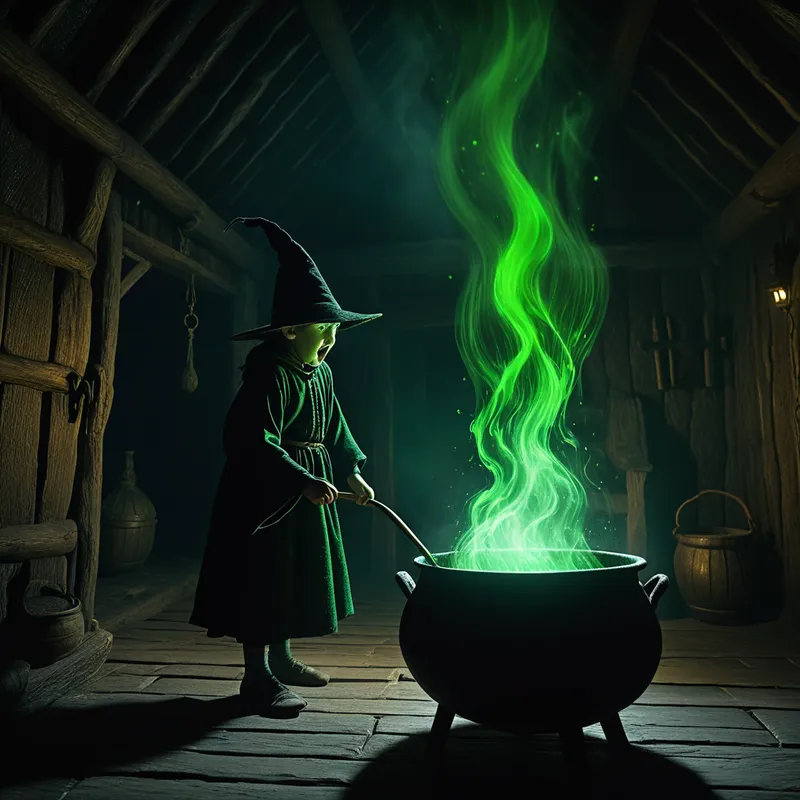
Listen, and I will tell you of a birth that was not a birth, but a becoming. In the deep heart of Cymru, where the mist clings to the mountains like memory, there lived a woman of formidable power: Ceridwen. She was a keeper of the Awen, the fiery breath of inspiration itself. For her son, Morfran, who was blessed in spirit but not in form, she resolved to brew a potion of ultimate wisdom. For a year and a day, the Cauldron of Inspiration bubbled and steamed, tended by a blind man and a young boy named Gwion Bach.
The air in the hut was thick with the scent of sacred herbs and the promise of power. Three drops of this brew would grant all knowledge—past, present, and future. The rest was a deadly poison. As the final moment approached, the cauldron hissed and roared. Three scalding, luminous drops flew from the rim. By fate or by the will of the brew itself, they landed not on Morfran’s lips, but upon the thumb of Gwion Bach. Instinctively, he thrust his burned thumb into his mouth.
The world exploded into meaning. He knew the language of the wind and the secret names of the stars. He knew he must flee, for Ceridwen’s wrath would be as vast as her magic. And so the great chase began. Gwion, with the Awen coursing through him, shape-shifted into a hare, swift and terrified. Ceridwen became a greyhound, relentless and swift. He plunged into a river as a fish; she pursued as an otter. He took wing as a bird; she followed as a hawk. Exhausted, desperate, he saw a barn filled with winnowed wheat and became a single, insignificant grain among millions.
Ceridwen stood at the threshold. Her eyes, burning with fury and grief, saw through all disguises. She shifted her form one last time, becoming a sleek, black hen. She pecked and scratched through the mound of grain until she found him, that one grain of knowledge, and swallowed him whole.
But the story does not end in the belly of the hen. For nine months, Ceridwen carried that grain within her. The Awen could not be destroyed, only transformed. When her time came, she gave birth not to a child of her flesh, but to a child of her magic. He was so radiant, so beautiful, that she could not bear to kill him. Wrapping him in a leather bag, she cast him into the sea on a day of great storm.
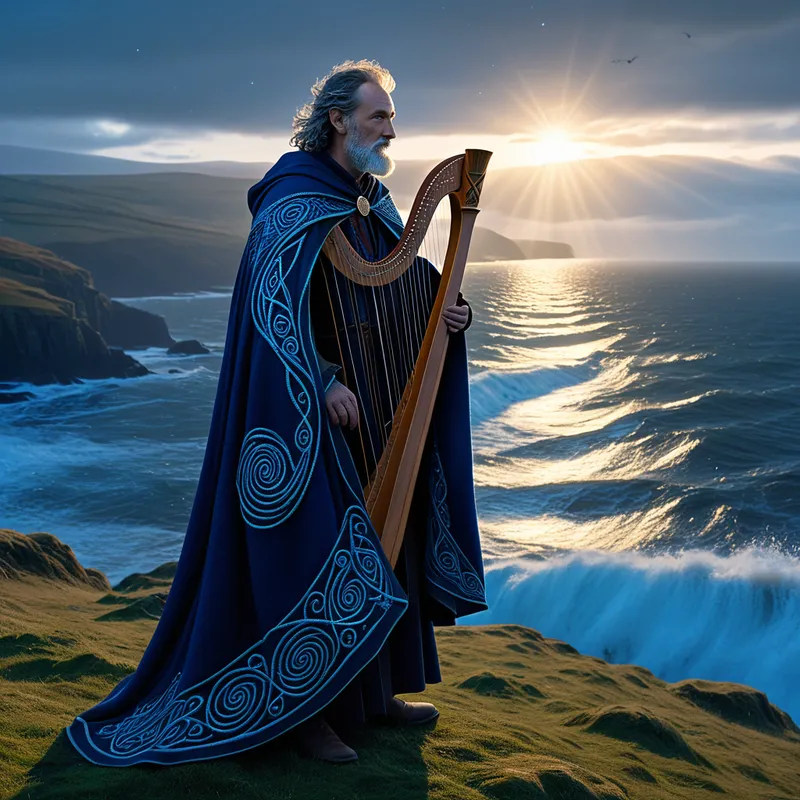
The bag was found, caught in a salmon weir, by a good man named Elffin. When he opened the bag, he beheld not a crying babe, but a boy with a brow shining with light. The child did not wail; he spoke. His first words were a poem of stunning beauty and prophecy, declaring his name: “Taliesin,” which means “Radiant Brow.” From that moment, he was the chief bard of the Annwn, his voice a vessel for the wisdom he had swallowed, been chased by, and was finally reborn through.
Cultural Origins & Context
The story of Taliesin is preserved in the <abbr title=“The “Book of Taliesin,” a 14th-century manuscript containing poems attributed to the legendary bard”>Llyfr Taliesin, a medieval Welsh manuscript, though the oral tradition it springs from is far older, rooted in the pre-Christian, druidic soil of the Celtic world. This was not a myth told merely for entertainment; it was a foundational narrative of the bardic order itself. Bards were not just poets or musicians; they were historians, judges, and keepers of the tribe’s soul, mediating between the human realm and the Annwn.
The tale functioned as a mythic charter for the source of poetic inspiration. It answered the profound question: where does true wisdom come from? The answer was not from study alone, but from a dangerous, transformative encounter with the raw, chaotic, and feminine source of all knowledge—Ceridwen and her cauldron. To become a vessel for the Awen was to undergo a symbolic death and rebirth. The myth served as an initiatory template, teaching that wisdom is earned through ordeal, that the seeker must be consumed by the very mystery they seek to understand, and that the true self emerges only after being cast adrift in the chaotic waters of experience.
Symbolic Architecture
At its core, the myth of Taliesin is an intricate map of psychic transformation. Ceridwen represents the transformative, often terrifying, power of the unconscious itself—the Great Mother in her devouring and creative aspects. Her cauldron is the womb of the psyche where raw potential is cooked into conscious form.
The first taste of wisdom is always an accident that feels like a burn, initiating a chase we did not choose but must now endure.
Gwion’s flight and shape-shifting symbolize the ego’s desperate attempts to evade the overwhelming power of this new consciousness. Each transformation—hare, fish, bird, grain—represents a different facet of the psyche: instinct, emotion, intellect, and the minute seed of potential. Yet, the unconscious, in the form of Ceridwen, knows all these forms. There is no escape through fragmentation. The final ingestion signifies the necessary, terrifying dissolution of the old, limited identity (Gwion the servant) into the nurturing/destroying matrix of the deeper Self.
The nine-month gestation is the critical period of incubation, where the swallowed knowledge is alchemically integrated. The casting into the sea represents the final surrender to the collective unconscious, the chaotic source of all life. The retrieval by Elffin symbolizes the rebirth of this transformed consciousness into the human community, now as a guiding, illuminating force—Taliesin, the radiant sage.
The Dreamer’s Resonance
When this mythic pattern stirs in the modern dreamer, it signals a profound somatic and psychological process of awakening. To dream of being chased by a relentless, intelligent force (often feminine) after accidentally consuming or touching something forbidden or luminous speaks to an encounter with repressed knowledge or a burgeoning talent that the conscious mind fears.
Dreams of frantic shape-shifting—“I kept trying to be something else to get away”—mirror Gwion’s flight, revealing a psyche attempting to hide from its own expanding awareness. A dream of being swallowed, enclosed in a dark space, or floating in a vast sea can feel terrifying, but in the Taliesin pattern, it is the prelude to rebirth. It is the psyche’s way of enacting the necessary dissolution of an outworn identity structure. The somatic feeling is often one of simultaneous panic and profound containment—the clutch of the hen, the sway of the sea. This is the body registering the alchemical vessel at work.

Alchemical Translation
For the modern individual, the Taliesin myth models the complete arc of individuation. It begins with the Accidental Initiation: a moment of unexpected insight, a psychological wound, or a sudden calling that “burns” the old life and cannot be undone. This is swallowing the drop of Awen.
The chase is not a punishment, but the psyche’s method of distillation. We are forced to become everything we are—every animal instinct, every fluid emotion, every soaring thought—until we are reduced to our essential, seed-like truth.
The subsequent Chase and Dissolution is the painful but necessary deconstruction. We try on different personas, run from our shadow, until we are finally “eaten” by the very complex or depth we sought to avoid—be it a creative block, a deep grief, or an unintegrated aspect of the mother or feminine principle. This is the dark night, the feeling of being consumed by the problem.
The Gestation in the Vessel is the period of seeming inactivity, depression, or withdrawal, where the work happens beneath consciousness. It requires patience and trust in a process we do not control. Finally, Rebirth and Declaration is the emergence of the new attitude. The “radiant brow” is the symbol of illuminated consciousness. The individual no longer speaks with the voice of the adapted ego (Gwion) but from the integrated Self (Taliesin), offering their unique song—their creative work, their hard-won wisdom—to the world. They have become a vessel for the Awen, not its owner, and in that service, find their true name and voice.
Associated Symbols
Explore related symbols from the CaleaDream lexicon: