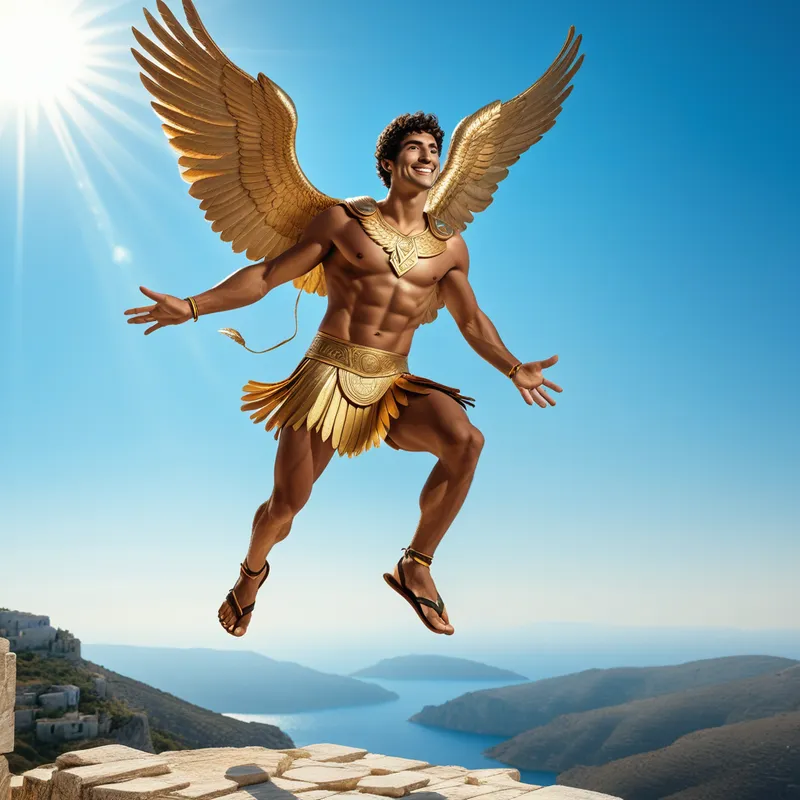
Talaria Myth Meaning & Symbolism
The story of the winged sandals, divine tools of Hermes that symbolize the swift, boundary-crossing nature of thought, message, and soul.
The Tale of Talaria
Hear now the whisper on [the wind](/myths/the-wind “Myth from Various culture.”/), the rustle that is not leaves but the beat of feathers against air. Before the first word was spoken, there was the need to carry it. In the high, clear light of Olympus, where time pools like honey, a need arose. The great Zeus looked upon the sprawled earth, the deep blue sea, and the shadowy realms below, and saw them as islands, separate and silent. Decrees languished. Truths grew stale in the speaking. The cosmos required a connective tissue, a living current to bind its parts.
And so he summoned his son, the quick one, [the child](/myths/the-child “Myth from Alchemy culture.”/) of dawn and cunning. [Hermes](/myths/hermes “Myth from Global/Universal culture.”/) stood before the throne, his eyes holding the glint of a just-stolen idea. “My son,” Zeus’s voice rolled like distant thunder, “the worlds are vast and their secrets many. My will must fly swifter than Ares’s spear. The prayers of mortals must find my ear before they turn to ash. You shall be the go-between, [the word](/myths/the-word “Myth from Biblical culture.”/)-bearer, the soul-guide. But for such work, your mortal pace will not suffice.”
From the forge of [Hephaestus](/myths/hephaestus “Myth from Global/Universal culture.”/), where fire sang and hammer blows shaped destiny, came the answer. They were not weapons of war, nor shields of defiance. They were instruments of pure potential. Crafted from the supplest leather, yet lighter than a sigh, and bound with straps that seemed woven from sunlight. But their glory was at the heels: twin pairs of wings, not of a simple bird, but of a creature born of aspiration itself—feathers of gold and silver, each barbed filament catching the light of every realm. These were the Talaria.
Hermes slipped them onto his feet. The moment they touched his skin, a vibration hummed through his bones, a song of boundless roads. He did not merely walk; [the earth](/myths/the-earth “Myth from Hindu culture.”/) itself seemed to reel beneath him, offering its contours as a launch. With a laugh that held the echo of trickling streams and market haggles, he pushed off. [The world](/myths/the-world “Myth from Tarot culture.”/) blurred. Mountain peaks became stepping stones. The churning sea was a flat, grey plain crossed in three heartbeats. He traced the path of the sun, danced on the rim of a thundercloud, and skimmed the treetops so lightly that not a single leaf was disturbed.
His first true test came not in the light, but in the dark. A soul, pale and trembling, stood by a silent river. The path to [Hades](/myths/hades “Myth from Greek culture.”/) was steep, cold, and fraught with forgetting. Hermes descended, the Talaria beating a soft, rhythmic pulse—a heartbeat for the breathless. Their golden light pushed back the clinging shadows of the Acheron. Where other gods might fear to tread, he was guide and companion, his speed now a mercy, delivering the soul from the agony of limbo to its appointed place. He was [the psychopomp](/myths/the-psychopomp “Myth from Various culture.”/), and the Talaria were the surety of his passage, the promise that no journey, not even the final one, need be made alone or without direction.
Thus, the sandals became his essence. They carried lies to gullible ears and truths to desperate kings. They bore him to the cradle of the newborn hero and to the deathbed of the fallen titan. They were the instruments of connection, making the vast, lonely cosmos a conversing whole.
Cultural Origins & Context
The myth of the Talaria is inextricably woven into the fabric of Hermes, one of the most ancient and complex figures in the Greek [pantheon](/myths/pantheon “Myth from Roman culture.”/). His origins likely stretch back to pre-Olympian boundary markers and stone heaps (herma), symbols of transition and protection. As his cult evolved, so did his attributes, crystallizing in the epic poetry of [Homer](/myths/homer “Myth from Greek culture.”/) and the later Homeric Hymns.
The Talaria were not mere fancy in these stories; they were a narrative necessity. In a worldview where gods were personifications of natural and psychological forces, Hermes embodied movement, exchange, and the crossing of thresholds. The sandals provided a tangible, vivid symbol for this abstract function. They were passed down through oral tradition by bards and rhapsodes, who would have mimicked the swift, darting motion of the god in their performance. In a society where travel was perilous and communication slow, the fantasy of divine speed held profound practical and imaginative appeal. The myth served to explain the suddenness of divine intervention, the uncanny arrival of an idea, or the mysterious journeys of the soul after death, placing Hermes, and by extension his tools, at the very nexus of cosmic and human traffic.
Symbolic Architecture
The Talaria are a masterclass in condensed [symbolism](/symbols/symbolism “Symbol: The use of symbols to represent ideas or qualities, often conveying deeper meanings beyond literal interpretation. In dreams, it’s the language of the unconscious.”/). On one level, they are the ultimate tool of the liminal entity. Wings, universally symbolic of [spirit](/symbols/spirit “Symbol: Spirit symbolizes the essence of life, vitality, and the spiritual journey of the individual.”/), aspiration, and freedom, are placed not on the back (the seat of burden and labor) but on the [feet](/symbols/feet “Symbol: Feet symbolize our foundation, stability, and the way we connect with the world around us, often reflecting our sense of direction and purpose.”/)—the point of contact with the [earth](/symbols/earth “Symbol: The symbol of Earth often represents grounding, stability, and the physical realm, embodying a connection to nature and the innate support it provides.”/), the instruments of our most grounded progress. This union creates the [archetype](/symbols/archetype “Symbol: A universal, primordial pattern or prototype in the collective unconscious that shapes human experience, behavior, and creative expression.”/) of the grounded flier, the messenger who is of all worlds but trapped in [none](/symbols/none “Symbol: The absence represented by ‘none’ can signify emptiness, potential, or a yearning for substance.”/).
The soul’s progress is not an escape from the earth, but a transformation of our relationship to it; we are meant to walk upon it with the awareness of flight.
Psychologically, the Talaria represent the speed and fluidity of thought itself—the intuitive function that leaps across logical chasms to deliver [insight](/symbols/insight “Symbol: A sudden, deep understanding of a complex situation or truth, often arriving unexpectedly and illuminating hidden connections.”/). They symbolize the [moment](/symbols/moment “Symbol: The symbol of a ‘moment’ embodies the significance of transient experiences that encapsulate emotional depth or pivotal transformations in life.”/) of inspiration that arrives unbidden, the sudden [connection](/symbols/connection “Symbol: Connection symbolizes relationships, communication, and bonds among individuals.”/) between disparate ideas, the “aha!” that changes everything. They are also the [capacity](/symbols/capacity “Symbol: A measure of one’s potential, limits, or ability to contain, process, or achieve something, often reflecting self-assessment or external demands.”/) of the [psyche](/myths/psyche “Myth from Greek culture.”/) to traverse its own inner landscapes with agility, moving from conscious ego to the [depths](/symbols/depths “Symbol: Represents the subconscious, hidden emotions, or foundational aspects of the self, often linked to primal fears or profound truths.”/) of the unconscious and back again, carrying messages from the [shadow](/symbols/shadow “Symbol: The ‘shadow’ embodies the unconscious, repressed aspects of the self and often represents fears or hidden emotions.”/) or [the Self](/myths/the-self “Myth from Jungian culture.”/).
Furthermore, as tools of the [psychopomp](/myths/psychopomp “Myth from Greek culture.”/), they symbolize the guiding principle within us that can navigate periods of profound transition, [death](/symbols/death “Symbol: Symbolizes transformation, endings, and new beginnings; often associated with fear of the unknown.”/), and [rebirth](/symbols/rebirth “Symbol: A profound transformation where old aspects of self or life die, making way for new beginnings, growth, and renewal.”/). They are the inner compass that activates during [crisis](/symbols/crisis “Symbol: A crisis symbolizes turmoil, urgent challenges, and the need for immediate resolution or change.”/), offering not a way out, but a way through with swiftness and [purpose](/symbols/purpose “Symbol: Purpose signifies direction, meaning, and intention in life, often reflecting personal ambitions and core values.”/).
The Dreamer’s Resonance
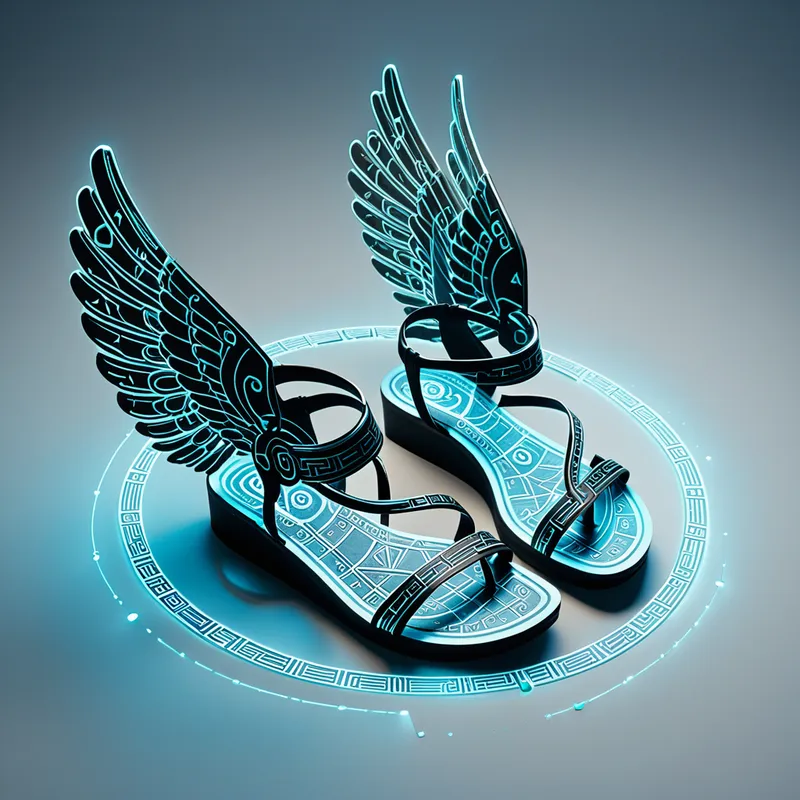
When the motif of the Talaria appears in modern dreams, it seldom manifests as literal winged sandals. Instead, the dreamer experiences the function. One may dream of running with impossible, effortless speed, feet barely touching the ground, evading a pursuer or racing toward a distant goal. Another may find themselves effortlessly leaping between skyscrapers or floating down a staircase. The somatic sensation is often one of exhilarating lightness, mastery, and freedom from gravitational (read: psychological) weight.
This dream signals a psychological process where a part of [the ego](/myths/the-ego “Myth from Jungian culture.”/)—the messenger function—is being activated or called upon. The dreamer may be in a situation requiring quick thinking, diplomatic communication, or adaptation. Alternatively, it may indicate that insights from the unconscious are trying to “break through” to consciousness with unusual speed and urgency. The dream could also reflect a successful navigation of a difficult life transition, where the individual felt guided or propelled by an inner resource they didn’t know they possessed. Conversely, dreaming of losing such speed, or of the wings being broken, speaks to a feeling of being trapped, mentally sluggish, or unable to communicate or move through a life circumstance.
Alchemical Translation
The alchemical journey of individuation is, at its heart, a series of communications between the conscious ego and the larger, unknown Self. The Talaria model this process perfectly. The initial state is one of separation: the ego is isolated on its “Olympus,” the unconscious is a distant “[underworld](/myths/underworld “Myth from Greek culture.”/),” and the outer world is a sprawling, misunderstood territory.
Individuation is the soul learning to wear its own Talaria—to move with purpose between the realms of what it knows and what it must come to know, carrying the gold of insight in both directions.
The crafting of the sandals by Hephaestus represents the necessary, often painful, work of the forge: the discipline, the failures, the heat of introspection that shapes raw potential (leather) into a functional tool, adorned with the precious metals of hard-won value (wisdom, insight). To “don the Talaria” is to consciously activate this inner Hermes—the mediating function of the psyche. It is to commit to being a messenger for one’s own truth, to travel into the shadowy realms of repressed memory or fear to retrieve a lost part of the soul, and to bring back the decree of the Self to the ruling ego.
The [triumph](/myths/triumph “Myth from Roman culture.”/) is not in the flight alone, but in the return. The true alchemy happens in the delivery, in the integration of what was found in the depths or received from the heights into the fabric of daily, grounded life. The individual becomes their own psychopomp, guiding themselves through inner deaths and rebirths, and their own divine messenger, ensuring that no part of their being remains isolated and unheard. They achieve a psychic state of fluid integrity, where thought, feeling, and action are connected with divine speed.
Associated Symbols
Explore related symbols from the CaleaDream lexicon: