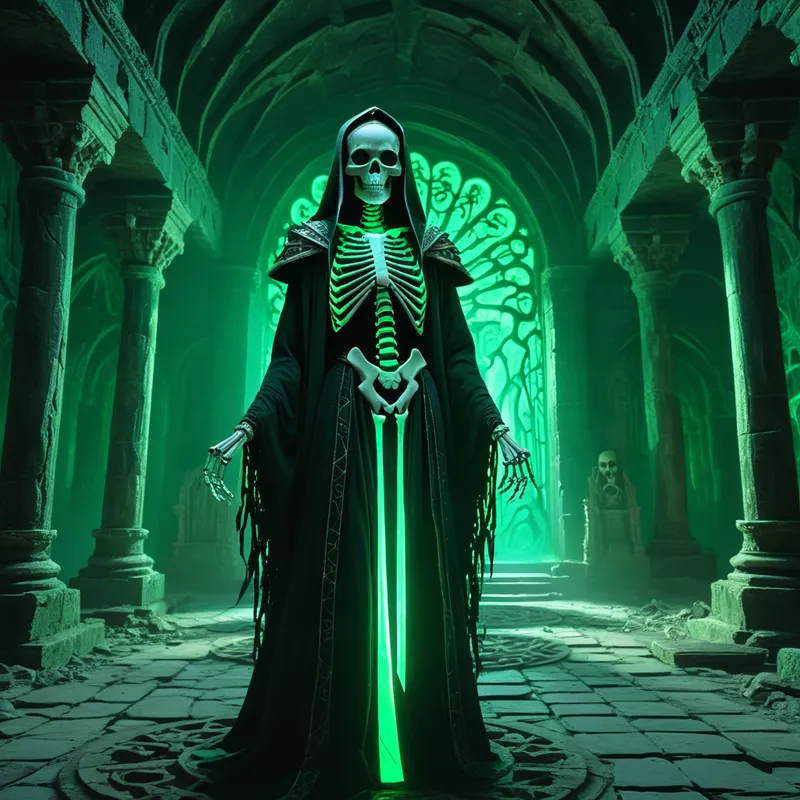
Takiyasha the Witch and the Skeleton Spectre Myth Meaning & Symbolism
A princess turned witch summons a colossal skeleton from a scroll to avenge her father's death, embodying the fury of a betrayed legacy.
The Tale of Takiyasha the Witch and the Skeleton Spectre
Listen, and hear the tale whispered on the wind through the ruined halls of Sōma Palace. It begins not with magic, but with blood. Taira no Masakado raised his banner against the Heian court, a rebel whose ambition was cut short by betrayal and the sword. His legacy was not peace, but a simmering curse, left in the care of his daughter, the princess Takiyasha-hime.
In the decaying grandeur of the palace, where moonlight fell through shattered beams onto overgrown courtyards, the princess grew. But she did not grow in grace or submission. She grew in fury. The spirit of her fallen father was a cold fire in her heart. She forsook the path of a noble lady and turned to the dark arts, becoming <abbr title="'The Witch of the Waterfall,' the name Princess Takiyasha took after studying sorcery'>Takiyasha, a sorceress who communed with the vengeful dead and commanded the creatures of shadow. Her sole purpose was woven from threads of loss and rage: to restore her father's stolen kingdom and drown the world that betrayed him in retribution.
Her solitude was broken by the arrival of Mitsukuni, a loyal emissary of the very court that slew Masakado. He came under guise, seeking the source of unsettling rumors—whispers of a witch in the ruins, gathering power. In the cavernous main hall, lit only by a single brazier, he found her. Takiyasha stood not as a supplicant, but as a queen of ashes. There was no parley. Her eyes, reflecting the flickering flames, held only recognition of an enemy.
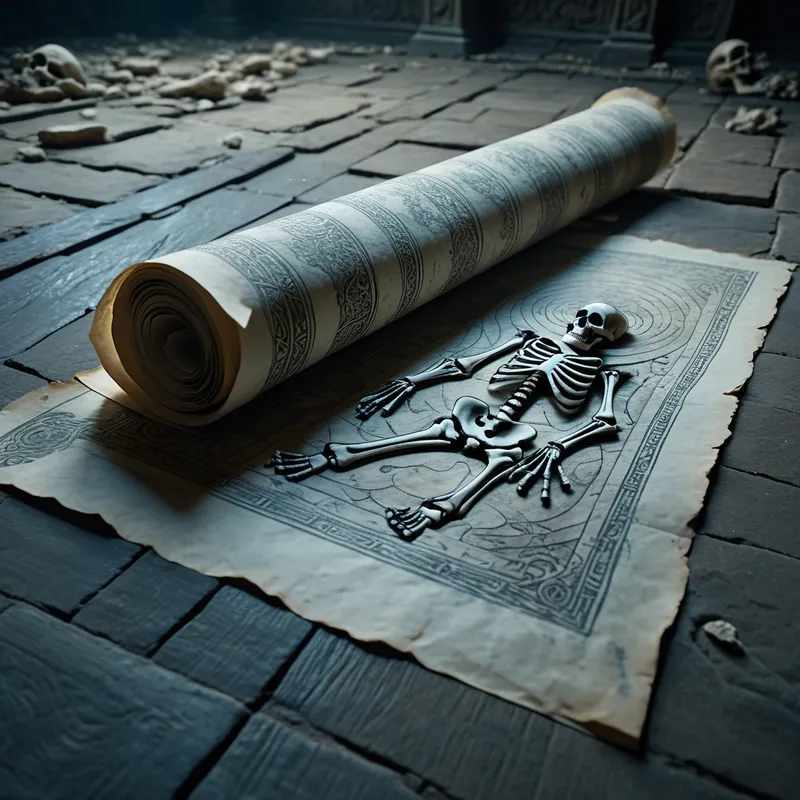
The confrontation crackled in the air. As Mitsukuni’s guards stepped forward, Takiyasha’s lips moved in a silent, ancient chant. She unfurled a long, weathered scroll upon the dusty floor. The ink upon it was not mere pigment; it was a prison, a diagram of concentrated malice. From its surface, a greenish mist began to coil, thickening, taking shape. Bones, vast and yellowed, assembled from the void—a rib cage large enough to cage a house, a skull with cavernous sockets that held not eyes, but a hungry, abyssal glow.
The Skeleton Spectre rose, a titan of death, its every movement a dry, thunderous rattle that shook the very stones of the palace. It was the physical manifestation of the unresolved past, the unburied corpse of a rebellion, now animated by a daughter’s boundless wrath. It loomed over Mitsukuni and his men, a catastrophe given form.
But Mitsukuni was no ordinary man. As the colossal bone-fingers reached to crush him, he did not falter. Drawing upon a purity of purpose—or perhaps the mandate of the sun itself, embodied by the emperor—he shouted a powerful incantation, a norito of binding and banishment. His words were like chains of light, striking the spectre. The monstrous skeleton shuddered, its form beginning to blur and dissolve back into the insubstantial mist from which it came. With a final, grating sigh that echoed through the ruins, it collapsed inward, returning to the silent scroll on the floor.
Takiyasha, her great vengeance thwarted, vanished into the deeper shadows of the ruin, leaving only the echo of her defiance and the chilling lesson: some legacies are not inheritances, but hauntings.
Cultural Origins & Context
This tale is not a myth of the divine Shinto pantheon, but a later legend born from the rich soil of Japanese history and popular theater. It finds its most vibrant life in the 19th century, during the Edo period, a time when kabuki and ukiyo-e prints flourished. The story of Takiyasha is famously immortalized in a series of woodblock prints by the artist Utagawa Kuniyoshi.
Its function was multifaceted. On one level, it was thrilling entertainment, a ghost story (kaidan) featuring a compelling anti-heroine and a spectacular monster. On another, it served as a cautionary tale rooted in historical memory. Taira no Masakado was a real, controversial figure, and his spirit was famously believed to be enshrined as a powerful, vengeful deity (goryō) in Tokyo. The myth, therefore, negotiates the cultural anxiety around rebellion, failed ambition, and the lingering power of "polluted" death. It asks what happens to the energy of a shattered dream, and warns that it may not rest, but find new life in the hearts of the next generation.
Symbolic Architecture
The myth is a profound drama of the psyche, where history becomes pathology and memory becomes a weapon.
The skeleton is not merely a monster; it is the articulated architecture of a past that refuses to be buried.
Takiyasha represents the identified ego completely possessed by a complex—specifically, a parental complex. She is not herself, but the living vessel of her father's unfinished destiny. Her transformation from princess to witch signifies a radical psychic shift: when the personal will is subsumed by an ancestral grievance, one's innate potential is twisted into a tool for vengeance. Her magic is the specialized, destructive power of the obsessed.
The Skeleton Spectre is the ultimate symbol of this possessed state. It is the shadow of the Taira legacy, made grotesquely visible. A skeleton is what remains when life and flesh are gone; here, it is the bare, structural hatred, the framework of a cause stripped of its humanity and animated solely by spite. It is not a natural creature, but a constructed horror, drawn from the "scroll" of recorded history and personal trauma.
Mitsukuni, often simplified as the "hero," symbolizes the necessary, integrative function of consciousness. He represents the principle of chisei (order, governance) confronting myō (the strange, the monstrous). His victory is not through brute force, but through the spoken word (norito), representing the power of naming, confronting, and integrating psychic material. He does not destroy the skeleton with a sword, but dissolves it with recognition—the first step in healing.

The Dreamer's Resonance
When this myth pattern stirs in the modern dreamer, it signals a profound engagement with an inherited psychological structure. To dream of a Takiyasha-figure (a powerful, isolated figure bent on righting a past wrong) may indicate the dreamer is identifying too strongly with a family narrative of victimhood, betrayal, or unmet ambition. The somatic sense is often one of cold fury, a rigid tension in the jaw and shoulders, the body armoring itself for a war that is not its own.
Dreaming of the Skeleton Spectre—especially one emerging from a book, a family home, or a scroll-like document—is a direct encounter with the "bone structure" of a personal or familial complex. It is the feeling that a dead issue is somehow alive, moving, and threatening to crush one's current life. The rattling sound is key; it is the noise of dry, lifeless patterns repeating. The dreamer may awake with a sense of dread connected to legacy, debt, or an obligation that feels inhuman in its demands.

Alchemical Translation
The psychic alchemy modeled here is the transmutation of a possessing legacy into a conscious inheritance.
The curse is not in the history itself, but in the unconscious repetition of it. The spell is broken not by winning the old war, but by seeing the skeleton for what it is.
The first step, embodied by Mitsukuni's arrival, is conscious intrusion. One must have the courage to enter the "ruined palace" of one's personal history, to investigate the source of the haunting rumors within. This is the act of self-inquiry, of therapy, of honest genealogy.
The second is confrontation and naming. Takiyasha must be seen; the rage must be acknowledged, not as a righteous force, but as a symptom. The Skeleton Spectre must be faced. In psychological terms, this is making the unconscious complex conscious—seeing the bare bones of the pattern. Mitsukuni's norito is the act of speaking the truth about the pattern, of saying, "This is not my life; this is my father's unfinished death."
The final, alchemical stage is dissolution and reclamation. The skeleton is not killed, but dissolved. The energy bound up in the vengeful complex is released. For the modern individual, this means the immense psychic energy previously spent on nursing an ancient grievance, on living out a script of rebellion or victimhood, becomes available. Takiyasha's potent magic, once solely directed outward in destruction, can be reclaimed. What was a witch's power to curse can become a sovereign individual's power to create, but only after the ancestral spectre has been faced, named, and laid to rest. The ruin can then be seen not as a fortress for a lost cause, but as fertile ground for a new beginning.
Associated Symbols
Explore related symbols from the CaleaDream lexicon: