Takemikazuchi Myth Meaning & Symbolism
A thunder god descends to subdue the land, his sword a question and his presence a decree, forging order from primal chaos through divine authority.
The Tale of Takemikazuchi
Listen, and hear the tale of the land before it was a land. The Eightfold Isles lay restless, a murmuring, seething expanse of reed plains where the spirits of earth and rock, of river and mountain, were wild and ungoverned. Their voices were the rustle of uncut grass, the rumble of shifting stone—a chorus of chaos. In the High Plain of Heaven, Amaterasu and the assembly of celestial kami looked down. The earth was unruly, a realm unfit for the descent of her lineage. It needed not creation, but declaration. It needed a word made manifest, a will made law.
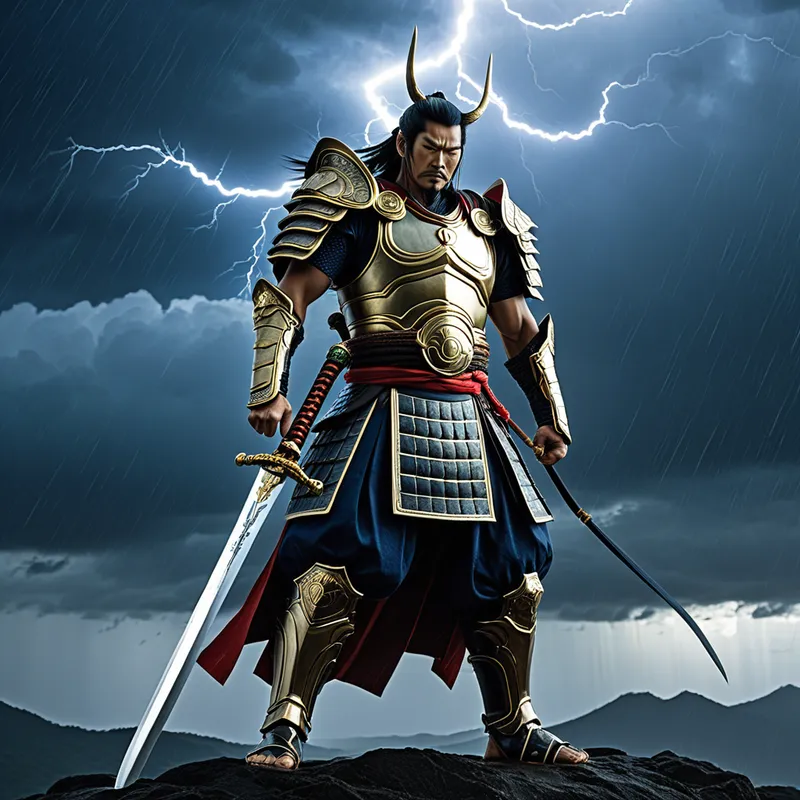
The task fell to him whose name means “Brave-Awful-Possessing-Male.” Takemikazuchi. He did not walk; he descended. He came not on the wind, but as the wind that precedes the storm. His arrival was not a footfall, but the sudden, oppressive silence before the crack of the sky. He stood upon the Reed Plain, and the very air grew heavy, charged with the scent of ozone and impending force.
Before him stood the master of those wild lands, Ōnamuchi, or so they called him. His strength was the strength of the deep earth, patient and immense. But Takemikazuchi spoke with a voice that was not sound, but vibration. “The Heavenly Deities have sent me. This land, they decree, shall be ruled by the offspring of the Sun. Will you yield it?”
Ōnamuchi was silent, a mountain considering a cloud. Then he spoke, his voice like stones grinding deep underground. “I cannot answer. My son will speak for this land.” And he called forth his son, Kotoshironushi. The son came, wise and cunning, a spirit of negotiation and charm. He took one look at Takemikazuchi—at the terrible stillness in his eyes, at the implicit violence coiled in his very posture—and he knew. This was not a negotiation. This was a verdict waiting to be pronounced. Without a word, Kotoshironushi turned his boats upside down, making a silent chamber of them, and vanished within, yielding the field.
But the earth had another voice. A second son, Takeminakata, came forth. His power was the rushing torrent, the crushing grip of the landslide. He challenged the heavenly envoy. “Let us test our strength!” he roared, and he reached out to grasp the arm of Takemikazuchi. The moment he touched it, his hand seized as if gripping a blade of ice, then transformed into a sheet of frost, then shattered into droplets of morning dew. Terror seized him. He fled, the thunder god in relentless pursuit, across the wilds, to the great sea of Suwa. There, exhausted and broken, Takeminakata surrendered. “I will yield this land. I will not leave this place.”
And so, with a silence more profound than any battle cry, Takemikazuchi claimed the land. He did not till the soil or build a city. He planted his will, like a sword, into the heart of the chaos. He asked his question—“Whose is this land?”—and by the act of asking with such absolute authority, he received the only possible answer. He returned to the heavens, his work complete. The reed plains were now ready. Order had been imposed, not through gentle persuasion, but through the undeniable, awe-ful presence of a principle that could not be refused.
Cultural Origins & Context
This myth, primarily recorded in the Kojiki and the Nihon Shoki, is a foundational Shinto narrative of chinkon, the pacification and ordering of the land. It is not merely a story of conquest, but a sacred charter for the establishment of the Japanese state and the divine right of the imperial line, descended from Amaterasu. The telling of this tale was the prerogative of ritual specialists and court chroniclers, its performance a re-enactment of the very establishment of cosmic and social order.
Societally, it functioned to legitimize the Yamato clan’s hegemony over other regional clans and their kami. The subjugation of the powerful earth kami Ōnamuchi and his sons symbolized the integration (or subordination) of local cults and chieftains into a unified hierarchy under the heavenly mandate. Takemikazuchi himself became particularly associated with the powerful Nakatomi and Fujiwara clans, and his worship is central to the famous Ise Jingu and the Kashima Shrine, where he is enshrined as a guardian of the realm and a deity of martial arts.
Symbolic Architecture
At its core, Takemikazuchi is the [archetype](/symbols/archetype “Symbol: A universal, primordial pattern or prototype in the collective unconscious that shapes human experience, behavior, and creative expression.”/) of the sovereign [word](/symbols/word “Symbol: Words in dreams often represent communication, expression, and the power of language in shaping our realities.”/). He is not brute force personified, but the [moment](/symbols/moment “Symbol: The symbol of a ‘moment’ embodies the significance of transient experiences that encapsulate emotional depth or pivotal transformations in life.”/) when abstract will becomes concrete [reality](/symbols/reality “Symbol: Reality signifies the state of existence and perception, often reflecting one’s understanding of truth and life experiences.”/). His sword, the Futsunomitama, is [less](/symbols/less “Symbol: The concept of ‘less’ often signifies a need for simplicity, reduction, or minimalism in one’s life or thoughts.”/) a tool for cutting and more a [symbol](/symbols/symbol “Symbol: A symbol can represent an idea, concept, or belief, serving as a powerful tool for communication and understanding.”/) for dividing—separating [chaos](/symbols/chaos “Symbol: In Arts & Music, chaos represents raw creative potential, uncontrolled expression, and the breakdown of order to forge new artistic forms.”/) from order, the claimable from the unclaimable, the self from the undifferentiated [mass](/symbols/mass “Symbol: Mass often symbolizes a gathering or collective experience, representing shared beliefs, burdens, or the weight of emotions within a community.”/) of instinct and possibility.
The thunderclap is not destruction, but a sudden, shocking clarity—a boundary drawn in sound and light across the formless sky.
The [earth](/symbols/earth “Symbol: The symbol of Earth often represents grounding, stability, and the physical realm, embodying a connection to nature and the innate support it provides.”/) kami represent the primal, autochthonous psyche—rich, fertile, and full of potential, but also chaotic, resistant, and without conscious [direction](/symbols/direction “Symbol: Direction in dreams often relates to life choices, guidance, and the path one is following, emphasizing the importance of navigation in personal journeys.”/). Takeminakata’s arm turning to ice and shattering symbolizes the [fate](/symbols/fate “Symbol: Fate represents the belief in predetermined outcomes, suggesting that some aspects of life are beyond human control.”/) of raw, unconscious power when it attempts to grasp a conscious, focused principle: it cannot hold it; it disintegrates. The [flight](/symbols/flight “Symbol: Flight symbolizes freedom, escape, and the pursuit of one’s aspirations, reflecting a desire to transcend limitations.”/) to Suwa and the vow to remain there is a profound [image](/symbols/image “Symbol: An image represents perception, memories, and the visual narratives we create in our minds.”/) of psychic containment. The defeated instinct is not annihilated but localized, transformed into a tutelary [spirit](/symbols/spirit “Symbol: Spirit symbolizes the essence of life, vitality, and the spiritual journey of the individual.”/) of a specific domain (e.g., a talent, a [passion](/symbols/passion “Symbol: Intense emotional or physical desire, often linked to love, creativity, or purpose. Represents life force and deep engagement.”/), a wound) that can now be accessed in a regulated way.
The Dreamer’s Resonance
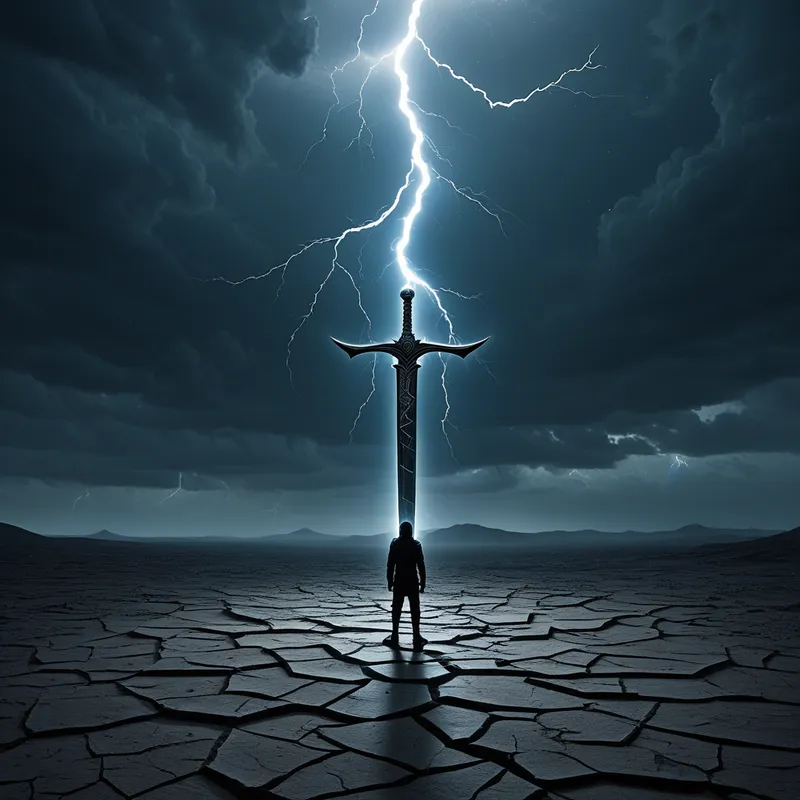
When this myth stirs in the modern soul, it often manifests in dreams of immense, imposing figures or objects that demand a response. One might dream of a colossal, silent figure standing at the threshold of one’s home, or a single, flawless weapon resting in the center of a chaotic, overgrown garden. The somatic feeling is one of awe—a mixture of terror and reverence, a pressure in the chest and a stillness in the limbs.
This is the psyche’s signal that a moment of psychic sovereignty is at hand. The “Reed Plain” is the internal landscape of one’s life—fertile but disordered, full of half-formed projects, unintegrated emotions, and competing desires. The dream is presenting the archetypal force necessary to bring order. The dreamer is not Takemikazuchi, but rather Ōnamuchi or his sons, facing the inevitable question from a higher aspect of their own Self: “Whose is this life? Who will rule here?” The anxiety and awe in the dream are the resistances of the old, comfortable chaos being confronted by the terrifying necessity of conscious choice and self-authority.
Alchemical Translation
The alchemical process modeled here is the transmutation of chaos into cosmos. For the individual, the “land” is the totality of one’s being—the unconscious drives, inherited patterns, and raw potential. The “heavenly mandate” is the call from the Self, the central archetype of wholeness, to organize this material into a coherent, authentic individual.
Individuation begins not with a gentle question, but with a divine imperative—a thunderous demand from the soul that the scattered pieces of one’s life acknowledge a central, ruling principle.
First, one must confront the “Kotoshironushi” within—the clever negotiator who seeks to avoid conflict through compromise, charm, or intellectualization. This part wisely yields, seeing the futility of bargaining with destiny. Then comes the harder confrontation with “Takeminakata”—the defiant, muscular ego, the will-to-power that believes it can grasp and control the process through sheer force of personality. This part must be “broken,” its arm of grasping control shattered, so it can flee to its “Suwa”—a contained, sacred space within the psyche where its energy can be honored but not allowed to rule. Only through this dual surrender—of cleverness and of brute force—can the land of the self be prepared for the establishment of the true, sovereign center. The sword planted is the unwavering commitment to one’s own foundational truth, from which all other aspects of life must now take their bearing.
Associated Symbols
Explore related symbols from the CaleaDream lexicon:
- Thunder — The voice of divine authority and sudden, shocking clarity that breaks through stagnant chaos, representing the moment of irrevocable decree from the Self.
- Sword — The symbol of discriminating will, the Futsunomitama that cuts through ambiguity and establishes a boundary between order and disorder within the psyche.
- Earth — The primal, fertile, and chaotic realm of the unconscious self, rich with potential but awaiting the organizing principle of consciousness.
- Mountain — The enduring, stubborn resistance of the ego or entrenched patterns (Ōnamuchi) that must be confronted by a higher authority.
- Chaos — The undifferentiated state of the Reed Plains, representing internal confusion, unprioritized desires, and the lack of a central governing principle.
- Order — The heavenly mandate, the achieved state of internal governance where disparate psychic elements are integrated under a conscious direction.
- Hero — Takemikazuchi as the archetypal agent who executes the difficult, non-negotiable task of imposing structure for a greater purpose.
- Shinto Shrine — The sacred, contained space (like Suwa) where subdued energies are honored and ritualized, transforming raw power into stabilized, accessible spiritual presence.
- Stone — The foundational, unyielding quality of the divine decree and the lasting impact of the sovereign word upon the character of the individual.
- Journey — The pursuit of Takeminakata, symbolizing the necessary process of confronting and integrating one’s most defiant and powerful resistances to change.
- Spirit — The myriad kami of the land, representing the multitude of semi-autonomous complexes, talents, and instincts within the personal unconscious.