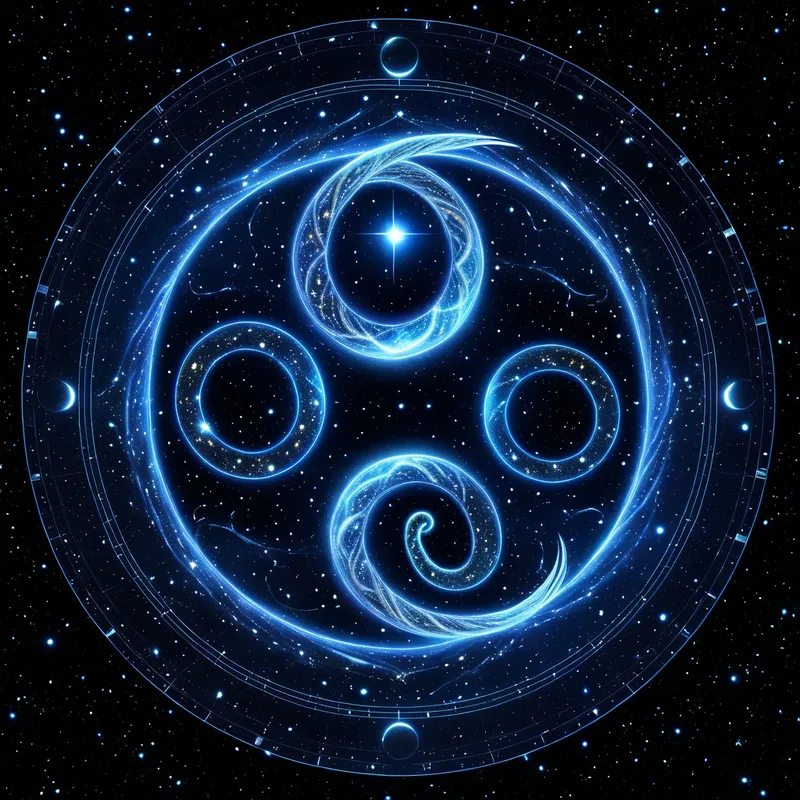
Tai Chi Myth Meaning & Symbolism
The myth of the undifferentiated Dao birthing the twin forces of Yin and Yang, whose eternal dance creates and sustains all existence.
The Tale of Tai Chi
Before the ten thousand things, there was the Dao. And the Dao was still. It was a silence so profound it was a kind of sound, a darkness so complete it was a form of light, a womb of infinite possibility where nothing was separate, and therefore, nothing yet was.
This was Wuji—the boundless, the limitless, the void pregnant with everything.
And within that perfect, pregnant stillness, a breath was drawn. Not a breath of air, for there was no air, but the first movement of intent. A tension, soft as a thought, arose. The One, feeling the fullness of its own solitude, began to know itself. This knowing was a vibration, a subtle differentiation—a leaning.
From this leaning, the great polarity was born. Not in conflict, but in mutual yearning. From the heart of Wuji emerged Tai Chi, the Supreme Ultimate. Imagine it not as a thing, but as the first act: a slow, inevitable turning. From this turning, two essences distilled themselves, like mist separating from water.
The light, the active, the ascending force gathered itself. It became Yang. It was the sun that was not yet a sun, the mountain peak yearning for the sky, the firmness of a father’s back. It was pure potential action, a rushing upward like heat.
The dark, the receptive, the descending force coalesced. It became Yin. It was the moon that was not yet a moon, the valley welcoming the river, the softness of a mother’s embrace. It was pure potential stillness, a settling downward like cool shadow.
They did not face each other as enemies, but as lovers destined for an eternal dance. Yang, in its full flight, found its limit and saw within itself the seed of Yin—a small circle of darkness in its brightest core. Yin, in its deepest repose, found its limit and saw within itself the seed of Yang—a small circle of light in its darkest heart.
And so they moved. They began the great, slow, swirling dance of creation. Yang expanded, and Yin yielded. Yin enveloped, and Yang penetrated. Their interaction was not a battle, but a conversation—a ceaseless, flowing inquiry. From their interplay, the breath (Qi) began to move. From the patterns of their dance, the five phases (Wuxing) emerged: the bursting forth of Wood, the blazing of Fire, the nurturing of Earth, the structuring of Metal, the flowing of Water.
The void was now a cosmos. The silence was now a symphony of becoming. The ten thousand things—the stars, the rivers, the stones, the creatures—all crystallized from the rhythmic, dynamic tension between these two primordial lovers, forever chasing each other’s tails in the circle of existence. The dance was the world. The balance was life.
Cultural Origins & Context
The myth of Tai Chi is not a narrative with characters and plot in the Western sense, but a cosmological and philosophical framework foundational to Chinese thought. Its origins are ancient, emerging from the observations of natural philosophers and sages during the Zhou Dynasty and crystallizing in texts like the I Ching (Book of Changes) and later in Daoist philosophy, most notably in the Dao De Jing. It was passed down not merely as a story, but as a living principle encoded in art, medicine (TCM), statecraft, and martial practice.
Its societal function was profound: it provided a model for understanding change, conflict, and harmony. It taught that opposites are not to be conquered, but harmonized. The emperor ruled (Yang) but had to be receptive (Yin) to the will of heaven and the needs of the people. The farmer planted (Yang) in receptive earth (Yin). This myth was the bedrock for a culture that valued balance, cyclical change, and the dynamic middle way over static perfection or final victory.
Symbolic Architecture
At its core, the myth of Tai Chi is a map of consciousness itself. It symbolizes the fundamental psychic fact that life arises from tension, and wholeness from the integration of opposites.
The cosmos is not born from a singular note, but from the resonant interval between two.
Wuji represents the unconscious pleroma, the state of infantile oneness with the world before the ego differentiates. Tai Chi is the moment of conscious awakening, the first flicker of self-awareness that inevitably creates a sense of “I” and “Not-I.” Yang symbolizes the conscious ego: active, striving, logical, and outwardly focused. Yin symbolizes the unconscious: receptive, intuitive, emotional, and inwardly deep.
The critical symbol is the dot of opposite within each half. This reveals the profound psychological truth: in the height of our conscious striving (Yang), we are seeded with exhaustion, doubt, and the call of the inner world (Yin). In the depth of our withdrawal or depression (Yin), we contain a spark of potential, a new idea, the urge to act (Yang). The enemy is never the opposite force, but the refusal to acknowledge its rightful place in the dance.
The Dreamer’s Resonance
When this myth stirs in the modern psyche, it often manifests in dreams of duality seeking resolution. One may dream of two animals—a bird and a fish, a tiger and a dragon—circling each other. One may dream of being on a seesaw, perpetually trying to find the center point, or of trying to blend two contrasting colors into a third. The somatic feeling is one of being pulled in two directions, not violently, but with a persistent, rhythmic tension.
Psychologically, this signals a process of confronting a psychic opposite. Perhaps the dreamer has been over-identified with their Yang aspect: relentless productivity, forcing outcomes, ignoring the body’s needs. The unconscious, in its Yin wisdom, sends the dream to re-introduce the missing element—rest, receptivity, emotion. The dream is the psyche’s attempt to initiate the Tai Chi dance, to begin the slow, integrating movement that leads away from one-sidedness and toward a more fluid, adaptable state of being.
Alchemical Translation
The individuation process, the journey toward psychic wholeness, is perfectly modeled by the myth of Tai Chi. It begins not with adding something new, but with recognizing the inherent tension within.
Individuation is not the victory of light over dark, but the capacity to hold the circuit between them.
First, we must acknowledge our personal Wuji—those undifferentiated states where we feel merged, lost, or without boundaries. From there, we courageously engage our personal Tai Chi: we allow the opposites within us to differentiate. We let the ambitious striver (Yang) and the vulnerable child (Yin) both have a voice. We honor the logical mind and the intuitive body.
The alchemical work is in the dance, not the elimination of one side. It is learning to let ambition arise, then consciously yield to rest. It is allowing grief its full depth (Yin), trusting that within it lies the seed of renewed engagement with life (Yang). We practice finding the Yin in our Yang actions (compassion in our competition) and the Yang in our Yin states (decisive action born from deep reflection).
Ultimately, the goal is to become the circle that contains the dance. To be the vessel within which our inner opposites can interact, generate creative Qi, and give birth to the “ten thousand things”—the multifaceted, authentic expression of a life that is not rigidly one thing, but a flowing, balanced, and dynamic whole. We become, in a sense, both the dancer and the space in which the dance occurs.
Associated Symbols
Explore related symbols from the CaleaDream lexicon: