Tablets of the Law Myth Meaning & Symbolism
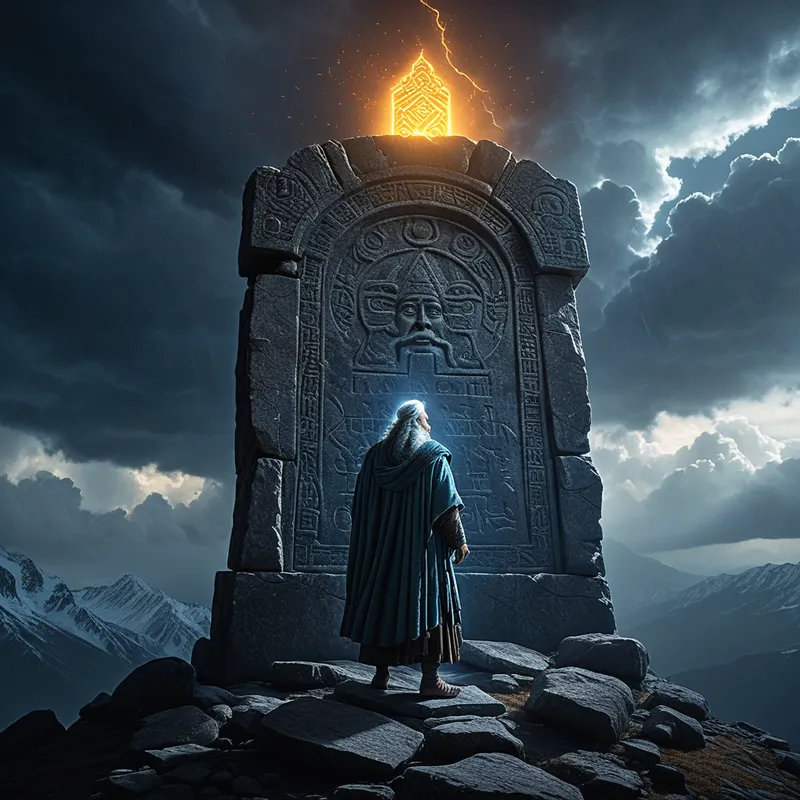
Moses receives divine law on stone tablets atop a storm-wreathed mountain, only to shatter them in rage, forging a deeper covenant from the broken pieces.
The Tale of the Tablets of the Law
Hear now the tale of the mountain, the smoke, and [the law](/myths/the-law “Myth from Biblical culture.”/) written by fire.
The air was thin and tasted of lightning. Above the barren rock of Sinai, a thick cloud descended, not of [water](/myths/water “Myth from Chinese culture.”/), but of the presence of the Unnameable. The ground trembled. Trumpets of no earthly forge sounded, growing louder until the people at the mountain’s foot covered their ears and their hearts quailed. For forty days and forty nights, the cloud brooded upon [the summit](/myths/the-summit “Myth from Taoist culture.”/), and within it, a man named [Moses](/myths/moses “Myth from Biblical culture.”/) stood in the terrifying intimacy of the Divine.
There was no form, only Voice—a sound that carved the soul. And from that Voice came instruction, the blueprint for a people yet unformed. Then, with His own finger, the Unnameable inscribed upon tablets of stone, tablets hewn from the mountain itself. The script was not chiseled; it was fused, the letters themselves holding the fire of their origin. These were the Ten Commandments, the core of the covenant: a boundary drawn between chaos and a holy order.
Moses descended, the weight of the stones a sacred burden, his face shining with a reflected radiance so fierce he had to veil it. But as he approached the camp, a new sound reached him—not the trumpet of divinity, but the raucous clamor of revelry. The smell of burnt offerings, wrong and thick, filled his nostrils. He saw them then: the people, his people, dancing wild-eyed around a molten calf, their gold given up for an idol of their own fear and impatience.
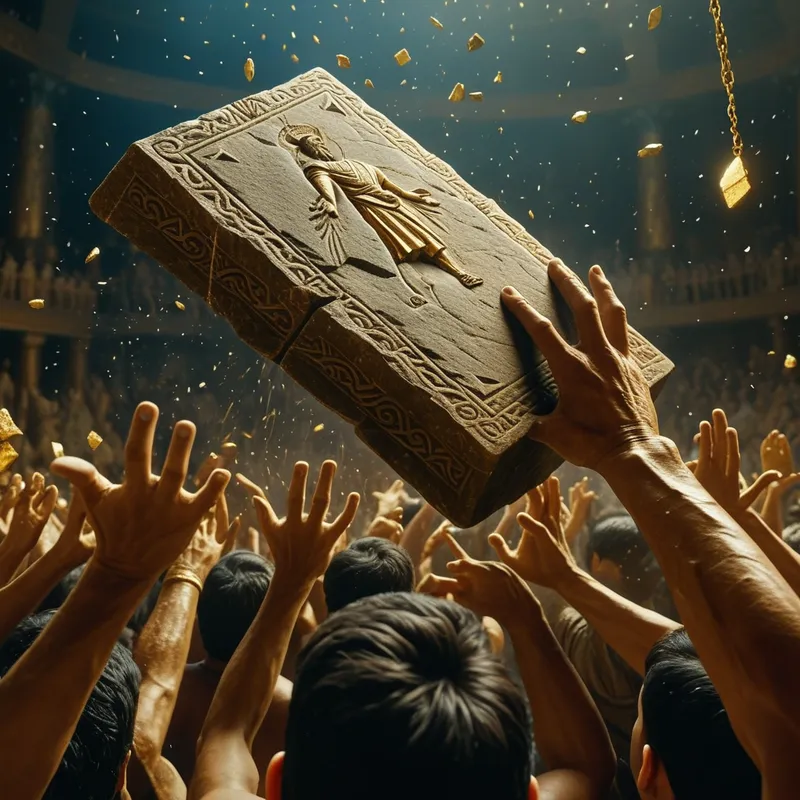
A cold fury, hotter than any flame, rose in Moses. The vision of the mountain, the unbearable intimacy of the law, crashed against the sight of this broken promise. In that moment of holy rage, he did not deliberate. He raised his arms, and with a cry that held all the grief of shattered communion, he hurled the tablets from him. They struck the base of the mountain and shattered—not into dust, but into fragments, the fiery letters extinguished, the perfect law broken against the hard earth of human failure.
The dancing stopped. A silence, more profound than the earlier thunder, fell. From that silence, a new journey began. Moses returned to the cloud, to the terrifying summit. And there, he was given a second chance—not a simple replacement, but a deeper covenant. He hewed new stones himself, bearing the labor up the mountain. The law was written again, but this time, it was carried in a chest of acacia wood, the Ark of the Covenant, a vessel for a treasure that was now, forever, accompanied by the memory of its own breaking.
Cultural Origins & Context
This foundational narrative is recorded in the books of Exodus and Deuteronomy. It is the central constitutional myth of ancient Israel, distinguishing them not by ethnicity alone, but by voluntary submission to a divinely-ordained legal and ethical code. The story was preserved and transmitted by priestly and prophetic lineages, recited during pilgrimages and read publicly to reaffirm the community’s identity and obligations.
Its societal function was multifaceted: it established the supreme authority of YHWH as lawgiver, explained the sacredness of the Ark, and provided a theological framework for understanding failure and renewal. The shattering was not an erasure but a pivotal event that introduced mercy and intercession into the relationship between the divine and the human. The law was not imposed upon a perfect people; it was given to a failing one, its very breaking woven into the fabric of the covenant.
Symbolic Architecture
The tablets are more than a legal code; they are the [archetype](/symbols/archetype “Symbol: A universal, primordial pattern or prototype in the collective unconscious that shapes human experience, behavior, and creative expression.”/) of [cosmos](/symbols/cosmos “Symbol: The entire universe as an ordered, harmonious system, often representing the totality of existence, spiritual connection, and the unknown.”/) imposed upon [chaos](/symbols/chaos “Symbol: In Arts & Music, chaos represents raw creative potential, uncontrolled expression, and the breakdown of order to forge new artistic forms.”/). They represent the [human](/symbols/human “Symbol: The symbol of a human represents individuality, complexity of emotions, and social relationships.”/) [psyche](/myths/psyche “Myth from Greek culture.”/)’s deepest yearning for an external, objective [structure](/symbols/structure “Symbol: Structure in dreams often symbolizes stability, organization, and the framework of one’s life, reflecting how one perceives their environment and personal life.”/) to organize the inner tumult of instinct, desire, and fear. The [mountain](/symbols/mountain “Symbol: Mountains often symbolize challenges, aspirations, and the journey toward self-discovery and enlightenment.”/) is the [axis](/symbols/axis “Symbol: A central line or principle around which things revolve, representing stability, orientation, and the fundamental structure of reality or consciousness.”/) mundi, the point of contact between the [human](/symbols/human “Symbol: The symbol of a human represents individuality, complexity of emotions, and social relationships.”/) and the transcendent, where the [pattern](/symbols/pattern “Symbol: A ‘Pattern’ in dreams often signifies the underlying structure of experiences and thoughts, representing both order and the repetitiveness of life’s situations.”/) is received.
The first tablets were divine perfection, impossible for humanity to hold. Their shattering was not a tragedy, but a necessary descent into the reality of the human condition.
The act of breaking is profoundly symbolic. Moses, in his rage, performs the necessary destruction of an ideal that has proven too abstract, too remote from the shadowy, golden-calf [reality](/symbols/reality “Symbol: Reality signifies the state of existence and perception, often reflecting one’s understanding of truth and life experiences.”/) of the collective. The idol represents the [regression](/symbols/regression “Symbol: A psychological or spiritual return to earlier states of being, often involving revisiting past patterns, memories, or developmental stages for insight or healing.”/) to a simpler, more instinctual psychic economy—a refusal to bear the [weight](/symbols/weight “Symbol: Weight symbolizes burdens, responsibilities, and emotional loads one carries in life.”/) of conscious [responsibility](/symbols/responsibility “Symbol: Responsibility in dreams often signifies the weight of duties and the expectations placed upon the dreamer.”/). The shattered fragments are the crucial middle stage: [the law](/symbols/the-law “Symbol: Represents external rules, societal order, moral boundaries, and the tension between personal freedom and collective structure.”/) is no longer perfect and whole, nor is it entirely lost. It is in pieces, awaiting a new, more integrated form.
The second set of tablets, hewn by human hands but inscribed again by the divine, symbolize the internalized law. It is no longer purely external commandment but a [covenant](/symbols/covenant “Symbol: A binding agreement or sacred promise between parties, often carrying deep moral, spiritual, or social obligations and consequences.”/) written on the “tablets of the [heart](/symbols/heart “Symbol: The heart symbolizes love, emotion, and the core of one’s existence, representing deep connections with others and self.”/).” The Ark that carries them is the [vessel](/symbols/vessel “Symbol: A container or structure that holds, transports, or protects something essential, representing the self, emotions, or life journey.”/) of [the Self](/myths/the-self “Myth from Jungian culture.”/), containing both the perfect ideal and the [memory](/symbols/memory “Symbol: Memory symbolizes the past, lessons learned, and the narratives we construct about our identities.”/) of its fracture.
The Dreamer’s Resonance
When this myth stirs in modern dreams, it speaks to a crisis of structure. To dream of receiving stone tablets is to encounter a moment of profound, perhaps intimidating, clarity—a new ethical insight, a life principle, or a demanding vocation that feels divinely mandated. The dreamer is at their personal Sinai.
To dream of shattering the tablets is the psyche working through the inevitable collision between this ideal and the messy, compromised reality of one’s life or community. It may feel like a failure of will, a burst of righteous anger, or a liberating destruction of an oppressive rule. The somatic sensation is often one of release followed by a hollow dread—the weight is gone, but so is the guiding light.
Dreaming of gathering the fragments, or of a radiant broken tablet, indicates the active process of integration. The dreamer is not seeking a return to naive wholeness, but is laboriously assembling a personal code from the ruins of broken absolutes, a law that acknowledges its own fractures.

Alchemical Translation
The alchemical journey here is from lapis (the stone) to filius philosophorum (the philosophical child). The first, perfect tablets are the [prima materia](/myths/prima-materia “Myth from Alchemical culture.”/)—the raw, divine ideal. The shattering is the essential stage of mortificatio or [separatio](/myths/separatio “Myth from Alchemical culture.”/), the killing and separating of the matter. The ideal must be broken by contact with [the shadow](/myths/the-shadow “Myth from Jungian culture.”/) ([the golden calf](/myths/the-golden-calf “Myth from Biblical culture.”/)), for only through its dissolution can its essence be extracted and made workable.
The covenant renewed is not a return to the beginning, but an ascent to a higher grade. The law that survives its own breaking carries the wisdom of the break within it.
Moses’s ascent with human-hewn stones is the coagulatio—the re-forming. The dreamer in this stage must actively participate in crafting [the vessel](/myths/the-vessel “Myth from Alchemical culture.”/) (the Ark) that will hold their truth. This is the core of individuation: moving from a state where rules are externally imposed and rigid, to a state where one’s guiding principles are internally sourced, resilient, and compassionate because they have survived confrontation with one’s own capacity for idolatry and failure. The final law is not lighter, but it is carried differently—not as a burden of perfection, but as the sacred charge of a hard-won integrity. The broken pieces become the foundation of a more conscious temple.
Associated Symbols
Explore related symbols from the CaleaDream lexicon: