Tablets of the Covenant Myth Meaning & Symbolism
Moses ascends a fiery mountain to receive divinely inscribed laws, a covenant shattered by human idolatry and miraculously restored through penitent renewal.
The Tale of Tablets of the Covenant
Hear now the tale of the mountain that touched heaven, and the stones that bore the voice of God.
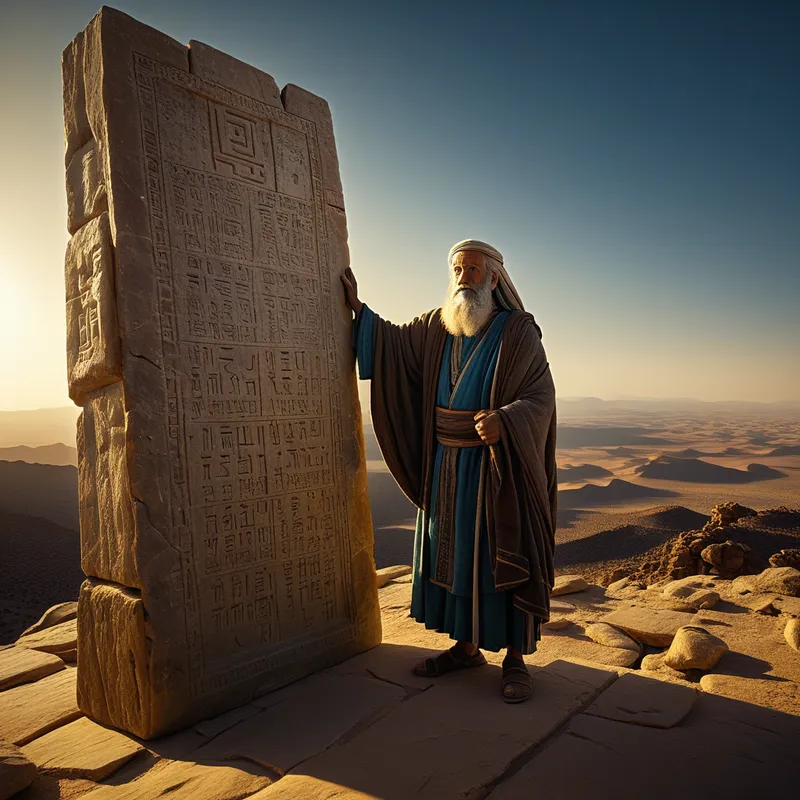
The air was thin and tasted of lightning. Below, in the valley of Shur, the people waited—a restless sea of tents and fear, recently escaped from the iron fist of [Pharaoh](/myths/pharaoh “Myth from Egyptian culture.”/). Above them, [Mount Sinai](/myths/mount-sinai “Myth from Biblical culture.”/) was a clenched fist of granite against [the sky](/myths/the-sky “Myth from Persian culture.”/), wreathed in a thick, churning cloud. Thunder was not a sound there, but a presence. The mountain itself trembled, and a fire that did not consume the rock burned at its summit. It was a boundary stone between [the world](/myths/the-world “Myth from Tarot culture.”/) of dust and the realm of the Unseen.
One man ascended. [Moses](/myths/moses “Myth from Biblical culture.”/), his staff in hand, his heart a drumbeat syncopated with dread and longing. For forty days and forty nights, he walked into the smoke, leaving behind the smell of man and goat, entering the fragrance of ozone and stone. He spoke with the I AM, whose voice was the shaping of worlds. And there, in that terrible intimacy, a covenant was forged. Not of gold or parchment, but of stone. With His own finger, the Divine inscribed upon two tablets of basalt the fundamental architecture of a holy people: ten words of boundary and blessing, of prohibition and promise. They were the bones of a new society, the rhythm for a [sacred heart](/myths/sacred-heart “Myth from Christian culture.”/).
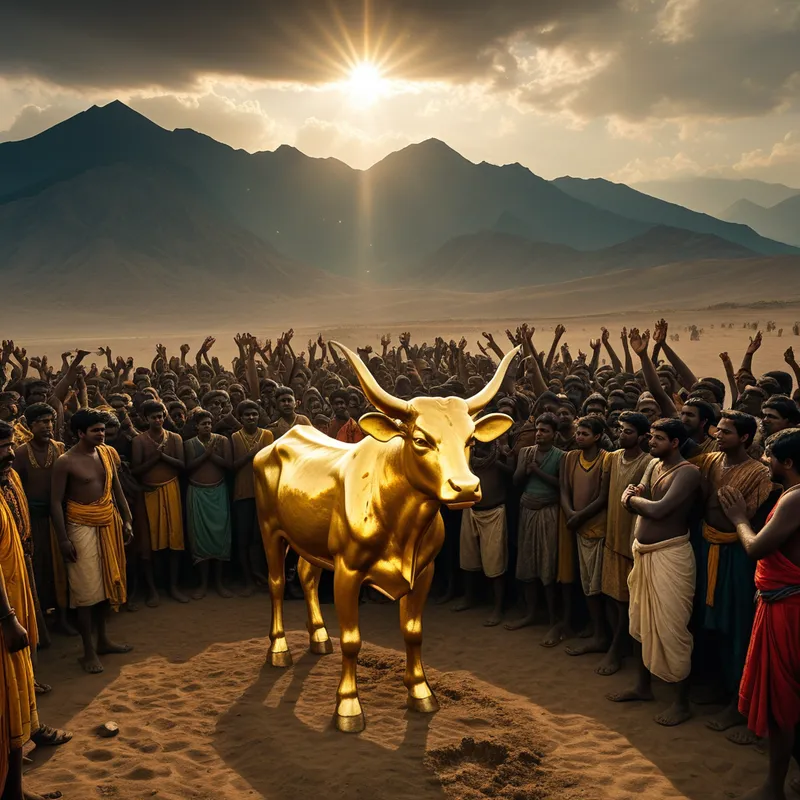
But the valley had forgotten the rhythm. Time stretched thin without their leader. Fear, that old serpent, coiled in their bellies. “Make us a god to go before us,” they cried to Aaron. Gold was melted, shaped, and behold—a calf of molten gold. The music they made was not of psalms, but of revelry. They gave their awe to a [thing](/myths/thing “Myth from Norse culture.”/) their own hands had made, trading the Unseen for the glittering, immediate, and dead.
On the mountain, the tablets grew heavy in Moses’s hands. The Voice spoke of the betrayal. In a fury of holy grief, Moses descended. The sight of the idolatrous feast struck him like a physical blow. The sacred stones in his hands became mirrors of the people’s shattered faith. With a cry that came from the depths of the covenant itself, he hurled the tablets at the foot of the mountain. They shattered—a sound like the world cracking.
Silence followed. Then, the long, hard work of penitence. The golden dust was ground, mixed with [water](/myths/water “Myth from Chinese culture.”/), and drunk—a bitter sacrament of consequence. After pleads and purges, Moses ascended again, alone, with two new, blank stones hewn by his own hand. And once more, the Finger wrote. The words were the same, but everything was different. The first law was given; the second law was earned. He returned, his face shining with a reflected light so fierce he had to veil it, bearing the restored covenant—not born of pristine glory, but forged in the fires of failure and fierce, costly grace.
Cultural Origins & Context
This narrative is the axial myth of the Torah, found primarily in the books of Exodus and Deuteronomy. It functions as the foundational constitutional drama for the nation of Israel. Historically situated in the context of Late Bronze Age nomadic and semi-nomadic societies, the story served to distinguish the Israelite identity radically from the surrounding polytheistic cultures of Canaan and Egypt. Their god was not a statue to be manipulated, but a voice to be obeyed; their society was not organized around a king’s decree alone, but around a transcendent, written moral law.
The story was preserved and transmitted by priestly and Levitical scribes, likely during the monarchy and especially after the Babylonian Exile, a period of profound national trauma where the question of broken covenants and divine law was existential. It was told during pilgrimage festivals and read in synagogues, not merely as history, but as an ever-present template for the relationship between the divine and the communal. Its societal function was multifaceted: it established the supreme authority of the Decalogue, explained the origin of the Ark of the Covenant, and provided a potent narrative for understanding national failure, repentance, and the possibility of renewal.
Symbolic Architecture
The tablets are far more than ancient law codes; they are the symbolic infrastructure of a conscious [soul](/symbols/soul “Symbol: The soul represents the essence of a person, encompassing their spirit, identity, and connection to the universe.”/). The [mountain](/symbols/mountain “Symbol: Mountains often symbolize challenges, aspirations, and the journey toward self-discovery and enlightenment.”/) represents the terrifying but necessary [ascent](/symbols/ascent “Symbol: Symbolizes upward movement, progress, spiritual elevation, or striving toward higher goals, often representing personal growth or transcendence.”/) toward the ultimate, the encounter with the numinous that demands everything. The fire and cloud signify the simultaneous [revelation](/symbols/revelation “Symbol: A sudden, profound disclosure of truth or insight, often through artistic or musical means, that transforms understanding.”/) and concealment of the divine—knowable in its effects, ultimately mysterious in its essence.
The first tablets, divinely hewn, represent the ideal, the perfect pattern fallen from heaven. They are the archetypal law of the Self, pristine and whole.
Their shattering is not a tragedy but a profound psychological necessity. It symbolizes the inevitable [collision](/symbols/collision “Symbol: A sudden, forceful impact between objects or forces, often representing conflict, unexpected change, or the meeting of opposing elements in life.”/) between the perfect, absolute demand of the inner [truth](/symbols/truth “Symbol: Truth represents authenticity, honesty, and the quest for knowledge beyond mere appearances.”/) ([the Self](/myths/the-self “Myth from Jungian culture.”/)) and the flawed, fearful, idol-making [reality](/symbols/reality “Symbol: Reality signifies the state of existence and perception, often reflecting one’s understanding of truth and life experiences.”/) of [the ego](/myths/the-ego “Myth from Jungian culture.”/) and the collective. The [golden calf](/myths/golden-calf “Myth from Biblical culture.”/) is the ultimate [symbol](/symbols/symbol “Symbol: A symbol can represent an idea, concept, or belief, serving as a powerful tool for communication and understanding.”/) of [the ego](/myths/the-ego “Myth from Jungian culture.”/)’s preference for the tangible idol—be it addiction, dogma, nationalism, or materialism—over the demanding, invisible [relationship](/symbols/relationship “Symbol: A representation of connections we have with others in our lives, often reflecting our emotional state.”/) with the deeper Self.
The second tablets, cut by [human](/symbols/human “Symbol: The symbol of a human represents individuality, complexity of emotions, and social relationships.”/) hands but inscribed again by God, are the core of the myth’s genius. They represent the earned [structure](/symbols/structure “Symbol: Structure in dreams often symbolizes stability, organization, and the framework of one’s life, reflecting how one perceives their environment and personal life.”/). [The law](/symbols/the-law “Symbol: Represents external rules, societal order, moral boundaries, and the tension between personal freedom and collective structure.”/) is no longer external and imposed in [innocence](/symbols/innocence “Symbol: A state of purity, naivety, and freedom from guilt or corruption, often associated with childhood and moral simplicity.”/); it is internalized through the experience of failure, [remorse](/symbols/remorse “Symbol: A deep emotional regret for past actions, often tied to moral or ethical failure, signaling a desire for atonement or reconciliation.”/), and the hard labor of making oneself ready to receive it again. This is the move from a morality of obedience to an ethic of [integration](/symbols/integration “Symbol: The process of unifying disparate parts of the self or experience into a cohesive whole, often representing psychological wholeness or resolution of internal conflict.”/).
The Dreamer’s Resonance
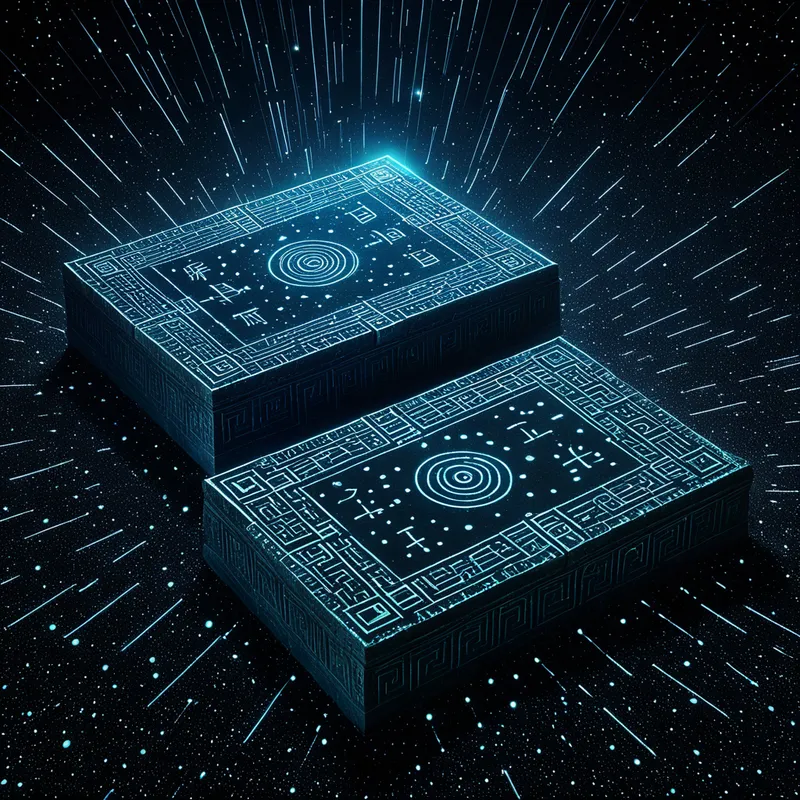
When this myth stirs in the modern dreamscape, it often signals a critical phase in the dreamer’s relationship with their own inner authority and moral compass. Dreaming of receiving tablets or sacred texts points to a moment of profound inner revelation, where a core, non-negotiable truth about one’s life path is being delivered. There is often a feeling of awe, burden, and solemn responsibility.
Dreams of shattering tablets, or of being unable to read the writing upon them, speak directly to a crisis of integrity. The dreamer may feel they have betrayed a deep personal value or life calling for a “golden calf”—a seductive but soul-empty pursuit of money, status, or pleasure. The somatic feeling is often one of fragmentation, guilt, or a heavy, crumbling weight in the chest.
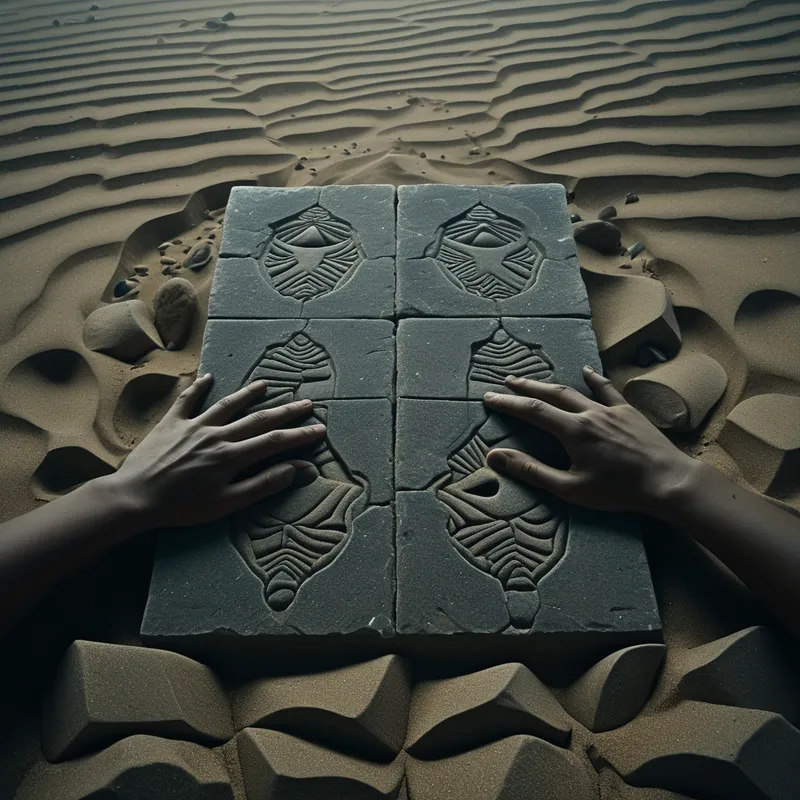
Conversely, dreaming of painstakingly gathering broken stone fragments, or of rewriting faded letters, indicates the [psyche](/myths/psyche “Myth from Greek culture.”/) is in the penitential, integrative phase. It is the hard, unglamorous work of shadow-work: acknowledging the idolatry, drinking the bitter water of consequence, and preparing the raw, human material (the self-hewn stone) for a renewed, more conscious covenant.
Alchemical Translation
The alchemical journey modeled here is the opus contra naturam—the work against one’s own lower, unconscious nature. The [prima materia](/myths/prima-materia “Myth from Alchemical culture.”/) is the chaotic, newly-liberated but childish collective ([the Israelites in the desert](/myths/the-israelites-in-the-desert “Myth from Abrahamic culture.”/), analogous to the ego-consciousness freed from an oppressive complex, like “Egypt”). The goal is the [lapis philosophorum](/myths/lapis-philosophorum “Myth from Alchemical culture.”/), the philosopher’s stone—symbolized by the perfected, enduring tablets housed in the Ark, the integrated Self.
The first ascent is the [nigredo](/myths/nigredo “Myth from Alchemical culture.”/), the blackening. It is the confrontation with the divine shadow, the terrifying purity of [the law](/myths/the-law “Myth from Biblical culture.”/) that annihilates all compromise. The creation of the calf is the inevitable regression, the psyche’s revolt and fall back into unconscious identification. The shattering is the crucial mortificatio, the death of the naive identification with the perfect ideal. The ego’s illusion that it can perfectly embody the Self’s law is broken.
The grinding of the calf into dust and its bitter ingestion is the putrefactio—the dissolution of the inflated complex into conscious, if painful, awareness. One must assimilate one’s own idolatry.
The second ascent is the albedo, the whitening. Moses, with his human-made stones, represents the ego now in service to the Self, no longer in naive identification with it. The re-inscription is the coniunctio, [the sacred marriage](/myths/the-sacred-marriage “Myth from Various culture.”/) where the divine pattern is impressed upon the prepared human vessel. The final state is not the pristine, untouched tablet, but the veiled, shining face of Moses—the integrated individual who carries the living law within, a law tempered by the experience of its own breaking, radiating a transformed consciousness that must sometimes be mediated for the world. The covenant is no longer an external contract, but the living architecture of an individuated soul.
Associated Symbols
Explore related symbols from the CaleaDream lexicon: