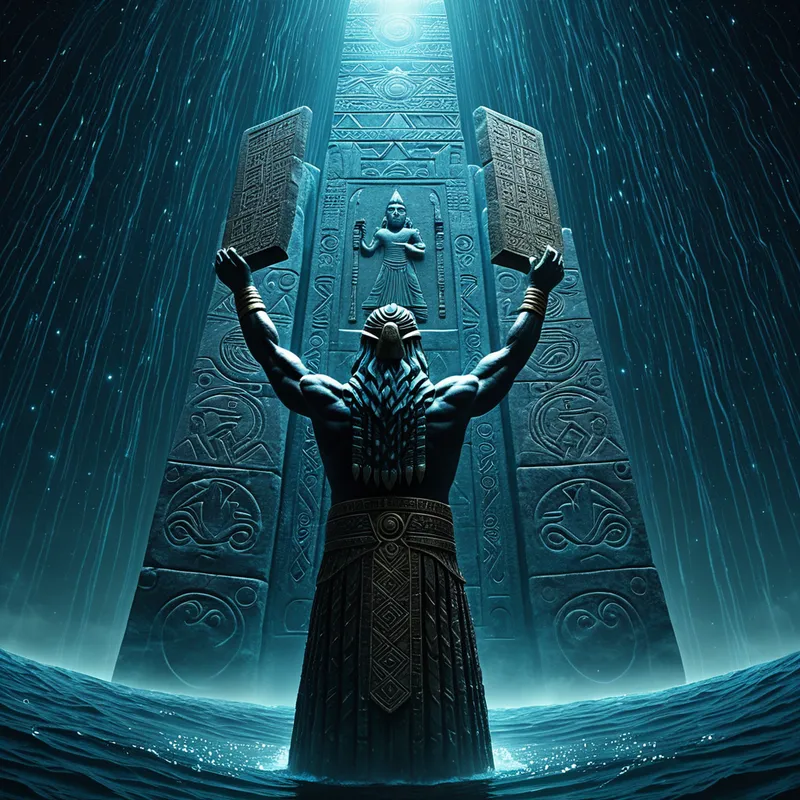
Tablets of Destiny Myth Meaning & Symbolism
A myth of cosmic rebellion where the god Enki outwits the monstrous Tiamat to secure the divine decrees that govern fate.
The Tale of the Tablets of Destiny
Listen, and hear the tale from before time had a name. In the beginning, there was only the Apsu, the sweet waters, and Tiamat, the salt waters. They mingled, and from their union sprang the first gods. But the noise and motion of these young deities was a torment to Apsu, who plotted their quietus. The wise Enki, hearing of this, acted first. He cast a deep sleep upon Apsu, subdued him, and upon his stilled form, built his own shining abode.
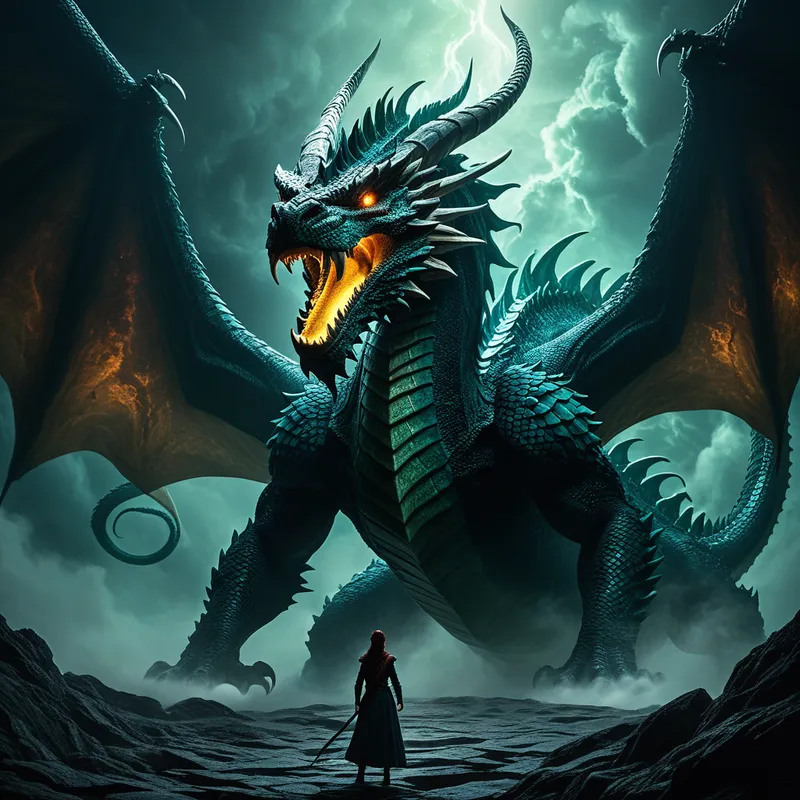
Yet this act of ordering the deep unleashed a greater terror. Tiamat, the mother of all, raged at the binding of her consort. She gave birth to a host of monstrous serpents, sharp-toothed dragons, and scorpion-men—an army of chaos itself. To lead them, she appointed Kingu, her new mate, and placed upon his breast the ultimate prize: the Tablets of Destiny.
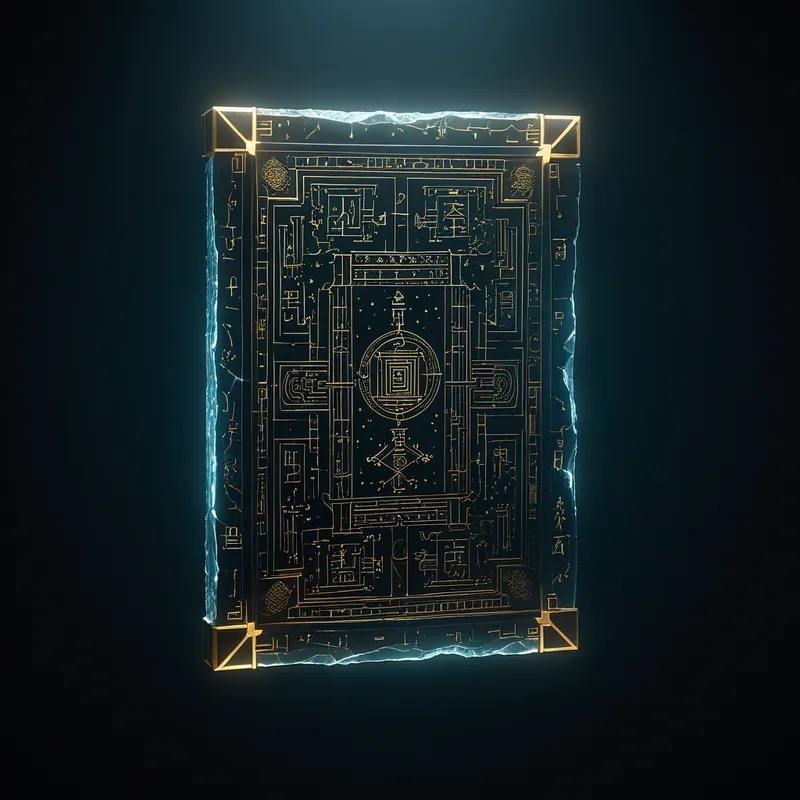
These were no mere stone slabs. They were the luminous, living decrees of the universe. To hold them was to command the fates of all things, to have one’s word become the law of stars and seasons. With them, Kingu and Tiamat were invincible. The younger gods trembled, hiding from the approaching storm of primordial fury.
One by one, the great gods were called to face the dragon, and one by one, they turned back, their courage melting like wax before the fire of her roar. The cosmos teetered on the brink of unmaking. Then, from the council of the fearful, Marduk stepped forward. He agreed to confront Tiamat, but on one condition: if he prevailed, supreme authority must be his. The desperate gods agreed.
Armed with the four winds, a net, and an invincible spear, Marduk rode his storm-chariot into the void. He challenged Tiamat, and as she opened her maw to swallow him, he drove the winds into her belly, distending her. He loosed an arrow that split her heart, and her monstrous light was extinguished. From her halved body, he fashioned the heavens and the earth.
Victorious, Marduk turned to Kingu. He bound the usurper, tore the Tablets of Destiny from his breast, and sealed them with his own seal. He presented them not to himself in arrogance, but to the wise Enki, the one whose initial act of ordering had set this great drama in motion. In Enki’s care, the Tablets would be used to establish the laws of the cosmos, the rhythms of nature, and the destinies of gods and humans. Order was secured, not by brute force alone, but by the rightful stewardship of sacred knowledge.
Cultural Origins & Context
This epic, known to us primarily from the later Enuma Elish, is a foundational text of Mesopotamian civilization. While its most complete version is Babylonian, its heart beats with Sumerian themes of cosmic order (me) versus chaos. It was recited during the Akitu festival, a ritual re-enactment of this cosmic victory that served to legitimize the king’s rule—the human steward of divine order—and to ensure the fertility and stability of the land for the coming year.
The story functioned as a societal anchor. It explained the world’s structure: why the sky is separate from the earth, why seasons change, and why kingship exists. It was a divine charter for civilization itself, asserting that the world we inhabit is the result of a hard-won victory over the ever-present threat of dissolution. The priestly reciters were not merely storytellers; they were technicians of the sacred, performing a necessary act of cosmic maintenance through the power of the spoken myth.
Symbolic Architecture
At its core, the myth maps the psyche’s struggle to emerge from undifferentiated, unconscious existence into conscious, ordered selfhood. Tiamat represents the primal, creative, yet potentially devouring womb of the unconscious—the source of all life and all terror. The Tablets of Destiny symbolize the latent code of the Self, the intrinsic pattern and potential authority that lies within this chaos.
The Tablets are not created; they are discovered. They are the pre-existing law of one’s own being, waiting to be claimed from the grip of unconscious complexes.
Kingu, wearing the Tablets, is the shadowy usurper—the inflated ego or a powerful complex that claims the authority of the Self for its own chaotic ends. Marduk represents the focused force of consciousness, the heroic ego capable of facing the terrifying depths. His victory, however, is incomplete without the final act: the transfer of the Tablets to Enki, god of wisdom, magic, and the fresh waters of the deep mind. This signifies that raw power (Marduk) must be wedded to deep knowing (Enki) for true sovereignty.
The Dreamer’s Resonance
When this myth stirs in the modern dreamer, it often manifests as a profound struggle for personal authority. You may dream of a powerful, chaotic figure (a boss, a parent, a monster) who possesses a crucial document, key, or tool that rightfully belongs to you. There is a somatic sense of constriction, of being ruled by an external or internal force that dictates your “fate.”
The dream may feature floods, storms, or chaotic battles—the psychic landscape of Tiamat. The process underway is the differentiation of the ego from the overwhelming power of unconscious contents. The dreamer is the council of gods, afraid and fragmented, mustering the courage to empower a single, decisive aspect of themselves (Marduk) to confront the chaos. The climax is not merely defeat of the monster, but the retrieval of the sacred object—the claim to one’s own intrinsic law.

Alchemical Translation
The myth’s arc is a perfect map for the Jungian process of individuation. We begin in the prima materia of the unconscious, identified with its rhythms and storms (Tiamat). A crisis emerges when a complex (Kingu) seizes control of our life’s narrative, wearing the mask of our destiny. We feel fated, trapped, living a script not our own.
Individuation is the rebellion of the latent Self against the tyranny of the false ruler within.
The heroic stage is the conscious engagement: gathering our resources (the four winds of intellect, feeling, sensation, intuition), we confront the overwhelming mother-complex or shadow. This is a terrifying, necessary inflation. We “slay” the devouring aspect of the unconscious to create space—the coincidentia oppositorum where heaven (consciousness) and earth (the body/unconscious) are separated yet related.
The final, crucial transmutation is the conjunctio: the marriage of the victor’s power with the deep wisdom of the Enki principle. We do not keep the Tablets of Destiny for egoic glory. We surrender them to the deeper, wiser Self. Our conscious will aligns with our intrinsic pattern. We no longer follow a fate imposed from without (or from a unconscious complex within); we enact a destiny that is authentically, sovereignly our own. The chaos is not destroyed, but ordered; the power is not possessed, but stewarded. We become, at last, the faithful scribe of our own soul’s decrees.
Associated Symbols
Explore related symbols from the CaleaDream lexicon: