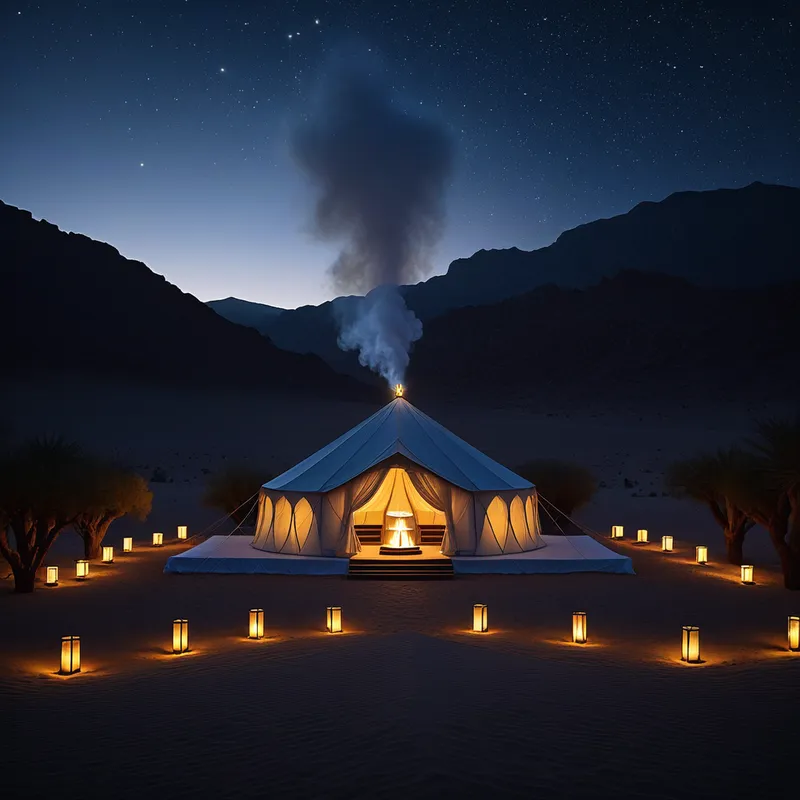
Tabernacle Myth Meaning & Symbolism
The story of a sacred, mobile dwelling built by wandering people to house the divine presence, a blueprint for the meeting of spirit and matter.
The Tale of Tabernacle
Listen. The story begins not in a city of stone, but in the breath of the desert, in the space between slavery and promise. A people, marked by the dust of escape and the memory of pillars of fire, camp at the foot of a trembling mountain. The air itself is charged, thick with the scent of ozone and awe. From the summit, shrouded in a cloud that is not a cloud—a darkness visible, a devouring fire—a voice speaks. It is not a sound that ears hear, but one that bones register, that the spirit translates into a terrifying, beautiful law: a covenant.
And within this covenant, a mystery is entrusted. The Unnameable One, who cannot be contained by the heavens, desires a dwelling. Not of fixed stone, but of skin and thread, of acacia wood and beaten gold. A traveling sanctuary. A tent for God.
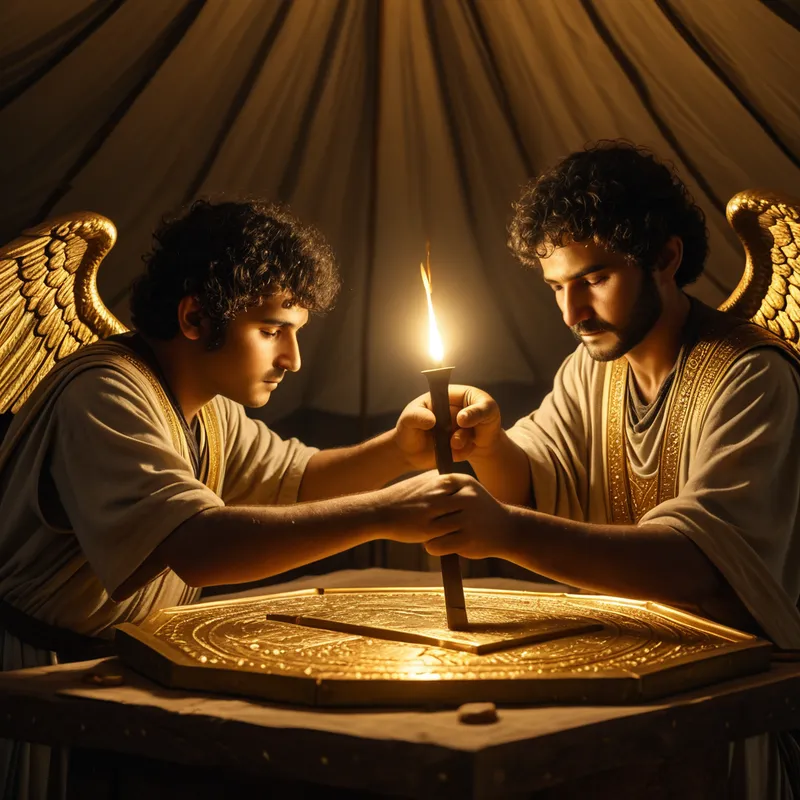
The call goes out to the heart of the skilled. Bezalel and Oholiab are summoned, their spirits stirred. The people, their hearts moved, bring offerings—not from obligation, but from a willing, overflowing spirit. Gold, silver, bronze; blue, purple, and scarlet yarn; fine linen and goat hair; ram skins dyed red, and the mysterious tahash skins; acacia wood, oil, spices, and precious stones. The wealth of Egypt, plundered in their exodus, is now poured out not for a pharaoh’s tomb, but for a living, moving home.
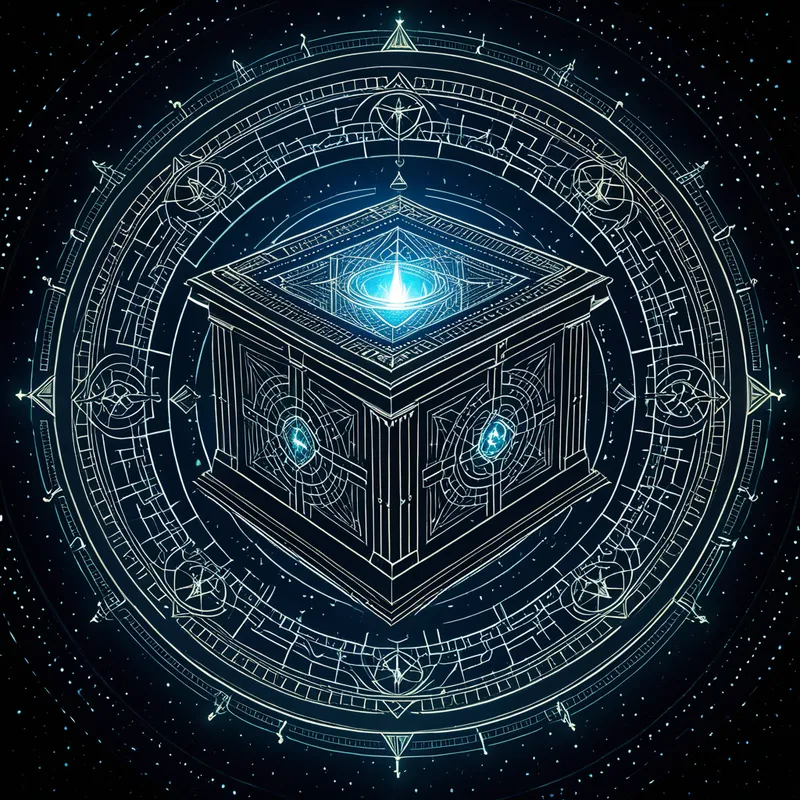
And so they build. From the outside in, from the profane to the most holy. A courtyard marked by linen curtains, with a bronze altar where fire forever consumes the offerings, a meeting place of surrender. Within that, a tent—the Mishkan—divided by a magnificent woven veil. The outer chamber, the Holy Place, holds the golden lampstand whose seven flames are never extinguished, the table for the bread of the Presence, and the altar of incense where prayers rise like smoke. Behind the veil, in perfect darkness, rests the inner sanctum, the Holy of Holies. Here sits the Ark of the Covenant, crowned by the Mercy Seat. And between the wings of the cherubim, a presence rests. A cloud by day, a fire by night. When the cloud lifts, the people break camp and follow. When it settles, they stop and build the sacred pattern anew. The divine is not anchored to a place, but to a pattern carried in the heart of a journeying people.
Cultural Origins & Context
This is not a myth of primordial time, but of historical formation. The narrative of the Tabernacle is central to the books of Exodus and Numbers, texts that scholars believe reached their final form during or after the Babylonian Exile. Its societal function was profound. For a people who had lost their temple and their land, the story of a portable sanctuary served as a powerful theological anchor: God’s presence was not dependent on a fixed political capital, but on the faithful observance of the covenant and its sacred patterns.
It was a myth told by priests and scribes, a detailed, ritual “blueprint” recited and studied. The exhaustive descriptions of measurements, materials, and procedures (chapters Exodus 25-31 and 35-40) functioned as a virtual temple, a textual sanctuary that could be built in the imagination when no physical one stood. It established a cosmic order in microcosm, mirroring the creation of the world itself, and provided the foundational logic for the later, permanent Temple in Jerusalem. It was the story of how a disparate group of former slaves became a holy nation, defined not by territory, but by a shared, mobile center of gravity.
Symbolic Architecture
The Tabernacle is a supreme symbol of the meeting point between transcendence and immanence, between the infinite and the particular. It is a map of consciousness itself.
The journey from the outer court to the Holy of Holies is the soul’s pilgrimage from external action to inner essence.
Each layer represents a stage of approach. The courtyard of sacrifice symbolizes the necessary offering of the ego, the raw, unrefined aspects of the self that must be acknowledged and transformed. The Holy Place, lit by human-tended lamps and bearing the bread of sustenance, represents the illuminated realm of the psyche—the home of intuition (the lampstand), nourishment (the bread), and directed prayer or aspiration (the incense). The veil is the final threshold, the boundary of the known self. Beyond it lies the Holy of Holies, the symbolic core of the Self in Jungian terms—the irreducible, mysterious center of the personality where the archetype of wholeness resides. The Ark within is the container of the foundational law (the tablets), the mystery of divine sustenance (the manna), and the authority of life (Aaron’s staff). It is the seat of the numinous, the “God-image” within the human structure.
The Dreamer’s Resonance
When this myth stirs in the modern unconscious, it often manifests as dreams of building, measuring, or discovering a sacred or meticulously ordered space within a chaotic environment. One might dream of carefully arranging rooms in a new house, constructing a complex model, or finding a hidden, perfectly preserved chamber behind a wall of their own home.
Somatically, this can correlate with a process of “getting one’s house in order”—a deep, often anxious need to create internal structure during a period of life transition, loss, or spiritual seeking. The psyche is attempting to build a container stable enough to hold a new, potentially overwhelming level of energy or awareness. The dream may highlight a specific “layer”: anxiety about a sacrifice (outer court), a focus on cultivating inner light or creativity (Holy Place), or a terrifying yet compelling call to cross a final threshold (the veil). The process is one of centering: establishing a reliable, sacred inner axis around which the whirl of identity and experience can coherently organize.
Alchemical Translation
The alchemical process mirrored in the Tabernacle myth is that of the vas, the sacred vessel. Individuation is not a formless merging, but a structured incarnation. The wandering in the desert represents the nigredo, the chaotic, stripped-down state after the collapse of old identities (the slavery in Egypt). The divine instructions are the emerging prima materia, the raw, numinous pattern for a new life.
The precise measurements and chosen materials signify the conscious, disciplined work of personality—taking the raw gifts, talents, and experiences (the offerings) and intentionally crafting them into a vessel fit for a purpose.
Building the Tabernacle is the labor of coagulatio: giving spirit a form. Each individual is both the builder and the temple. The ultimate goal is not to become divine, but to become a dwelling place where the transcendent function—the reconciling voice that emerges from the tension of opposites—can reside and guide one’s journey. The cloud that leads the people is that inner compass, the symbolic Self in motion. The myth teaches that wholeness is not a static achievement, but a dynamic, portable state of being. One carries the blueprint within, and in every new “camp” of life, the sacred pattern must be remembered and erected anew, creating a space where heaven can touch earth in the here and now of the soul’s desert.
Associated Symbols
Explore related symbols from the CaleaDream lexicon: