Sword of Damocles Myth Meaning & Symbolism
A courtier learns the true price of absolute power when he is forced to experience its constant, looming peril firsthand.
The Tale of Sword of Damocles
Let me tell you of a moment suspended in time, a single thread between bliss and oblivion. It happened not in the age of heroes, but in the courts of men, in the opulent, perfumed halls of Dionysius II. The air was thick with the scent of spiced wine and ambition. Here, amidst the glitter of gold and the murmur of flattery, lived a man named Damocles.
Damocles was a courtier, his life a tapestry woven with threads of envy and desire. His eyes, ever-watchful, drank in the splendor of the tyrant’s existence: the silken robes that whispered of power, the tables groaning under the weight of feasts from across the known world, [the chorus](/myths/the-chorus “Myth from Theater culture.”/) of voices that rose not in song, but in ceaseless praise for the man upon the throne. To Damocles, the life of Dionysius was not one of rule, but of pure, unadulterated fortune. He saw [the crown](/myths/the-crown “Myth from Various culture.”/), but not its weight; the scepter, but not the burden it represented.
One day, his flattery overflowing like wine from a cup, Damocles exclaimed to the tyrant of his unparalleled good luck, his divine favor. He spoke of the bliss of such absolute power. Dionysius, a man whose eyes held the deep, still knowledge of a thousand sleepless nights, listened. A shadow of a smile, devoid of warmth, touched his lips.
“If such a life seems so sweet to you, Damocles,” he said, his voice a low rumble, “would you care to taste of it?”
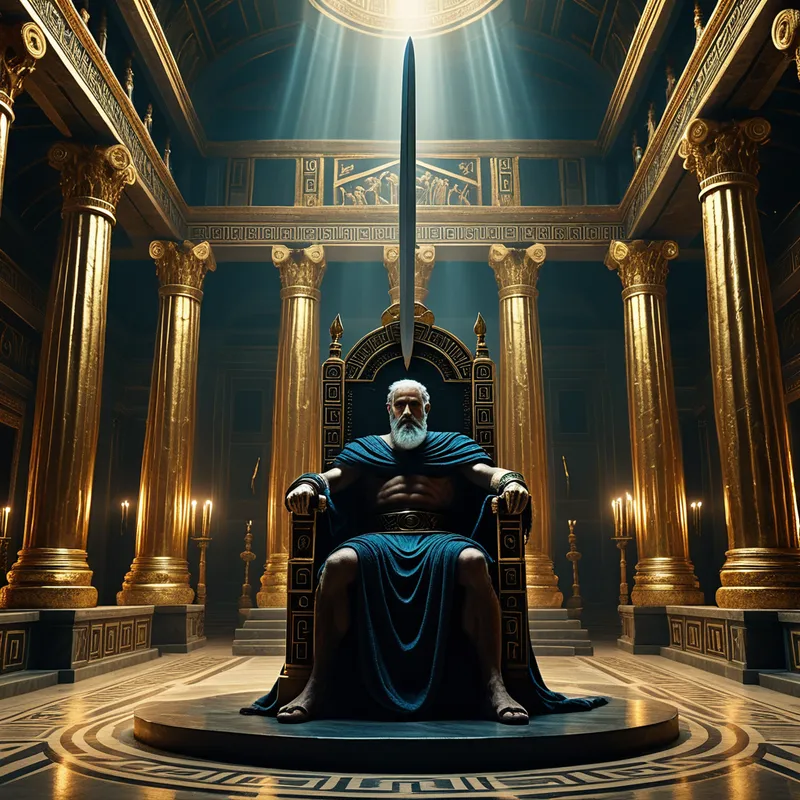
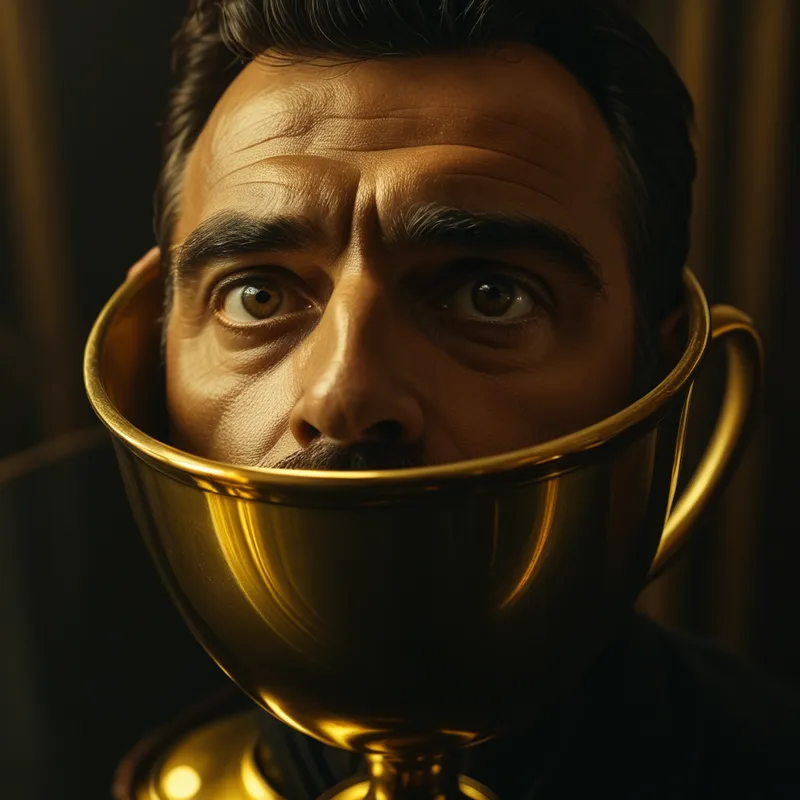
Before the courtier could stammer more than a breath of assent, he was ushered to the throne. The cushion, stuffed with the softest down, embraced him. A golden cup, cool and heavy, was placed in his hand. Musicians struck a chord. For a heartbeat, Damocles knew the dizzying summit of his dreams. He was king.
Then Dionysius gave a silent signal.
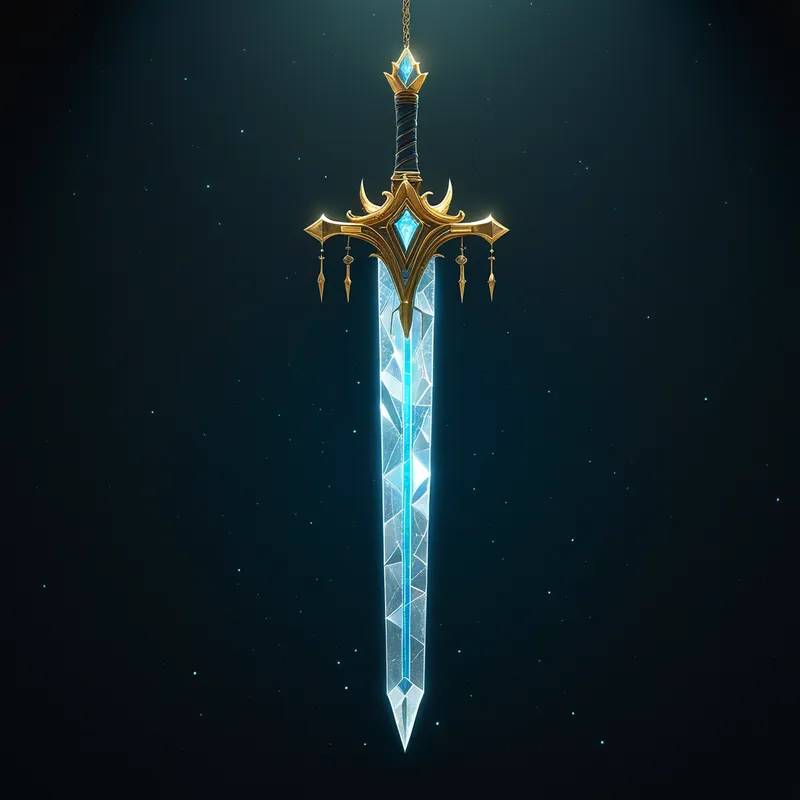
From the high, shadowed ceiling of the hall, a point of cold light caught Damocles’s eye. He looked up. His blood turned to ice. Directly above his head, suspended by a single, trembling horsehair, hung a massive sword. Its point, honed to a murderous sharpness, aimed unerringly at the crown of his skull. The music now sounded like a dirge. The taste of the wine was ash. Every laugh from the court was a potential vibration that could snap that fragile thread. The luxurious robe became a shroud. He sat in perfect, petrified stillness, understanding in his marrow that the slightest movement, the merest sigh, could bring the final, crushing verdict.
He could not eat. He could not drink. He could only stare upward, his neck aching, his soul shriveling under the gaze of that imminent ruin. The bliss of power had vanished, replaced by the pure, undiluted agony of its peril. Finally, with a whimper that broke the terrible silence, Damocles begged the tyrant to release him from his “good fortune.” He fled the throne, returning to his humble, anonymous life with a gratitude he had never known.
And Dionysius, reclaiming his seat beneath the ever-present sword, merely nodded. The lesson, silent and terrible, hung in the air long after Damocles had gone.
Cultural Origins & Context
This potent anecdote comes to us not from the epic poets, but from the Roman statesman and philosopher Cicero, who recorded it in his Tusculan Disputations in the 1st century BCE. Cicero used the tale as a philosophical parable, attributing it to earlier Greek sources now lost to time. Its setting in the court of Dionysius II of Syracuse (4th century BCE) grounds it in a historical context familiar to his audience—a time of tyrants, political intrigue, and the constant, real threat of assassination.
The myth functioned as a sophisticated piece of moral and political philosophy. It was a tool for teaching, a narrative capsule containing complex ideas about governance, happiness, and the human condition. In the Greek and later Roman worlds, where the line between a wise ruler and a paranoid tyrant was often perilously thin, the story served as a warning to both the powerful and those who envied them. It taught that with great privilege comes even greater peril, that the visibility of the ruler makes him the target of all unseen forces, and that true eudaimonia (flourishing) could never be found in a state of constant, existential threat. It was a story told in symposiums and schools, a cultural check against the naive allure of absolute power.
Symbolic Architecture
[The Sword of Damocles](/myths/the-sword-of-damocles “Myth from Judeo-Christian culture.”/) is not merely a [weapon](/symbols/weapon “Symbol: A weapon in dreams often symbolizes power, aggression, and the need for protection or defense.”/); it is the crystallized [symbol](/symbols/symbol “Symbol: A symbol can represent an idea, concept, or belief, serving as a powerful tool for communication and understanding.”/) of latent catastrophe. It represents the inevitable [shadow](/symbols/shadow “Symbol: The ‘shadow’ embodies the unconscious, repressed aspects of the self and often represents fears or hidden emotions.”/) side of any position of high visibility, [authority](/symbols/authority “Symbol: A symbol representing power structures, rules, and control, often reflecting one’s relationship with societal or personal governance.”/), or [fortune](/symbols/fortune “Symbol: Fortune symbolizes luck, wealth, and opportunities that may be present or sought in one’s life.”/). The sword is the [anxiety](/symbols/anxiety “Symbol: Anxiety in dreams reflects internal conflicts, fears of the unknown, or stress from waking life, often demonstrating the subconscious mind’s struggle for peace.”/) of the ruler, the fear of the wealthy, the hidden cost of success that is always present, even in moments of apparent [security](/symbols/security “Symbol: Security denotes safety, stability, and protection in one’s personal and emotional life.”/).
The throne is not a seat of rest, but the focal point where all lines of envy, ambition, and fate converge.
The single horsehair is the quintessential symbol of fragility and contingency. It speaks to the precarity of all [human](/symbols/human “Symbol: The symbol of a human represents individuality, complexity of emotions, and social relationships.”/) constructions—of power, of happiness, of [life](/symbols/life “Symbol: The symbol of ‘Life’ represents a journey of growth, interconnectedness, and existential meaning, encompassing both the joys and challenges that define human experience.”/) itself. Our most stable realities are suspended over an [abyss](/symbols/abyss “Symbol: A profound void representing the unconscious, the unknown, or a spiritual threshold between existence and non-existence.”/) by threads we dare not examine too closely. Dionysius, the ruler who lives with the sword, embodies the psychological state of integrated [awareness](/symbols/awareness “Symbol: Conscious perception of self, surroundings, or internal states. Often signifies awakening, insight, or heightened sensitivity.”/). He does not deny the peril; he has made a fraught [peace](/symbols/peace “Symbol: Peace represents a state of tranquility and harmony, both internally and externally, often reflecting a desire for resolution and serenity in one’s life.”/) with it, understanding it as the non-negotiable companion to his [station](/symbols/station “Symbol: Signifies a temporary stop, transition point, or a place of waiting in life’s journey.”/). Damocles, the envious courtier, represents the unconscious [psyche](/myths/psyche “Myth from Greek culture.”/) that desires the glow of the [crown](/symbols/crown “Symbol: A crown symbolizes authority, power, and achievement, often representing an individual’s aspirations, leadership, or societal role.”/) without comprehending the [weight](/symbols/weight “Symbol: Weight symbolizes burdens, responsibilities, and emotional loads one carries in life.”/) of [the shadow](/myths/the-shadow “Myth from Jungian culture.”/) it casts.
The Dreamer’s Resonance
When this myth pattern emerges in modern dreams, it rarely manifests as a literal sword and throne. The dreamer’s psyche is translating an inner state of suspended anxiety. One may dream of a precarious, towering stack of responsibilities at work, threatening to topple. A new parent might dream of their infant’s crib suspended over a void. An artist before a premiere might dream of a chandelier held by a fraying wire above a silent audience.
The somatic experience is one of hyper-vigilance and frozen tension—a neck perpetually cricked from looking up, a stomach in a permanent knot. Psychologically, the dreamer is confronting the burden of a role they have taken on or desired. The dream is an initiation, forcing a conscious recognition of the hidden costs, the relentless scrutiny, and the vulnerability that accompany any position of significance, be it professional, parental, or social. It asks the dreamer: Can you bear the gaze of the sword? Or must you, like Damocles, ask to be released from a fortune you are not yet strong enough to hold?

Alchemical Translation
The alchemical journey modeled here is the transmutation of naive desire into conscious responsibility—the lead of envy into the gold of wise sovereignty. The initial stage is the envy of Damocles, a [projection](/myths/projection “Myth from Alchemical culture.”/) of wholeness onto an external object (the throne). The invitation to sit upon it is the call to individuation, a forced encounter with the totality of a situation, its light and its shadow.
The agonizing period under the sword is the [nigredo](/myths/nigredo “Myth from Alchemical culture.”/), the blackening. It is the dissolution of the fantasy, the burning away of the illusion that power is pure pleasure. This is a necessary despair, [the dark night of the soul](/myths/the-dark-night-of-the-soul “Myth from Christian Mysticism culture.”/) where one realizes the price of the crown.
The psychic transmutation occurs not when the sword is removed, but when one learns to breathe beneath its point.
The resolution is not Damocles’s flight, but the potential integration represented by Dionysius. The alchemical goal is to become the ruler who can occupy the throne with full awareness of the suspended sword, not in paralyzing fear, but in sober, clear-eyed acknowledgment. It is to integrate the threat into one’s consciousness, to carry the weight of responsibility without being crushed by the anxiety of peril. The modern individual undergoes this process each time they step into a role of leadership, embrace a hard-won success, or accept the visibility that comes with authenticity. The myth teaches that true power is not the absence of the sword, but the fortitude to create meaning and take action despite its ever-present whisper.
Associated Symbols
Explore related symbols from the CaleaDream lexicon: