
Swiss Army Knife Myth Meaning & Symbolism
A mythic artisan sacrifices his singular identity to become the first multi-tool, embodying the soul's capacity for adaptation and integrated purpose.
The Tale of the Swiss Army Knife
Listen, and hear the tale that is not told of metal, but of spirit. It begins not in a factory, but in the high, silent cradle of the Alps, where the air is thin with truth and the stones remember every prayer.
There was an artisan, Lauscher am Stein. His skill was not in making many things, but in making the one right [thing](/myths/thing “Myth from Norse culture.”/). A farmer needed a ploughshare that would sing through the stubborn earth? Lauscher would forge one that lasted a lifetime. A shepherd required a blade to protect the flock? From his hands came a knife so balanced it felt like an extension of the arm itself. Yet, for all his mastery, a deep melancholy clung to him like forge-smoke. He saw the people of the valleys struggling, burdened by heavy packs filled with a dozen specialized tools for a dozen separate tasks. The woodcarver’s chisel was useless to the clockmaker; the fisherman’s hook was a mockery to the farmer. Each tool was a world unto itself, and these worlds did not speak.
One night, under a moon that looked like a silver coin stamped on the black velvet of [the sky](/myths/the-sky “Myth from Persian culture.”/), the mountain spirit Der Alte Fels spoke to him not in words, but in the groaning of glaciers and the sigh of the pines. The spirit presented a vision: a single, compact form that contained the essence of many functions—a unity of purpose. But the cost was the artisan’s own singular, legendary identity.
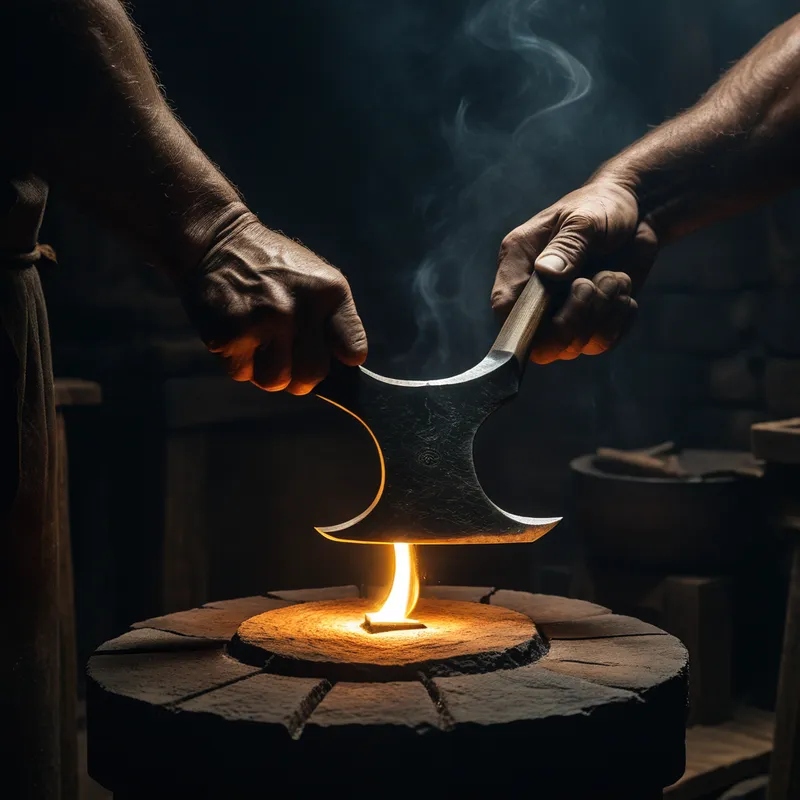
Torn, Lauscher descended to his forge. For seven days and seven nights, he worked, not with iron alone, but with his own essence. He did not simply forge the tools; he dreamed them into a cohesive whole. The final night, as the vision neared completion—a beautiful, compact object of red handle and gleaming fittings—he faced [the abyss](/myths/the-abyss “Myth from Kabbalistic culture.”/). To give this creation true life, it could not merely be a thing he made. It had to become a thing he was. His famed identity as the maker of the singular, perfect object had to die.
With a cry that was part sorrow, part [triumph](/myths/triumph “Myth from Roman culture.”/), he thrust the nascent tool into the heart of the forge’s fire and then, in an act of ultimate craftsmanship, into his own chest. There was no death, but a blinding [transfiguration](/myths/transfiguration “Myth from Christian culture.”/). Lauscher am Stein, the man, was gone. In his place, upon the anvil, lay the first Vielwerkzeug—the “Many-Tool.” It was humble, elegant, and utterly complete. When the first villager picked it up, they did not see a mere object; they felt a presence, a willing adaptability. It was the spirit of the artisan, now liberated from a single form, ready to serve a thousand needs without ever losing its core integrity.
Cultural Origins & Context
This narrative exists in the oral traditions of Alpine craftsmen, woodcarvers, and watchmakers, passed down not as a formal folktale but as an allegorical “shop story.” It was told during long winter evenings in mountain huts or in the backrooms of guild workshops in Bern and Zurich. The teller was never a bard, but a senior master to their apprentices, often while repairing a well-used pocket tool.
Its societal function was profound. In a culture that venerates precision, self-reliance, and pragmatic innovation, the myth served as a sacred justification for the Swiss ethos of efficient, integrated design. It answered a spiritual question posed by burgeoning industrialization: Can utility be sacred? The myth says yes, but only if it is born from a sacrifice of egoistic specialization for the sake of holistic service. It transformed the pragmatic multi-tool from a mere convenience into a cultural totem, a symbol of the Swiss national character: compact, reliable, ingeniously prepared, and always ready to be of use.
Symbolic Architecture
At its core, the myth is not about a gadget, but about the [psychology](/symbols/psychology “Symbol: Psychology in dreams often represents the exploration of the self, the subconscious mind, and emotional conflicts.”/) of the integrated Self. Lauscher’s initial mastery represents a developed but isolated skill—a dominant function in the [psyche](/myths/psyche “Myth from Greek culture.”/) that is brilliant but alone. His [melancholy](/symbols/melancholy “Symbol: A deep, lingering sadness often associated with introspection and a sense of loss or longing.”/) is the [soul](/symbols/soul “Symbol: The soul represents the essence of a person, encompassing their spirit, identity, and connection to the universe.”/)’s yearning for wholeness.
The sacrifice of the singular identity is the prerequisite for achieving a functional unity. One must cease to be “only a blade” to become part of the handle that holds all blades.
The Vielwerkzeug is the ultimate [symbol](/symbols/symbol “Symbol: A symbol can represent an idea, concept, or belief, serving as a powerful tool for communication and understanding.”/) of the complex. It is a single, contained entity that holds a multiplicity of potentials in a state of dynamic latency. Each tool—[blade](/symbols/blade “Symbol: A sharp-edged tool or weapon symbolizing cutting action, separation, precision, or violence. It represents both creative power and destructive force.”/), awl, screwdriver—represents a different facet of the [personality](/symbols/personality “Symbol: Personality in dreams often symbolizes the traits and characteristics of the dreamer, reflecting how they perceive themselves and how they believe they are perceived by others.”/): the cutter (discernment), the piercer ([insight](/symbols/insight “Symbol: A sudden, deep understanding of a complex situation or truth, often arriving unexpectedly and illuminating hidden connections.”/)), the turner (adjustment). In their folded state, they are the unmanifested potentials of the unconscious. In their deployed state, they are conscious competencies brought to bear on [the world](/myths/the-world “Myth from Tarot culture.”/)’s tasks. The red handle is the enduring core [identity](/symbols/identity “Symbol: Identity represents the sense of self, encompassing personal beliefs, cultural background, and social roles.”/), the “I” that remains constant while its capacities adapt and extend.
The Dreamer’s Resonance
To dream of the Swiss Army Knife is to dream of psychic integration and preparedness. Common motifs include finding the tool in a moment of crisis, struggling to open a specific blade, or discovering the dream-knife has rusted shut or gained impossible, fantastical attachments.
The somatic feeling is often one of latent power or frustrating limitation in the hands. Dreaming of using it successfully signals the dreamer is effectively synthesizing different skills or aspects of themselves to navigate a life challenge. Dreaming of it being broken or stuck, however, points to a conflict between these inner capacities—perhaps the analytical “blade” is warring with the connective “screwdriver,” or the dreamer feels their potential is locked within them, unable to be deployed. The dream is an assessment of the psyche’s current “readiness for life,” asking: Are your inner tools sharp, organized, and accessible, or are they a jumbled, rusted burden?
Alchemical Translation
The myth perfectly models the alchemical process of Individuation. Lauscher begins in a state of specialized mastery (the conscious ego’s proud domain). The call from Der Alte Fels is [the Self](/myths/the-self “Myth from Jungian culture.”/), the archetype of wholeness, introducing the problem of multiplicity.
The seven-day forge work is the [nigredo](/myths/nigredo “Myth from Alchemical culture.”/), the dark work of confronting [the shadow](/myths/the-shadow “Myth from Jungian culture.”/)—all the unused, undeveloped, or rejected “tools” of one’s personality. Melting them down in the fire of conscious attention is painful but necessary.
The moment of transfiguration, where tool and maker become one, is the coniunctio oppositorum—the sacred marriage of the ego with the vast, multifaceted potential of the unconscious. The ego (Lauscher) does not die; it becomes the vessel.
The resulting Vielwerkzeug is the [lapis philosophorum](/myths/lapis-philosophorum “Myth from Alchemical culture.”/), the philosopher’s stone of the psyche. It is not a state of perfected, static being, but a state of dynamic, adaptable readiness. For the modern individual, the alchemical instruction is clear: we are not meant to be only one thing. Our journey is to gather our scattered skills, wounds, talents, and roles—our inner blades, saws, and toothpicks—and undertake the courageous work of integrating them into a resilient, adaptable, and ever-ready core Self. We must be willing to sacrifice [the ego](/myths/the-ego “Myth from Jungian culture.”/)’s attachment to a narrow, “perfect” identity to become something far more profound: a versatile, compassionate, and endlessly resourceful human being.
Associated Symbols
Explore related symbols from the CaleaDream lexicon: