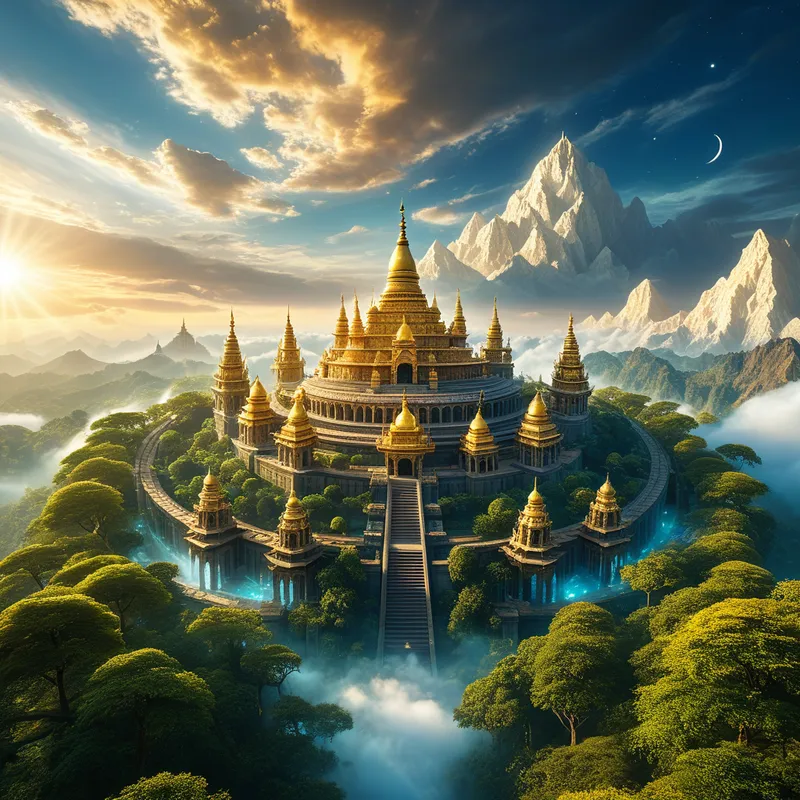
Swarga Loka Myth Meaning & Symbolism
The celestial realm of the gods, a paradise earned by righteous deeds, where pleasure is boundless but impermanent, challenging the soul's ultimate journey.
The Tale of Swarga Loka
Hear now of the realm that hangs between the zenith of the sun and the cradle of the stars. It is not a place for mortal feet, but for souls tempered in the fire of duty. This is Swarga Loka, the shining world, the reward woven into the very fabric of cosmic law.
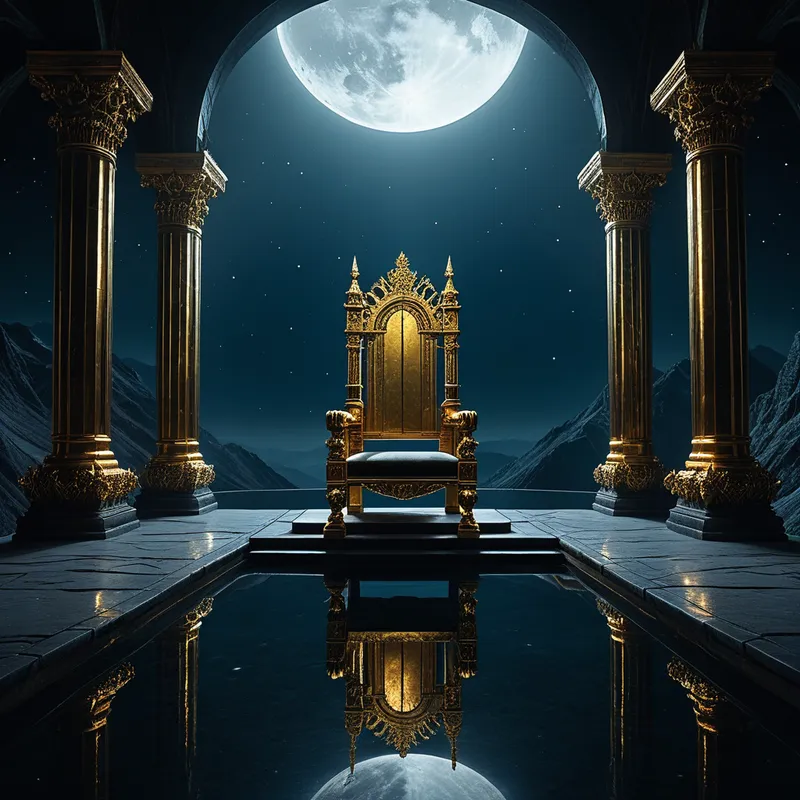
Its king is Indra, whose throne is the axis of the heavens. His court is a symphony of light and desire. Here, palaces are built not of stone, but of condensed joy, their spires piercing the soft underbelly of eternity. The air is thick with the perfume of Kalpavriksha, and the rivers flow with milk, honey, and amrita, the nectar of immortality. Celestial musicians, the Gandharvas, fill the eternal twilight with melodies that stir the memory of every bliss the soul has ever craved. The Apsaras dance—their movements are the visible form of perfect harmony, a promise that pleasure need never end.
But this realm is not merely given; it is earned. The gates of Swarga are guarded by the stern ledger of Karma. Only those whose earthly lives were a tapestry of righteous action, of Dharma faithfully upheld, may cross its threshold. The hero who sacrificed all for honor, the sage who meditated until his breath became mantra, the householder who gave his last grain to a guest—their accumulated merit becomes their passport. They arrive, their mortal weariness washed away, to be greeted as honored guests. They taste the fruits, they revel in the sights, they are restored.
Yet, woven into the gold of every cup and the silk of every couch is a single, immutable thread: a deadline. The merit that bought this ticket is a currency that spends. When the last coin of virtue is exchanged for the last drop of celestial wine, a subtle change stirs the perfumed air. The music, once enchanting, begins to sound distant. The face of the Apsara, once captivating, reveals a timeless, impersonal beauty. A quiet knowing descends upon the blessed soul. This paradise, for all its splendor, is a station, not a destination. The very perfection becomes a mirror, and in it, the soul sees not its end, but its unfinished journey. And so, with a sigh that is neither sorrow nor regret, but the acknowledgment of a deeper law, the soul takes leave. The golden gates close behind, and the cycle turns anew. The return to the mortal world is not a fall, but the next necessary step in an odyssey far greater than any single heaven.

Cultural Origins & Context
The myth of Swarga Loka is not a singular story but a pervasive cosmological setting, its details woven throughout the vast tapestry of Hindu scripture—from the ritual hymns of the Vedas to the epic narratives of the Itihasas and the illustrative tales of the Puranas. It functioned as the ultimate societal “promised land,” a narrative anchor for the Vedic and later classical worldviews.
Its primary tellers were the priests (Brahmins) and the itinerant bards (Sutas), who used its imagery to reinforce the dharmic social order. In a culture deeply concerned with right action (karma) and duty (dharma), Swarga Loka served as the cosmic incentive structure. It answered the fundamental human question: “Why be good, especially when evil seems to prosper?” The answer was clear, tangible, and magnificent. It provided hope and a framework for justice that transcended the often-harsh realities of earthly life. Furthermore, it established a hierarchy of realities. Earth (Bhuloka) was the field of action; Swarga was the temporary reward; and beyond both lay the possibility of liberation (Moksha). Thus, the myth served a dual function: it validated righteous living while simultaneously pointing beyond its own rewards, seeding the philosophical idea that even heaven is part of the cycle of birth and death (Samsara).
Symbolic Architecture
Psychologically, Swarga Loka is not merely a paradise; it is the archetypal image of the conscious ego’s ideal state. It represents the pinnacle of worldly success, the fulfillment of all personal desires, the achievement of social status, and the enjoyment of hard-won psychological comforts. It is the “kingdom” the ego builds when it follows the rules perfectly.
Swarga is the soul’s most beautiful prison, its walls made of fulfilled desires and its lock fashioned from the fear of what lies beyond satisfaction.
The king, Indra, symbolizes the ruling consciousness—powerful, celebratory, but also notoriously insecure and subject to pride (as many myths of his conflicts with sages illustrate). The Apsaras and Gandharvas represent the enchanting but ultimately transient pleasures and talents that distract and entertain the psyche. The Airavata and the wish-fulfilling trees are symbols of abundance without effort. The entire realm is a perfected state of extroversion, where all value is found in external objects, experiences, and validation.
The critical, transformative symbol is the spent merit. This represents the inherent limitation of the ego’s project. Personal achievement, social acclaim, and sensory pleasure have a psychic half-life. They satiate but do not fulfill. The soul’s departure from Swarga is the necessary, if often painful, moment when the conscious personality realizes that its greatest triumphs are not the end of its story. This is the birth of spiritual hunger, the intuition that there is a state of being (Brahman) that exists beyond the polarity of pleasure and pain, reward and punishment.
The Dreamer’s Resonance
When the imagery of Swarga Loka arises in modern dreams, it rarely appears as a literal heavenly city. Instead, it manifests as the feeling-tone of having “arrived.” This could be a dream of receiving a prestigious award to universal applause, of living in a flawless, luxurious home, or of being adored and served in a perfect social setting. The initial somatic experience is one of expansion, lightness, and profound gratification.
However, if this is a transformative dream and not merely a wish-fulfillment fantasy, a subtle shift will occur. The applause may become hollow, echoing in a vast hall. the perfect home may feel eerily empty or sterile. The adoration may feel impersonal, as if directed at a mask. This is the dream-ego experiencing the “spent merit.” The psyche is signaling that a phase of life built on a particular set of achievements or external validations has reached its natural conclusion. The dreamer may wake with a curious mixture of satisfaction and restless longing—a “divine discontent.” This is the soul’s innate wisdom pushing beyond the comfort of the known paradise, urging a descent or a new ascent for the sake of deeper, more authentic integration.
Alchemical Translation
The journey to and from Swarga Loka is a masterful allegory for a critical phase in the individuation process: the confrontation with the success of the persona. The first alchemical stage is the ascent: the individual, through discipline and adherence to societal and internal codes (dharma), builds a successful, admirable personality. They “earn their heaven” in the eyes of the world and their own superego. This is a necessary and noble achievement—the creation of a competent, ethical ego.
The crucial alchemical operation, however, is the voluntary departure. This is the dissolution of the identification with that very success. It is the moment the CEO questions the meaning of the corner office, the artist grows bored of their own acclaimed style, or the philanthropist feels empty despite the gratitude. This is not ingratitude, but the call of the Self.
The true alchemy begins not in the pursuit of heaven, but in the conscious choice to leave its gardens. There, one exchanges the gold of social reward for the leaden, fertile soil of the unexplored self.
This departure models psychic transmutation. The soul trades the known perfection of Swarga for the unknown potential of further journeying (whether back to earthly life or toward moksha in the myth). Psychologically, this means de-integrating the persona to engage with the shadow, the anima/animus, and other archetypal contents that were excluded in the single-minded pursuit of the “heavenly” ideal. The reward is no longer pleasure, but meaning; no longer stability, but authenticity; no longer the rulership of a celestial city, but the humble sovereignty of an integrated Self that contains both heaven and earth, pleasure and void, in its boundless embrace. The myth teaches that our highest achievements are not final destinations, but sacred thresholds.
Associated Symbols
Explore related symbols from the CaleaDream lexicon: