Svarog Myth Meaning & Symbolism
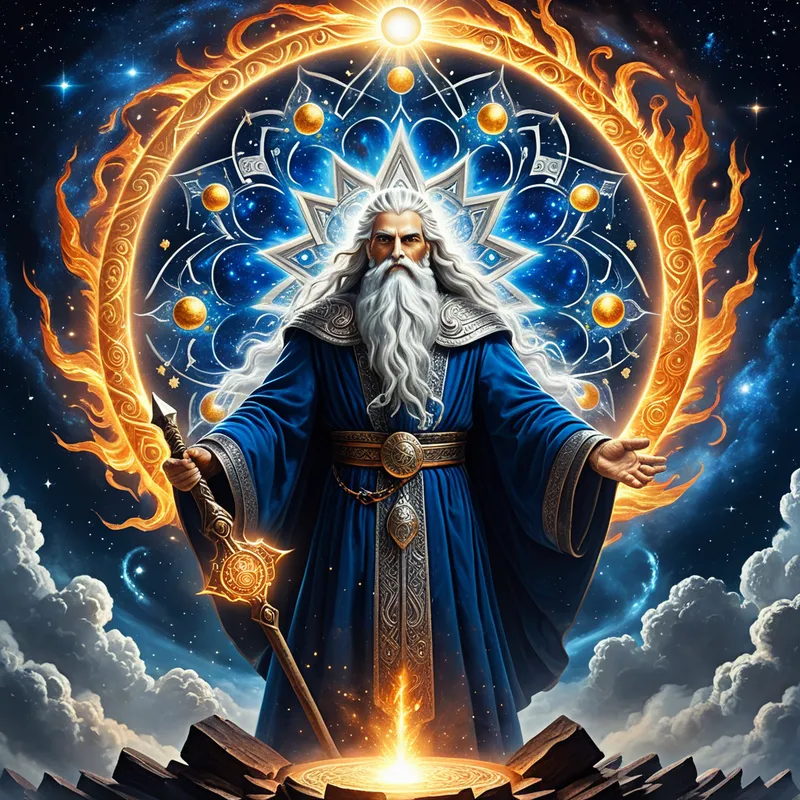
The myth of the celestial smith who forges the sun and cosmic laws, embodying the primal act of creation from chaos into sacred order.
The Tale of Svarog
Listen, and hear the tale of the First Forging.
In the beginning, there was only Chaos—a churning, dark, and formless sea. From its depths, a presence stirred. Not born, but simply being. This was Svarog. He opened his eyes, and the first thought was a spark in the endless dark. He breathed, and the breath became a wind that began to separate the heavy from the light.
But to see, he needed light. So Svarog reached into the heart of the primordial Fire that slept within Chaos. With hands that could hold mountains, he gathered the searing essence. He needed an anvil, so he took the densest core of potentiality and sang to it until it became solid and true—the First Stone. He needed a hammer, so he took the sound of his own will, the clang of purpose, and gave it weight.
Then began the labor of the ages. In the vast, silent forge of the void, Svarog raised his hammer. The first strike was a thunderclap that echoed forever. Sparks flew from the anvil, and where they landed, the first stars flickered to life. He worked the celestial metal, folding and beating, quenching it in the waters of potential. With each blow, the universe gained definition. The heavens were hammered into a great, vaulted dome—the Svarga.
His greatest work remained. From the purest ore, he forged a disk of such brilliant, living fire that it could not be held in one place. He set it in a golden chariot and commanded it to ride across the dome of Svarga, bringing day and measuring time. This was the Dazhbog, the Giving God, born from the forge.
But a world of light and dark, of sky and void, was a world of lawlessness. So Svarog, the smith, became Svarog, the law-giver. He took the heat of the forge and the strength of the anvil and from them forged not metal, but principles. He forged the law of the harvest, the law of the hearth, the law of kinship and honor. He dropped these laws down to the nascent Earth below, where they took root like iron seeds. His work was the establishment of Pravda—the sacred order—from the raw Krivda of the beginning.
Having set the cosmos in motion and given it law, Svarog retired to the highest point of his forged heaven. He tends the eternal fire of the forge, watching the journey of the sun he made, the turning of the stars he sparked, and the life that grows under the laws he decreed. He is the silent architect, the patient smith, whose hammer-blows still echo in the thunder and whose breath still stirs the winds.
Cultural Origins & Context
The figure of Svarog reaches us through the fragmented and often Christian-filtered chronicles of early Slavic history, such as the Primary Chronicle, and through a rich tapestry of folklore, ritual, and linguistic echoes. He is not the hero of a single, unified epic, but a foundational presence inferred from comparative mythology, the names of places and days (like Svarožic, a son or fire spirit), and the stubborn persistence of folk metaphors.
He was likely a deity of the pre-Christian pantheon venerated by the Eastern and possibly Western Slavic tribes. As a Sky Father, his domain was the heavens, the sun, and the cosmic order. His identity as a smith is profoundly significant, linking celestial power with the most advanced and mystical technology of the ancient world: metallurgy. The smith was a magician, one who transformed earth (ore) into tools and weapons using fire and air, mirroring the cosmic act of creation.
The myth was not a story told for mere entertainment, but a sacred narrative that explained the origin of the world’s structure—why the sun moves, why there is thunder, why society has rules. It was a myth that validated the social order as a reflection of the cosmic order. To live by Pravda was to live in alignment with Svarog’s original forging.
Symbolic Architecture
At its core, the myth of Svarog is about the imposition of conscious form onto unconscious potential. He is the archetypal principle of [differentiation](/symbols/differentiation “Symbol: The process of distinguishing or separating parts of the self, emotions, or identity from a whole, often marking a developmental or psychological milestone.”/).
The first act of consciousness is not to observe, but to divide: light from dark, sky from void, order from chaos. This division is not violence, but the necessary precondition for existence.
The Hammer and Anvil represent the dynamic interplay of active force and passive [resistance](/symbols/resistance “Symbol: An object or tool representing opposition, struggle, or the act of pushing back against external forces or internal changes.”/). Nothing can be shaped without this [tension](/symbols/tension “Symbol: A state of mental or emotional strain, often manifesting physically as tightness, pressure, or unease, signaling unresolved conflict or anticipation.”/). The Fire of his forge is the fierce [energy](/symbols/energy “Symbol: Energy symbolizes vitality, motivation, and the drive that fuels actions and ambitions.”/) of creativity and will, the libido or psychic drive that fuels the work of individuation. The Laws he drops to [Earth](/symbols/earth “Symbol: The symbol of Earth often represents grounding, stability, and the physical realm, embodying a connection to nature and the innate support it provides.”/) symbolize the internal structures of the psyche—the ego, the [persona](/symbols/persona “Symbol: The social mask or outward identity one presents to the world, often concealing the true self.”/), the moral compass—that must be forged to navigate [life](/symbols/life “Symbol: The symbol of ‘Life’ represents a journey of growth, interconnectedness, and existential meaning, encompassing both the joys and challenges that define human experience.”/). Without them, we are adrift in inner [chaos](/symbols/chaos “Symbol: In Arts & Music, chaos represents raw creative potential, uncontrolled expression, and the breakdown of order to forge new artistic forms.”/) (Krivda).
Svarog himself embodies the deus otiosus or “withdrawn god” [archetype](/symbols/archetype “Symbol: A universal, primordial pattern or prototype in the collective unconscious that shapes human experience, behavior, and creative expression.”/). He performs the ultimate act, then recedes, allowing his creation (the world, his son the sun) to operate under its own power according to the established laws. This reflects a mature psychological state where the conscious ego, once forged with great [effort](/symbols/effort “Symbol: Effort signifies the physical, mental, and emotional energy invested toward achieving goals and personal growth.”/), can run autonomously, guided by internalized principles rather than constant micromanagement from the Self.
The Dreamer’s Resonance
When the archetype of Svarog stirs in the modern Dream, it often heralds a profound phase of internal structuring or re-forging. One might dream of a vast, silent workshop; of shaping a glowing, hot, malleable substance with immense tools; of forging a key, a sword, or a piece of jewelry. There is a sense of solemn, self-directed labor.
Somatically, this can correlate with a feeling of “getting one’s act together”—a consolidation of energy, a commitment to a discipline, or the establishment of healthy personal boundaries (the “laws” of the self). It is the psyche’s response to a period of chaos or formlessness, whether from a life transition, a creative block, or emotional turmoil. The dream is asserting the need for an inner Forge, a sacred space within where raw experience and potential can be intentionally shaped into something functional and beautiful. To dream of Svarog’s hammer is to feel the call to become the architect of your own character.
Alchemical Translation
The alchemical journey mirrored in Svarog’s myth is the opus itself: the Great Work of transforming base matter (prima materia, or Chaos) into the philosophical gold (Cosmic Order, the Self).
The first stage, nigredo, is the primal Chaos—the undifferentiated, often depressive or confused state. Svarog’s awakening is the spark of awareness that begins the process. The albedo, or whitening, is seen in the separation of light from dark, the creation of the starry sky—the emergence of clarity and distinction. The citrinitas, or yellowing, is the forging of the Sun, Dazhbog—the birth of a guiding consciousness, a “solar” principle that illuminates the inner world.
The final stage, rubedo, the reddening, is not just the finished product, but the enduring heat of the forge itself. It is the establishment of a permanent, dynamic center of transformation within the psyche.
For the modern individual, this translates to the process of “individuation” as conscious self-creation. We are born into inner chaos—a swirl of instincts, complexes, and potentials. The “Svarog work” is the disciplined, often solitary labor of taking that raw material: our inherited traits, our wounds, our passions. We must build our own anvil (a stable sense of self), light our own forge (connect to our vital energy), and begin to hammer out our own laws (values, ethics, personal truths). We forge our “sun”—our unique purpose and identity that brings light and order to our personal universe. And like Svarog, the ultimate goal is to forge a system so true it can run on its own, allowing the central, creative Self to reside in a state of watchful, peaceful mastery.
Associated Symbols
Explore related symbols from the CaleaDream lexicon:
- Fire — The primordial, creative, and transformative force from which Svarog forges the cosmos, representing divine will and the spark of consciousness.
- Sky — The vault of Svarga, Svarog’s domain and his greatest creation, symbolizing the heights of consciousness, order, and the realm of law.
- Sun — Dazhbog, the sun forged by Svarog, representing the born consciousness, enlightenment, and the cyclical order imposed on time.
- Hammer — The divine tool of creation and law-giving, embodying active force, decisive action, and the power to shape reality.
- Anvil — The foundational stone of creation, representing stability, resilience, and the necessary resistance against which the self is formed.
- Order — The sacred Pravda forged by Svarog, symbolizing cosmic and psychic structure, law, truth, and the antithesis of chaos.
- Chaos — The primordial state of Krivda before Svarog’s work, representing the undifferentiated unconscious, potential, and raw material of the self.
- Stone — The material of the first anvil and the dropped laws, symbolizing permanence, foundation, and the hard, enduring truths of existence.
- Thunder — The echo of Svarog’s celestial hammer strikes, representing the awe-inspiring, disruptive power of creative acts and divine authority.
- Forge — The celestial workshop, representing the sacred inner space where transformation through trial, heat, and pressure occurs.