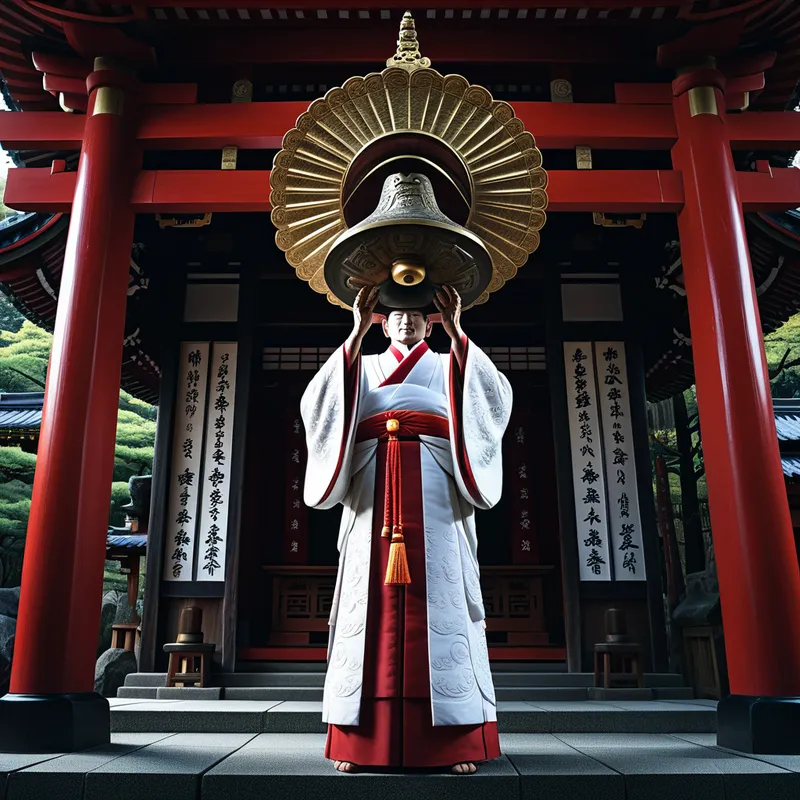
Suzu Bell Myth Meaning & Symbolism
A sacred bell's stolen purity is restored by a hero's journey into the underworld, symbolizing the cleansing of the soul's defilement through sacred sound.
The Tale of Suzu Bell
Listen, and hear the story that is not told, but felt—a vibration in the air, a tremor in the earth, a resonance in the spirit. In the Age of the Gods, when the world was still soft and the boundary between the Ame and the Kakuriyo was but a silken veil, there existed a bell. Not forged by mortal hands, but born from the breath of Izanami and the tears of Izanagi. This was the Suzu, the Bell of Awakening Purity.
It hung in the highest rafters of the first great shrine, its bronze form a perfect vessel. When the wind passed through the sacred grove, or when a kannushi stirred it with reverence, it did not merely ring. It sang. Its voice was the sound of clear mountain streams, of rustling, untouched leaves, of a heart utterly free from stain. Its chime was harae made audible, washing over the land, keeping the spiritual currents clean and bright.
But from the deep places, from the accumulated shadows of forgotten transgressions and unspoken griefs, a presence stirred. Kegare, the formless defilement, coveted the bell’s purity. It could not create, only tarnish; could not sing, only silence. One night, as the world slept under a veiled moon, Kegare seeped upward, a miasmic fog. It did not shatter the bell, for its power was too great for brute force. Instead, it coated it. A thick, clinging tarnish, like spiritual corrosion, smothered the sacred bronze. The bell fell silent. A profound, aching quiet descended upon the land. Springs clouded. Hearts grew heavy with unnamed sorrow. The veil between worlds thickened, and malignant whispers filled the silence where sacred sound once reigned.
The cry went out across the kami. Who would restore the voice? Many tried. Warriors struck the bell, but their blows produced only dull, sickly thuds. Priests chanted, but their words lacked the foundational tone. The silence deepened, becoming a weight.
Then came a figure not of great power, but of profound sincerity. A young miko, whose name is lost to time, known only for the clarity of her intent. She did not look at the bell and see a task; she listened to the silence and heard a plea. Guided by dream and a steadfast heart, she knew the tarnish could not be scrubbed away in this world. Its essence had to be returned to the source of all kegare: the underworld, the land of Yomi.
Her journey was not of miles, but of descent. She walked into the deepest cave, down paths where light forgot its way, into the clammy stillness of Yomi. There, in a cavern where shadows had substance, she found the silent bell, now cold and black. She had brought no tools but a vial of water from the most sacred spring and strips of cloth woven from her own prayer robes. With water that was more intention than liquid, and cloth that was more devotion than fiber, she began to polish. Not with force, but with endless, patient circles. For three days and nights, she worked, as whispering defilements brushed against her. She did not fight them; she acknowledged them and continued her rhythmic, cleansing motion.
As she worked, a faint, ghostly tone began to emanate from the bronze. With each pass, it grew clearer. The clinging kegare, confronted by this relentless, gentle purity, began to dissolve, not into nothing, but into the earth where it belonged, neutralized. Finally, as the last vestige of tarnish faded, the Suzu rang out.
Its chime in that dark place was not loud, but absolute. It shattered the oppressive silence of Yomi itself. The sound echoed up through the roots of the world, bursting forth into the land above. Clear water bubbled anew, hearts lightened, and the veil thinned once more. The miko emerged, bearing not just a restored object, but the restored principle of purification itself. The bell’s song was home, and its voice was now inseparable from the courage that had journeyed into the deep to reclaim it.

Cultural Origins & Context
The myth of the Suzu Bell exists in the oral and ritual tapestry of Shinto, less as a single, codified epic and more as a foundational narrative embedded in the practice itself. It is a ritual etiology, a story that explains why the bell is used and what its sound truly means. Passed down among kannushi and miko during training, it served to instill the profound spiritual significance behind the physical act of ringing the suzu during ceremonies.
Historically, bells (suzu) in Shinto, often small clusters with external pellets, are used to attract the attention of the kami, to mark the beginning of a sacred rite, and most importantly, to purify the space. This myth provides the cosmological reason for that function. It tells the community that the sound is not merely a signal, but an active, cleansing force with a heroic history—a victory over entropy and spiritual decay that must be continually re-enacted. The story reinforces the core Shinto worldview of a world susceptible to kegare but always capable of restoration through harae. The hero being a miko underscores the vital role of ritual specialists as mediators who undertake the symbolic labor of maintaining cosmic and communal order.
Symbolic Architecture
At its heart, the myth is a masterful allegory for the process of purification, not as a simple washing, but as a courageous retrieval and integration.
The Suzu Bell symbolizes the innate, core purity of the spirit or soul—what in psychological terms we might call the authentic Self. Its song is the expression of that Self when unencumbered. The Tarnish (Kegare) represents not “evil” in a moral sense, but the inevitable accumulation of psychic pollution: trauma, unresolved grief, societal pressures, shame, and all that muffles our essential nature. It is the shadow that adheres through lived experience.
The journey to the underworld is not an escape from life, but a descent into the accumulated residue of life, where what has been silenced awaits the courage of attention.
The Descent into Yomi is the critical movement. Purification cannot happen by ignoring or superficially “positive thinking” away our defilements. It requires a voluntary descent into the personal underworld—the unconscious, the memory, the shadow—to confront what has caused the tarnishing. The Miko, the ritual heroine, represents the conscious ego that undertakes this difficult, introspective work. Her tools—sacred water and prayer cloth—symbolize the elements of conscious intention and devoted, repetitive practice (like therapy, meditation, or artistic expression) that gradually dissolve complex psychic material.
The final Restored Chime symbolizes the reclaimed voice of the Self. The purity was never lost, only obscured. The triumph is the integration of the journey’s experience into the sound itself; the bell’s song is now deeper, more resonant, for having known the silence.

The Dreamer’s Resonance
When this myth pattern arises in modern dreams, it signals a profound somatic and psychological process of cleansing and reclamation. A dreamer might encounter a beautiful but silent or dirty bell, a chime that is muffled, or find themselves in a dark place trying to clean a metal object.
Psychologically, this indicates that the dreamer’s psyche is initiating a process of harae. The “tarnish” in the dream is a direct symbol of a specific psychic accumulation that is blocking authentic expression or causing a sense of spiritual heaviness. This could be linked to a past event, a toxic relationship, or a buried emotion. The somatic feeling is often one of constriction in the chest or throat—the “muffled” voice made physical.
The dream is an invitation from the unconscious to undertake the “miko’s journey.” It suggests that the solution lies not in frantic outward action, but in a turn inward, into the “underworld” of one’s own history and emotional landscape. The repetitive cleaning action in the dream mirrors the often tedious, patient work of shadow integration required in waking life. The moment the bell begins to ring in the dream can correlate with a breakthrough in therapy, a moment of profound emotional release, or the sudden clarity of a creative vision finally finding its voice.
Alchemical Translation
The myth of the Suzu Bell is a perfect map for the alchemical process of individuation, framed as psychic transmutation. The stages are clear:
- Nigredo (The Blackening): The tarnishing of the bell. In life, this is the experience of crisis, depression, or a feeling of being lost and silenced by one’s own history or circumstances. The pristine, unconscious wholeness of childhood is coated with the complex patina of adult experience.
- The Call & Descent: The miko’s decision to go into Yomi. This is the conscious decision to engage with one’s pain, to enter therapy, to start a journal, to confront a fear. It is the ego agreeing to serve the Self by facing the shadow.
- Albedo (The Whitening): The patient, repetitive polishing in the dark. This is the core work of analysis and integration. Revisiting memories, feeling long-avoided emotions, practicing new behaviors. It is a whitening, a purification through focused attention. The sacred water is the flow of conscious awareness; the cloth is the consistent application of that awareness.
The alchemical gold is not a state of perfect, static purity, but a spirit whose song has been tempered by, and now includes, the memory of the darkness from which it was reclaimed.
- Citrinitas & Rubedo (The Yellowing & Reddening): The return of the chime and its resonance throughout the worlds. This is the fruit of the work: increased authenticity, creative expression, and a sense of vitality (ki) that feels renewed. The individual’s “song”—their way of being in the world—becomes clearer, more powerful, and more uniquely their own. They have not eliminated their history but have transmuted its oppressive weight into resonant wisdom.
For the modern individual, the myth teaches that our wholeness is never truly lost. It is, however, perpetually in need of conscious reclamation. Our task is to become the miko of our own soul, to have the courage to descend into our personal Yomi, and with patient, devoted action, polish away the tarnish of experience until our essential sound rings out once more, clear and true, for all the world—and ourselves—to hear.
Associated Symbols
Explore related symbols from the CaleaDream lexicon: