Suzu Myth Meaning & Symbolism
A myth of a sacred bell forged from divine sorrow, whose pure tone can cleanse corruption and bridge the realms of gods and mortals.
The Tale of Suzu
Listen, and hear the story that is not told, but heard—a vibration in the soul of the land.
In the Age of Gods, when the air was thick with the breath of kami and the shadows of men were long, a sickness crept into the world. It was a silence that was not peace, but a stifling fog. It settled in the sacred groves, muffling the whispers of the trees. It clung to the shrines, dimming the presence of the gods. The people moved through grey days, their prayers falling like stones, unheard. The connection between Utsushiyo and Kakuriyo was fraying, thread by sacred thread.
Amaterasu-Ōmikami, the Sun Goddess, wept. Her light still shone, but it could not pierce this spiritual malaise. From her tear, a daughter was born—<abbr title=“A celestial maiden, a weaving goddess."">Tanabata-hime. She was given a sacred task: to weave not cloth, but connection. To mend the torn fabric between worlds.
For ninety-nine days and nights, she sat at a divine loom, her shuttle flying. But the threads she wove from sunlight and moonlight would snap, corrupted by the pervasive fog. Despair, a feeling foreign to the heavens, touched her heart. She journeyed to the smithy of Amatsumara, the celestial artisan. “I cannot weave what is not there,” she confessed. “The sound of the connection is gone. We must make a new voice.”
Together, they gathered the last pure ores from the heart of the heavenly mountain. They lit a forge with a fragment of the sun’s fire. But the metal remained dull, silent. Tanabata-hime knew then the cost. A voice to cleanse the silence could not be born from silence. It must be born from sacrifice.
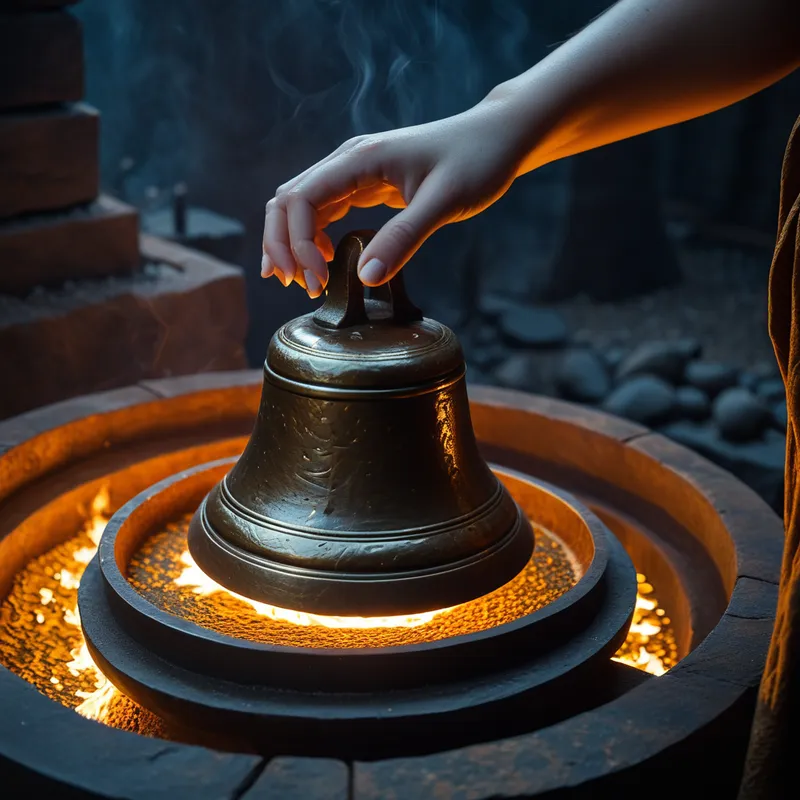
She placed her hands upon the molten bronze. “Let my sorrow for the disconnected world be its frame,” she whispered. “Let my hope for its mending be its song.” And she poured her divine essence, her very tamashii, into the searing metal. Her form began to fade, becoming translucent as morning mist. From her eyes fell seven tears, which fell into the casting as the final alloy.
The metal cooled not into a weapon, but into a bell—a magnificent Suzu. It was simple, profound, and hummed with a latent power. No hammer was needed. As the last of Tanabata-hime’s physical form dissolved into light, she breathed upon it.
Kaaaaaaaaannnnnnnnn…
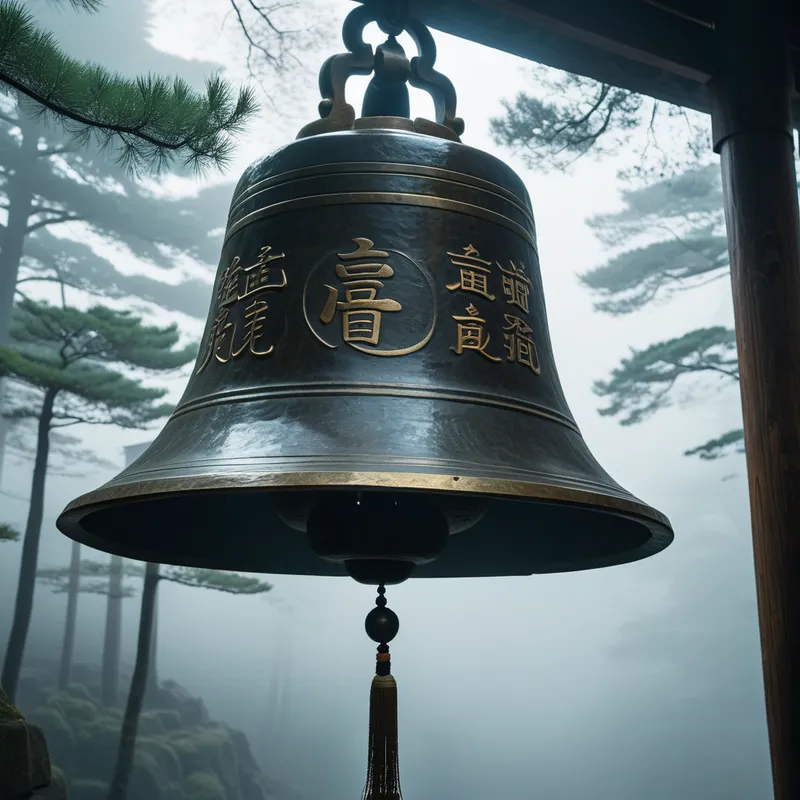
The tone was not loud, but infinitely deep. It rolled across the heavens and seeped into the earth. Where it touched, the grey fog shattered like glass. The sacred groves sighed with released breath. The shrines glimmered anew. The people, hearing the sound not with their ears but with their hearts, felt a forgotten clarity. The bell, now anchored in the highest shrine, required no hand to ring. It sang with the wind of the world’s breath, a perpetual note of purification and connection, a testament to the goddess who became a voice.
Cultural Origins & Context
The Suzu, as a sacred object, is deeply embedded in the Shinto tradition, far predating the Buddhist temple bell (bonshō). Its mythic origins, like those of many mukashibanashi, are not found in a single canonical text like the Kojiki or Nihon Shoki, but are woven into the oral tapestry of local densetsu and shrine histories.
This story functions as an aetiological myth for the profound ritual importance of bells in Shinto practice. The shimenawa-bound bell at a shrine entrance is not merely an alarm for the gods; it is a tool of harae. Its sound is believed to purify the space, ward off malevolent spirits (akuryō), and attract benevolent kami. The myth elevates this ritual function to a cosmic necessity, explaining a world where spiritual connection is fragile and must be actively, and sacrificially, maintained.
It was a tale likely told by kannushi and miko to pilgrims, explaining why they must ring the bell before prayer. The story transforms a ritual action into a participatory myth—each time a devotee pulls the rope, they are not just making noise; they are echoing the primordial, healing tone of the goddess, actively joining in the eternal work of cleansing the world’s spiritual silence.
Symbolic Architecture
At its core, the myth of Suzu is a profound allegory for the human need to create vessels for meaning and connection in the face of existential silence or corruption.
The creeping “grey fog” represents spiritual stagnation, psychic numbness, and the corruption of pure intention. It is the state where rituals become empty, words lose meaning, and the individual feels severed from their own inner life and the animating spirit of the world. The Suzu is the antidote: a crafted, intentional object whose sole purpose is to generate pure, resonant tone—the sound of the soul itself.
The sacred is not found in silence, but in the note that breaks it—the conscious vibration that declares, “I am here, and I am connected.”
Tanabata-hime’s sacrifice is pivotal. She does not battle the fog; she becomes the instrument to dispel it. This symbolizes the psychological truth that healing often requires a dissolution of the old, rigid ego-structure. Her transformation from a weaver (a creator of tangible patterns) to a tone (an intangible, pervasive influence) marks the shift from doing to being. The bell is her new body, a vessel that contains her essence but exists to interact with the world through vibration.
The seven tears represent the full spectrum of human emotion—sorrow, joy, hope, despair, love, longing, and peace—all alchemically alloyed into the bronze. This signifies that a truly healing presence is not born of forced positivity, but of integrated wholeness, where every facet of experience contributes to the depth of one’s resonance.
The Dreamer’s Resonance
When this myth stirs in the modern unconscious, it often manifests in dreams of sound, vibration, and failed or sacred communication. A dreamer may hear a distant, beautiful bell they cannot locate, or they may be trying to ring a bell that makes no sound. They might dream of being in a foggy, silent landscape where a single clear tone suddenly brings everything into sharp, vivid focus.
Somatically, this points to a process of “coming into tone.” The individual may be experiencing a period of depression, dissociation, or creative block—the “grey fog” of the myth. The psyche is signaling the need for a sacrificial act of self-expression to purge this stagnation. The dream of a silent bell reflects the frustration of having a voice or a gift that feels blocked, unheard, or corrupted by inner critics or external noise.
Conversely, dreaming of ringing a Suzu and producing a perfect, cleansing tone indicates a moment of profound psychic integration. It is the somatic feeling of a truth being spoken, a boundary being cleansed, or a connection being forged after a period of isolation. The body in the dream may feel the vibration in its bones, symbolizing this alignment at the deepest, most cellular level of the self.

Alchemical Translation
The journey of Tanabata-hime models the individuation process—the Jungian path to wholeness—with stunning clarity. It is an alchemical opus in three acts: Recognitio (Recognition), Sacrificium (Sacrifice), and Sonus (Sound).
First, Recognitio: She confronts the “fog,” the shadow of the collective and personal psyche. This is the stage where we acknowledge that our old ways of “weaving” our lives—our careers, relationships, self-image—are no longer creating connection, but are snapping under the weight of inauthenticity.
Second, Sacrificium: This is the crucible. She does not merely give something up; she gives herself over. Psychologically, this is the dissolution of the persona—the “goddess” identity—to serve a higher function. For the modern individual, this is the terrifying yet necessary step of letting go of who you thought you were supposed to be (the weaver of perfect patterns) to discover what you are meant to do in the world (become a resonant voice). It is the ego surrendering to the demands of the Self.
Individuation is not about forging a harder self, but about becoming a resonant vessel. The goal is not to be struck, but to ring true.
Finally, Sonus: The creation of the Suzu is the birth of the true, integrated voice. This is the “toning” of the personality. The individual no longer acts from a place of fragmented desire or fear, but from a core of integrated experience (the seven tears). Their actions and words carry a new quality—a clarity and purity that can cut through confusion (the fog) in themselves and others. They become an instrument of harae in their own sphere, not by preaching, but by the quality of their presence. Their very being becomes a note that helps others remember their own connection to the divine, to the animating <abbr title=“Life force, spirit."">kami within and around them.
Thus, the myth of Suzu ultimately tells us that our deepest purpose may not be to build monuments, but to become instruments. To allow our lives, forged in the fires of experience and alloyed with all our tears, to resonate with a tone so pure that it helps cleanse the shared silence of the world.
Associated Symbols
Explore related symbols from the CaleaDream lexicon: