Surya Namaskar Myth Meaning & Symbolism
An ancient ritual of greeting the sun, weaving physical postures into a story of cosmic homage, inner awakening, and the alchemy of light within darkness.
The Tale of Surya Namaskar
Listen. Before [the world](/myths/the-world “Myth from Tarot culture.”/) knew the names of its kings or the borders of its kingdoms, there was a silence that held its breath before the dawn. In this silence lived the Rishi, his life a thread woven into the fabric of the forest. He did not pray for wealth or power. His soul ached for a single, impossible [thing](/myths/thing “Myth from Norse culture.”/): to touch the source.
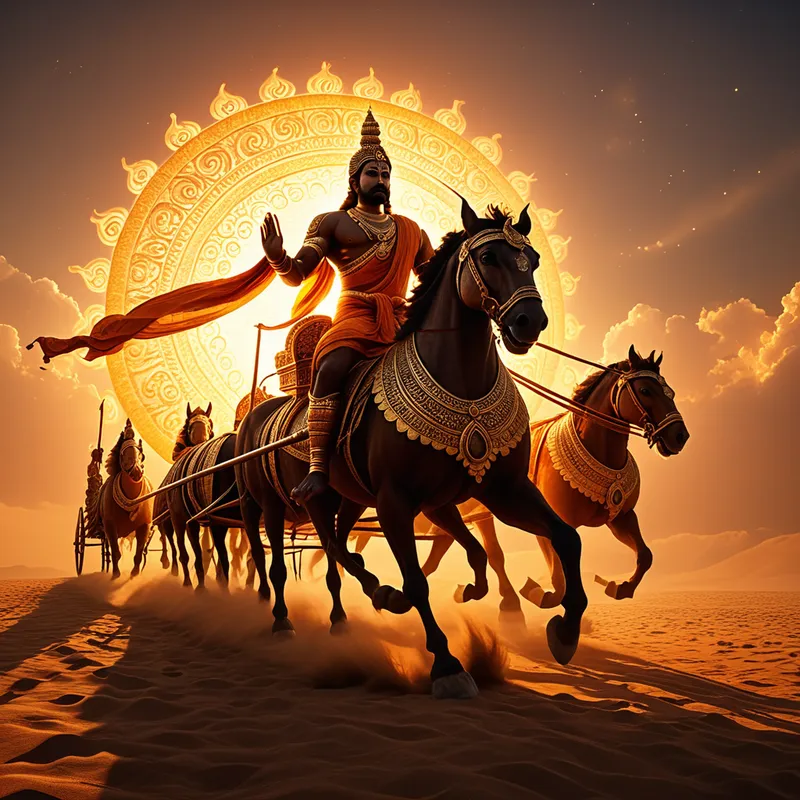
Each day, he watched the great chariot of [Surya](/myths/surya “Myth from Hindu culture.”/) blaze across [the sky](/myths/the-sky “Myth from Persian culture.”/), drawn by seven horses of untamed fire. The light was life, it was law, it was the very gaze of the divine. Yet it remained distant, a sovereign bestowing gifts from an unapproachable throne. The Rishi felt a profound separation, a loneliness not of the body, but of the spirit yearning to commune with its origin.
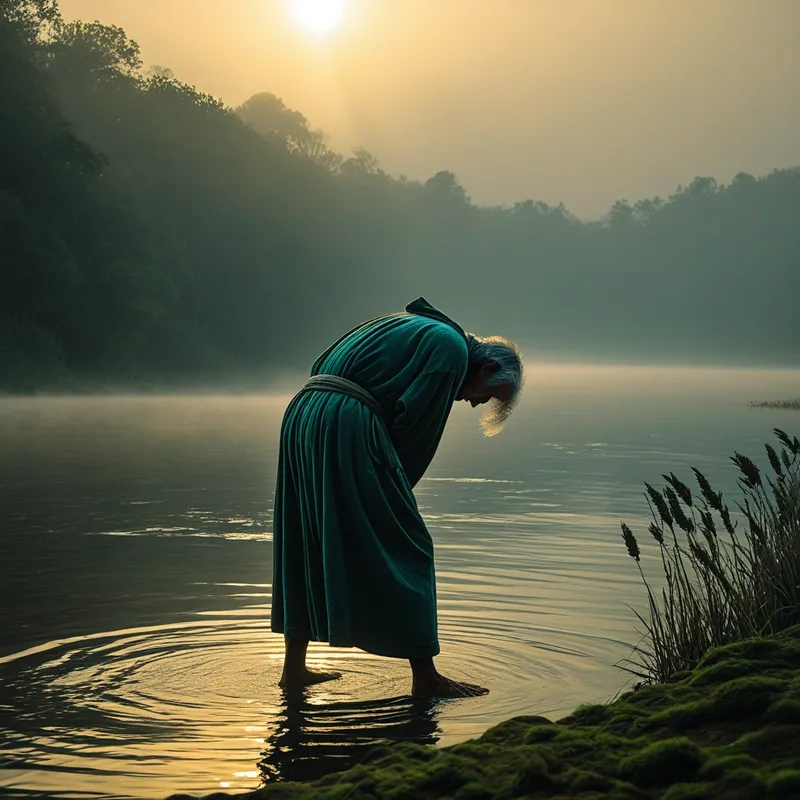
One evening, as the last ember of day faded, a resolve hardened within him like cooled metal. He would not merely watch. He would greet. He would create a language not of words, but of bone and breath, a dialogue written in the scripture of the flesh. He stood at [the river](/myths/the-river “Myth from Buddhist culture.”/)‘s edge, the [water](/myths/water “Myth from Chinese culture.”/) whispering old secrets. As the first hint of grey touched the eastern horizon, he moved.
He began not with a shout, but with a bow. Hands pressed together at his heart, he offered his reverence—Pranamasana. This was the first word of his silent hymn. Then, reaching upward, he stretched his entire being toward the unseen sun—Hasta Uttanasana—a plea etched in his straining spine. But to reach the light, one must first acknowledge [the earth](/myths/the-earth “Myth from Hindu culture.”/). He folded forward, head to knees—Padahastasana—in a gesture of humility, touching the dark soil from which he came.
The sequence unfolded like a destiny. He stepped back, one leg then the other, body becoming a mountain, strong and enduring—Ashwa Sanchalanasana to Parvatasana. Then, the profound surrender: lowering his body, eight points touching the earth—Ashtanga Namaskara—[the ego](/myths/the-ego “Myth from Jungian culture.”/) dissolved into dust. From this abasement, a serpentine power uncoiled. He arched upward, chest open to the sky—Bhujangasana—the heart refusing to be crushed. And again, the mountain pose, a return to strength after vulnerability.
This was not exercise; it was epic. Each movement was a stanza in a poem offered to the dawn. He performed this cycle, again and again, a human [mandala](/myths/mandala “Myth from Buddhist culture.”/) turning in devotion. For days, for seasons, he persisted. His body grew lean, his mind clear as a mountain lake.
Then, on a morning veiled in silver mist, it happened. As he flowed into the final upward stretch, the sun breached [the horizon](/myths/the-horizon “Myth from Various culture.”/). But this time, the light did not merely fall upon him; it answered. A warmth, distinct from the sun’s heat, bloomed within his own chest. A resonance. In that moment, the Rishi understood. [The chariot](/myths/the-chariot “Myth from Tarot culture.”/) in the sky and the rhythm in his blood were not two things, but one. He had not captured the sun; he had awakened the sun within. The ritual was complete. He had found the greeting, and in doing so, had been greeted in return.
Cultural Origins & Context
The mythic seed of Surya Namaskar is deeply rooted in the Vedic worldview, where Surya is not merely a celestial body but Brahman in its life-giving, manifest aspect. He is the eye of the gods, the soul of all that moves and is still. This ritualistic veneration likely evolved from simpler fire sacrifices (yajna) and mantra recitations dedicated to the solar deity.
It was passed down not through a single text, but through the living tradition of the guru-shishya (teacher-disciple) parampara. Sages in ashrams, often situated on riverbanks or in forests where the sunrise was a daily spectacle, would teach this dynamic form of worship. It served a dual societal function: as a spiritual discipline (sadhana) for cultivating vitality, clarity, and devotion, and as a practical means of aligning the human circadian rhythm with the cosmic cycle. It wove physical health, mental focus, and theological reverence into a single, seamless practice, making the lofty concept of union with the divine accessible through the intelligence of the body.
Symbolic Architecture
At its core, Surya Namaskar is a profound map of [consciousness](/symbols/consciousness “Symbol: Consciousness represents the state of awareness and perception, encompassing thoughts, feelings, and experiences.”/) disguised as a physical [sequence](/symbols/sequence “Symbol: The symbol of ‘sequence’ often signifies the order of events and the progression towards a desired outcome or goal.”/). The twelve postures (often linked to the twelve solar months or the twelve names of Surya) represent a complete cycle of descent and [ascent](/symbols/ascent “Symbol: Symbolizes upward movement, progress, spiritual elevation, or striving toward higher goals, often representing personal growth or transcendence.”/), a [microcosm](/symbols/microcosm “Symbol: A small, self-contained system that mirrors or represents a larger, more complex whole, often reflecting the universe within an individual.”/) of the [soul](/symbols/soul “Symbol: The soul represents the essence of a person, encompassing their spirit, identity, and connection to the universe.”/)‘s [journey](/symbols/journey “Symbol: A journey in dreams typically signifies adventure, growth, or a significant life transition.”/).
The sequence begins and ends with Pranamasana, the [gesture](/symbols/gesture “Symbol: A non-verbal bodily movement conveying meaning, emotion, or intention, often symbolic in communication and artistic expression.”/) of anjali [mudra](/symbols/mudra “Symbol: A symbolic hand gesture used in Hindu and Buddhist traditions to channel spiritual energy, express teachings, and focus meditation.”/) at the [heart](/symbols/heart “Symbol: The heart symbolizes love, emotion, and the core of one’s existence, representing deep connections with others and self.”/). This symbolizes the starting and ending point of all quests: [the Self](/myths/the-self “Myth from Jungian culture.”/). The subsequent movements are a dialectic of opposites: [expansion](/symbols/expansion “Symbol: A symbol of growth, increase, or extension beyond current boundaries, often representing personal development, opportunity, or overwhelming change.”/) (Hasta Uttanasana) and [contraction](/symbols/contraction “Symbol: A symbolic process of compression, reduction, or inward movement, often representing preparation, transition, or the tension between opposing forces.”/) (Padahastasana), [strength](/symbols/strength “Symbol: ‘Strength’ symbolizes resilience, courage, and the ability to overcome challenges.”/) (Parvatasana) and surrender (Ashtanga Namaskara), the upward surge of aspiration (Bhujangasana) and the grounded [stability](/symbols/stability “Symbol: A state of firmness, balance, and resistance to change, often represented by solid objects, foundations, or steady tools.”/) of [integration](/symbols/integration “Symbol: The process of unifying disparate parts of the self or experience into a cohesive whole, often representing psychological wholeness or resolution of internal conflict.”/).
The sun you bow to is not only in the sky; it is the latent luminescence at the core of your own being. The ritual is the method of polishing the inner lens until it reflects the primordial light.
Surya represents the archetypal principle of consciousness, [clarity](/symbols/clarity “Symbol: A state of mental transparency and sharp focus, often representing resolution of confusion or attainment of insight.”/), and [life](/symbols/life “Symbol: The symbol of ‘Life’ represents a journey of growth, interconnectedness, and existential meaning, encompassing both the joys and challenges that define human experience.”/)-force ([prana](/symbols/prana “Symbol: In Hindu and yogic traditions, prana is the universal life force or vital energy that animates all living beings and permeates the cosmos.”/)). The Rishi represents the [human](/symbols/human “Symbol: The symbol of a human represents individuality, complexity of emotions, and social relationships.”/) ego-complex, which initially experiences itself as separate from this radiant [source](/symbols/source “Symbol: The origin point of something, often representing beginnings, nourishment, or the fundamental cause behind phenomena.”/). The conflict is the ache of this [separation](/symbols/separation “Symbol: A spiritual or mythic division between realms, states of being, or consciousness, often marking a transition or loss of connection.”/). The [resolution](/symbols/resolution “Symbol: In arts and music, resolution refers to the movement from dissonance to consonance, creating a sense of completion, release, or finality in a composition.”/) is not the sun descending, but the [human](/symbols/human “Symbol: The symbol of a human represents individuality, complexity of emotions, and social relationships.”/) realizing its inherent solar [nature](/symbols/nature “Symbol: Nature symbolizes growth, connectivity, and the primal forces of existence.”/) through a disciplined, embodied [dialogue](/symbols/dialogue “Symbol: Conversation or exchange between characters, representing communication, relationships, and narrative flow in games and leisure activities.”/). Each [posture](/symbols/posture “Symbol: Posture in dreams represents one’s stance in life, social presentation, and inner confidence or submission. It reflects how one carries themselves through challenges and relationships.”/) is an alchemical gesture, transmuting gross inertia (tamas) into active vitality (rajas), and ultimately toward the illuminating quality of sattva.
The Dreamer’s Resonance
When this mythic pattern stirs in the modern dreamer, it often signals a profound somatic and psychological process of re-orientation. One may dream of performing slow, deliberate movements in a vast, empty space, or of reaching toward a brilliant light that feels both external and intimately internal.
Somatically, this can mirror the body’s intelligence seeking to integrate fragmented aspects of the self. The dream-sequence may feel arduous, a grinding of psychic joints, reflecting the resistance to the full cycle of experience—the reluctance to fully bow in humility or the fear of the powerful, cobra-like rise of repressed energy ([kundalini](/myths/kundalini “Myth from Hindu culture.”/)). Psychologically, it is the dream-ego attempting to establish a right relationship with its own inner source of power and consciousness. The dream sun may be obscured, too bright, or strangely cold, indicating the dreamer’s current relationship with their own vitality, authority, and spiritual core. To dream of completing the cycle fluidly is to dream of psychic wholeness, where effort and surrender, strength and flexibility, are in harmonious flow.
Alchemical Translation
The myth of Surya Namaskar is a masterful blueprint for the process of individuation—the Jungian journey toward psychic wholeness. The modern individual, like the Rishi, often begins in a state of alienation, feeling separate from their own inner source of energy and meaning (the inner Sun).
The ritual sequence models the alchemical opus:
- Coagulatio (Coagulation): Pranamasana. The gathering of oneself, the conscious decision to begin the work from the center of one’s being.
- Sublimatio (Sublimation): Hasta Uttanasana. The aspiration, the striving upward toward higher consciousness and purpose.
- [Solutio](/myths/solutio “Myth from Alchemical culture.”/) (Dissolution): Padahastasana and Ashtanga Namaskara. The necessary dissolution of the rigid ego. One must be humbled, broken down, and brought into contact with the unconscious, shadowy earth of one’s being.
- Calcinatio (Calcination): Parvatasana. The fiery trial that forges strength and endurance from the ashes of the dissolved self.
- [Separatio](/myths/separatio “Myth from Alchemical culture.”/) (Separation): The entire flow distinguishes and then integrates opposing forces: active/passive, light/dark, masculine/feminine.
- Coniunctio (Conjunction): The final return to the heart-mudra. This is [the sacred marriage](/myths/the-sacred-marriage “Myth from Various culture.”/), the hieros gamos, where the inner experiencer (Rishi) and the inner source of light (Surya) are recognized as one. The [psyche](/myths/psyche “Myth from Greek culture.”/) realizes it is both the worshipper and the worshipped.
The ultimate alchemy is not of turning lead to gold, but of recognizing that the body itself is the alchemical vessel, the breath is the bellows, and the attentive consciousness is the fire that performs the transmutation.
For the modern individual, this translates to any disciplined practice of showing up fully—to therapy, to art, to relationship, to silent meditation—with a rhythm that honors both effort and release. It is the daily greeting of one’s own potential, the bow to one’s own depths, and the steady, cyclical work of bringing the light of awareness to every contracted, shadowed, and glorious part of the self. One does not find the light by escaping the body’s journey, but by moving through it, posture by sacred posture, until the greeting becomes the state of being.
Associated Symbols
Explore related symbols from the CaleaDream lexicon: