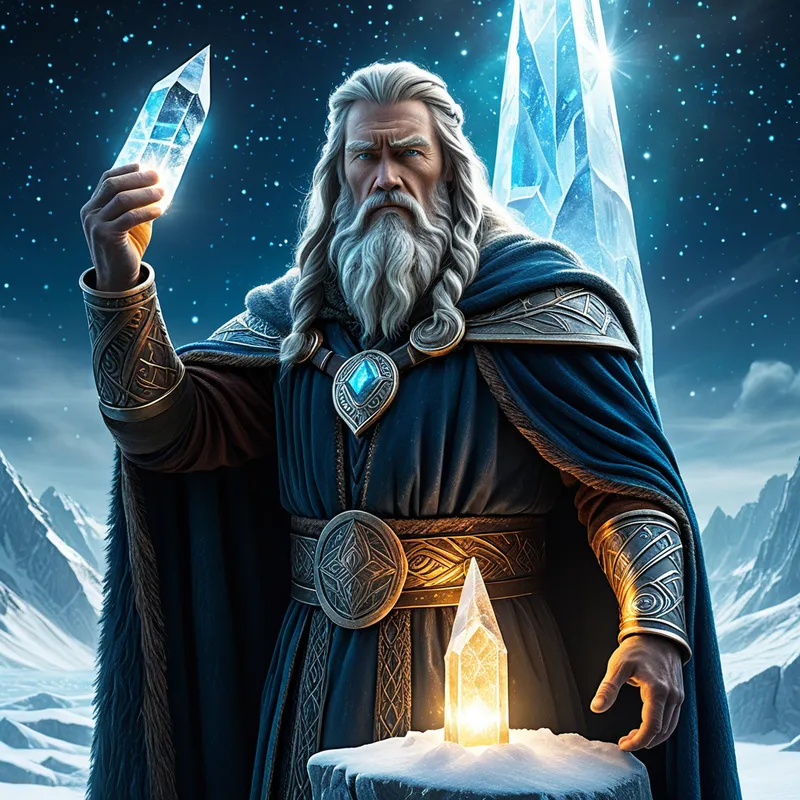
Sunstone Myth Meaning & Symbolism
A myth of stolen light, divine pursuit, and the forging of a new sun from a shard of the old, symbolizing the arduous creation of consciousness.
The Tale of Sunstone
Listen, and hear the tale of the world’s first winter, and the theft that nearly ended all things.
In the dawn of days, when the dew was still young on the branches of Yggdrasil, the sun and moon were not as they are. They were brilliant siblings, Sól and Máni, who rode their chariots across the vault of the sky in an endless, graceful chase, weaving the tapestry of day and night. Their light was not mere fire, but the very breath of the Aesir, the warmth of thought and the clarity of sight. All life—the green shoot, the leaping stag, the laughing child—drank from their radiance.
But in the iron forests of Jötunheimr, where shadows lay thick as tar, a brood of envy grew. The giants, children of the primordial frost, hated the ordered dance of the heavens. Their hearts, vast and cold as glaciers, coveted the light. Not to nurture, but to possess. To swallow it and sit in glorious, solitary darkness.
The boldest among them were Sköll and Hati, wolves whose jaws could crack the foundations of mountains. Yet it was not they, but their cunning kin, who devised the theft. On a day when the weave of fate grew thin, a giant of immense guile, whose name is lost to all but the whispering roots of the World Tree, stole into the sky-road. With hands that could clutch thunder, he did not attack the chariots, but the source itself. He reached into the heart of Sól’s blazing orb and tore free a shard of its core—a fragment of the original sun.
The world gasped. Light did not vanish, but it sickened. Sól’s chariot faltered; her light grew pale and wan. A creeping chill, older than the gods themselves, seeped from the edges of the world. The great winter, Fimbulvetr, began its approach. Frost giants laughed, their breath forming new glaciers. The Aesir gathered in Asgard, their golden hall Valhalla feeling suddenly frail. All-propser, Thor, gripped his hammer Mjölnir until his knuckles whitened, but even its lightning could not reignite a stolen star.
Then spoke Odin, his single eye burning with a terrible knowledge. “The shard lives. It is not destroyed, but hidden. Its light is now a seed, and a seed must be planted in sacrifice to grow.” The task fell not to the strongest, but to the one who understood the language of loss and the architecture of hope. A god whose name means “Shining One” volunteered—a deity of light and reconciliation, whose hands were skilled in shaping not weapons, but essence.
His journey was a descent. He followed the dying trail of warmth into the frozen belly of Jötunheimr, through caverns where the very air wept ice. He found the thief, not in a fortress, but in a cavern of mirrors made of black ice, endlessly reflecting the stolen shard’s feeble glow, hoarding its beauty in sterile repetition. A battle was fought, not of clashing steel, but of will against greed, of future against stagnation. The god prevailed, but at a cost. To claim the shard, he had to wrap his own divine hand around it. Its radiance, meant for all, seared his flesh, burning away a part of his own immortal substance.
He returned to Asgard, his hand forever marked, cradling the shard. The gods did not simply reattach it. They knew the old sun was wounded. In a solemn ceremony over the well of Urd, they fused the god’s sacrifice with the shard. They forged a new sunstone—a core of resilient, enduring light. They set it in the heart of Sól’s chariot. It did not merely restore; it transformed. The light that now floods our world is a compound light, born of theft, tempered by pursuit, and annealed in voluntary sacrifice. It is a light that knows the cold, and therefore burns all the more fiercely against it.
Cultural Origins & Context
The myth of the Sunstone, while not a singular, standardized narrative like the death of Baldr, is a powerful thematic strand woven through the Norse cosmological understanding. It emerges not from one eddic poem, but from the synthesis of several: the description of the wolves Sköll and Hati chasing the sun and moon in the Gylfaginning, the prophetic dread of Fimbulwinter in the Völuspá, and the pervasive cultural anxiety about the sun’s fragility. This was a myth lived by people for whom winter was a tangible, annual brush with extinction. The sun’s weakening in autumn was not just a season; it was a re-enactment of the primordial theft, and its return in spring a testament to the gods’ eternal, precarious victory.
It was a tale told by hearth-fires during the long darkness, a story that gave meaning to the struggle for survival. The skald (poet) would not recite it as dry history, but as a sacred drama, aligning the community’s immediate hardship with the cosmic order. Its societal function was one of profound resilience. It taught that light is not a given, but a prize won through cunning, courage, and sacrifice. It framed their entire worldview: order (örlög) is not a static state, but a dynamic, hard-won balance constantly threatened by chaos, and requiring vigilant, sacrificial upkeep.
Symbolic Architecture
At its core, the Sunstone myth is an allegory for the birth and maintenance of consciousness itself. The primordial, undifferentiated light represents a state of unconscious unity—a paradise that is also a potential prison, as it contains no shadow, no contrast. The giant’s theft is the necessary, traumatic act of differentiation. It is the emergence of the ego, the “I” that separates from the whole to possess an experience, even if that act is one of greed and wounds the source.
The theft of light is the first, violent act of consciousness, creating the subject who sees and the object that is seen. The ensuing winter is the psychic collapse that follows this separation—the depression, alienation, and coldness of a life lived in isolated possession.
The stolen shard is the nascent spark of individual awareness, now isolated and vulnerable. The god’s pursuit into the frozen land of giants is the heroic journey of the ego into the unconscious—the shadow realm—to reclaim what was lost. The critical moment is not the victory over the giant, but the god’s willing sacrifice: his hand is burned by the very light he seeks to save. This symbolizes the painful but essential process of relating to the reclaimed content. One cannot simply re-absorb a developed complex or talent (the shard) back into the unconscious; it must be integrated, and integration changes the integrator. The new, compound sun is the symbol of the individuated Self—a consciousness that is no longer naive, but resilient, having incorporated the experience of darkness and sacrifice into its very essence.

The Dreamer's Resonance
When this myth stirs in the modern dreamer, it often manifests as a profound sense of something vital being lost, hidden, or stolen. The dream landscape is frequently cold, barren, or locked in perpetual twilight. The dreamer may be searching through attic spaces, frozen tundras, or labyrinthine basements. The “sunstone” itself might appear as a lost piece of jewelry, a glowing key, a warm stone in a snowbank, or simply a persistent, comforting light seen through a distant window.
Somatically, this dream pattern correlates with a feeling of inner depletion, a “winter of the soul.” Psychologically, it signals that a core aspect of the dreamer’s vitality, creativity, or joy (their inner sun) has been dissociated—perhaps sacrificed to childhood survival, buried under trauma, or simply neglected in the grind of daily life. The dream is not merely a report of loss; it is the psyche initiating the recovery mission. The cold setting is the felt experience of life without that essential energy. The act of searching, even fruitlessly, is the first step in the god’s journey—the ego acknowledging the lack and turning inward to seek its source.

Alchemical Translation
The alchemical process mirrored in the Sunstone myth is the opus of transforming the prima materia of a traumatic or depleting loss into the philosophical gold of a resilient, authentic Self. It is a map for psychic transmutation.
The initial state (nigredo) is the great winter—the depression, numbness, or meaninglessness that follows a major loss or betrayal (the theft). The journey to Jötunheimr is the mortificatio—the conscious descent into the shadow, facing the “giants” of one’s own greed, envy, or the internalized voices that hoard one’s light. Recovering the shard is the separatio—distinguishing the precious, authentic core of one’s being from the frozen, repetitive patterns (the ice mirrors) that have trapped it.
The burning of the hand is the crucial coniunctio—the sacred marriage where the redeeming ego is itself wounded and altered by what it redeems. The ego does not assimilate the Self; it is forged anew in relationship to it.
Finally, the forging of the new sunstone is the rubedo and the creation of the lapis philosophorum—the stone of wholeness. This is the stage of conscious integration, where the reclaimed vitality is not simply reinstated, but actively woven into the fabric of one’s daily life, creating a new, more durable source of inner light. The individual becomes, like the reforged sun, a compound being. Their light is not the innocent, untested light of paradise, but the wise, enduring light that has known the depths of the cave and the bite of the frost, and chosen to shine nonetheless. They become, in the truest sense, a creator, actively participating in the perpetual restoration of their own world.
Associated Symbols
Explore related symbols from the CaleaDream lexicon: