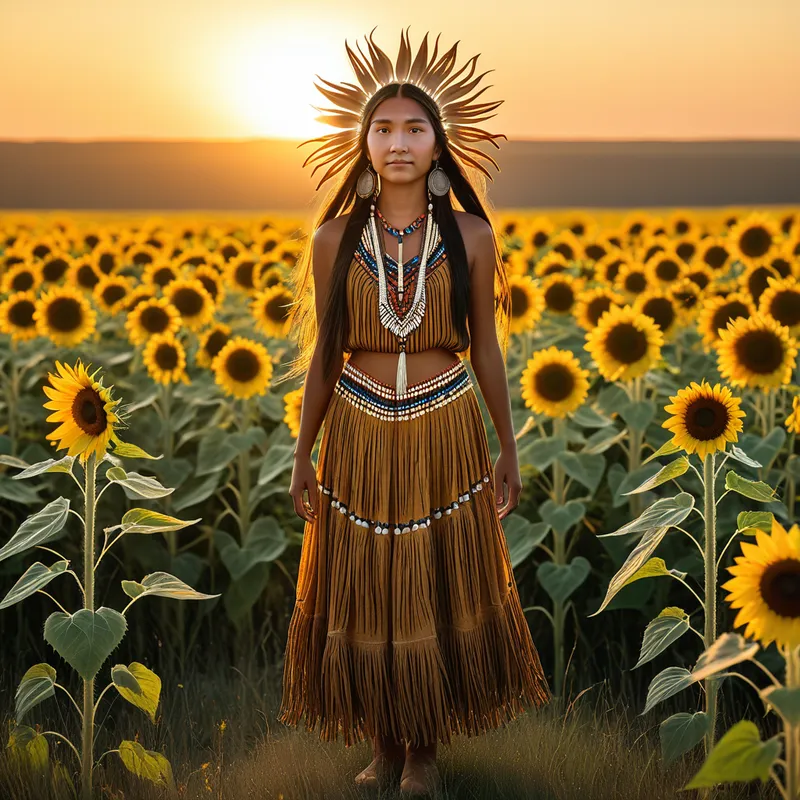
Sunflower Maiden Myth Meaning & Symbolism
A maiden's unwavering devotion to the Sun transforms her into the first sunflower, a living emblem of constancy, nourishment, and radiant beauty.
The Tale of Sunflower Maiden
Listen. Before the corn grew tall and the buffalo darkened the plains, there was a time when the world was still learning its shape. In those days, there lived a maiden unlike any other. Her name is lost to the whispering wind, but her nature is remembered: she was born with a piece of the sun caught in her spirit. From her first breath, she did not seek the warmth of the lodge-fire, but the true fire of Father Sun himself.
Each day, as the great golden orb began his journey across the sky-vault, she would leave her village and walk to the highest hill on the eastern plain. There, she would stand, barefoot upon the grass, and lift her face to the light. She did not pray with words, but with her whole being—a silent, radiant offering of awe. She watched him climb, she felt his heat upon her skin, and she wept silent tears of joy as he painted the evening in farewell hues of orange and purple. While others tended fields and tanned hides, her sole work was this vigil. Her people whispered. Some called her foolish; others, touched by a sacred madness. But her heart, a steady drum, beat only for that distant, glorious fire.
The seasons turned. The maiden grew, but her practice did not waver. Drought came. The earth cracked, the streams shrank to silver threads, and the people grew thin with hunger. Still, she went to her hill. In their desperation, some elders came to her. “Daughter,” they said, their voices rough with thirst, “your watching feeds no one. Come, help us dig for roots, pray for rain in the way we know.”
She looked at them, her eyes holding the last of the sunset. “I cannot,” she whispered, her voice the sound of dry grass stirring. “My life is not my own. It is pledged. To turn from him now would be to break the world in my soul.”
And so she returned. As the drought deepened, she stood on her hill, a solitary figure against the bleached sky. Her body grew thin, her lips parched, but her gaze never faltered. She did not ask for water for herself. Her entire devotion was an ask for the world: Remember this light. Remember this life.
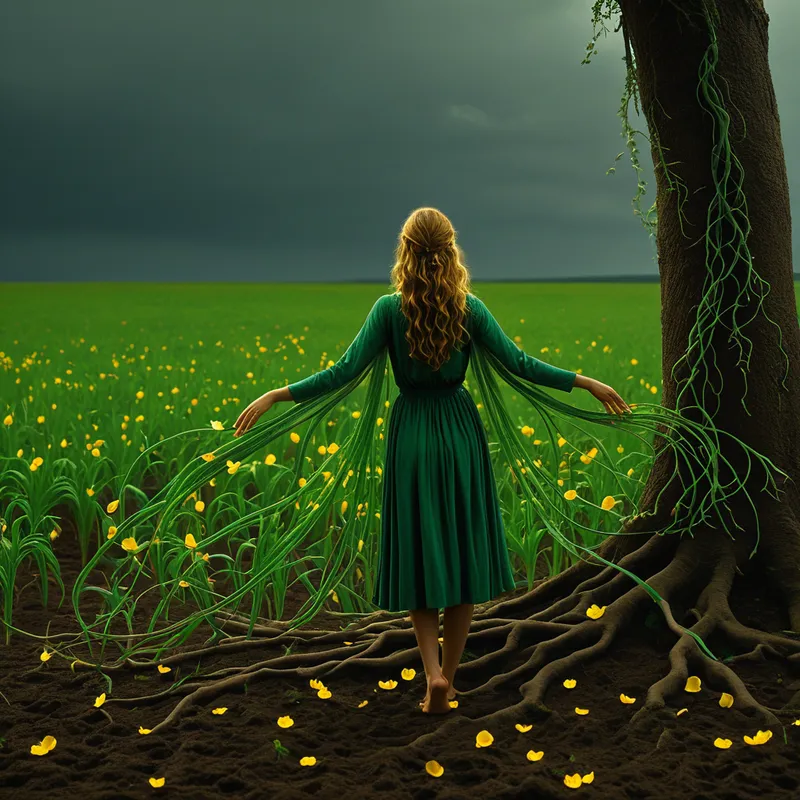
One morning, as the sun’s first lance pierced the horizon, something shifted. The maiden felt a profound pull, not from the sky, but from the earth beneath her feet. A deep warmth, a answering call, surged upward from the soil. Her toes curled, seeking purchase, and found themselves held fast. A sweet, heavy scent filled the air around her—the smell of warm dust and promise. She tried to lift her arms in her daily greeting, but they felt heavy, golden. Her skin tingled, not with heat, but with a slow, cellular unfurling.
She was not afraid. For in that moment, the sun did not just shine upon her; it shone from within her. Her yellow dress became a whorl of brilliant petals. Her outstretched arms became broad leaves, drinking the light. Her face, forever upturned, became the great, seeded disk of the first Sunflower. Her feet became a strong, fibrous taproot, driving deep into the thirsty earth, finding hidden water.
When the people came searching, they found not a maiden, but a majestic golden flower, taller than a man, its face faithfully tracking the sun’s path from dawn till dusk. And from the rich, black seeds that formed in its center, there came food. Oil. Life. Her devotion, once seen as a private folly, had become a public sacrament—a perennial promise of nourishment and unwavering faith, rooted in the very soil they thought had forsaken them.
Cultural Origins & Context
The story of the Sunflower Maiden finds its roots among the agrarian and plains-dwelling peoples of North America, particularly those for whom the sunflower (Helianthus annuus) was not just a plant, but a vital staff of life. Tribes such as the Hopi, Cherokee, and many across the Great Plains cultivated sunflowers centuries before European contact, using the seeds for food, oil, and ceremonial purposes.
This myth belongs to the rich oral tradition of etiological tales. It was likely told by elders and storytellers, not merely to explain a botanical fact, but to encode a profound cultural value. The story was recited during planting seasons, to children learning their connection to the land, and in times of hardship, as a reminder of the transformative power of steadfast faith. Its societal function was multifaceted: it explained the origin of a crucial crop, it validated the path of the singularly devoted (the visionary, the mystic, or the artist within the community), and it taught that ultimate generosity often springs from a personal covenant that others may not initially understand. The myth binds the practical (agriculture) to the spiritual (devotion) in an inseparable unity.
Symbolic Architecture
At its heart, the myth is a powerful allegory for the process of becoming what one loves. The Maiden is the human soul in its purest, most focused state. Her fixation on the Sun is not a rejection of community, but an alignment with the ultimate source.
To gaze so long upon the divine that you take on its attributes is the alchemy of the soul.
The Sun represents the Self, the central organizing principle of the psyche, and also the transcendent—the ultimate source of light, consciousness, and life. The Maiden’s daily vigil is the practice of meditation, prayer, or any disciplined focus that seeks connection with this core. The drought represents the inevitable periods of aridity in life and spirit, where such devotion seems pointless, even selfish, to the outer world.
Her transformation is not a punishment, but a consummation. She does not die; she translates. Her human form is inadequate to contain the totality of her connection, so she becomes a new form—one that perfectly expresses her nature. The sunflower is thus a symbol of constancy (heliotropism, following the sun), nourishment (the seeds), and radiant beauty born from single-minded focus. She becomes a bridge: her roots in the dark earth (the unconscious, the body), her face in the brilliant sky (consciousness, spirit).
The Dreamer’s Resonance
When this myth stirs in the modern dreamer, it often signals a critical phase of psychic crystallization. To dream of being rooted to the spot, of feeling one’s limbs turn to vegetation, or of staring fixedly at a brilliant light can feel unsettling, even terrifying—a loss of agency.
Somatically, this may mirror feelings of being “stuck” in life, paralyzed by a calling or passion that feels at odds with practical demands. Psychologically, however, this “stuckness” is the mythic drought. The dream is presenting the ordeal of the Maiden: the tension between a deep, soul-level orientation (the Sun) and the pressures of the external, collective world (the starving village). The dreamer is in the process of a profound commitment. The somatic sensation of transformation—the tingling skin, the heavy limbs—is the psyche’s blueprint for a necessary metamorphosis, where an old identity must become rigid, then break open, to allow a new, more authentic form to emerge. It is the dream of the visionary who has not yet found their form.

Alchemical Translation
For the modern individual navigating the path of individuation, the Sunflower Maiden’s journey is a masterful map of psychic transmutation.
The first stage is Identification: the ego becomes enamored with a value, an ideal, or a source of meaning—the Sun. This is the “calling.” The second stage is the Ordeal of Fidelity: the world, and often parts of our own psyche (our inner “elders”), will challenge this focus as impractical, selfish, or mad. This is the drought, the test of faith.
The true sacrifice is not of the calling, but of the former self that cannot contain the calling.
The third and crucial stage is Transmutation, Not Ascension. The Maiden does not fly away to the sun; she brings the sun’s qualities down to earth. This is the alchemical gold. The modern equivalent is when a passionate love for an idea (art, science, spirit, justice) undergoes a “phase change.” It ceases to be a hobby, a belief, or a desire, and becomes the very structure of one’s life and offering to the world. The painter’s eye becomes their worldview. The healer’s compassion becomes their daily action. The seeker’s devotion becomes a grounded, nourishing presence for others.
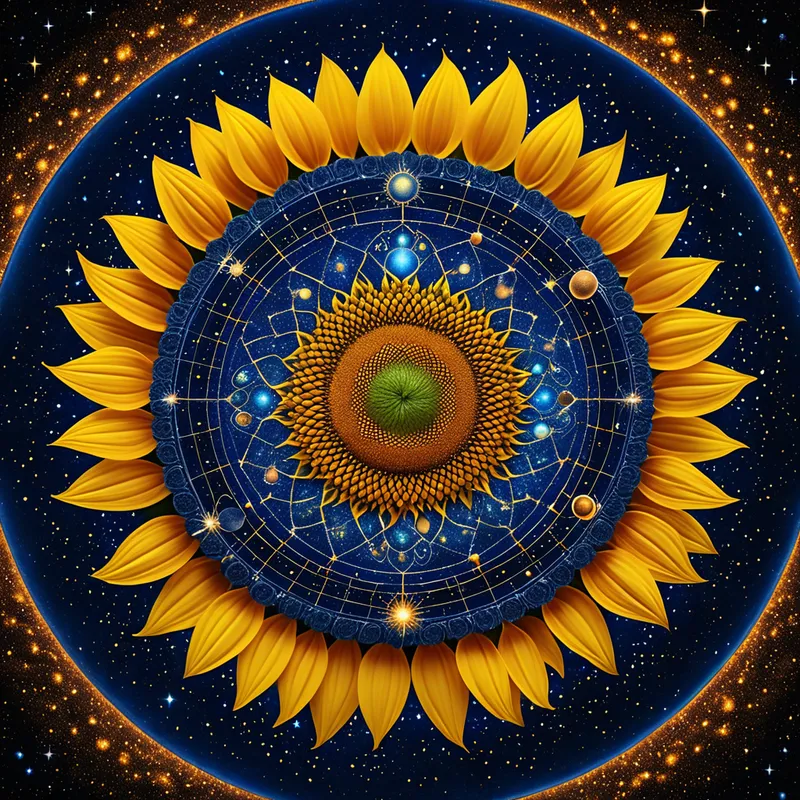
The sunflower seed, the final product, is the symbol of this completed work. It is dense with potential, a perfect package of sustenance born from the marriage of unwavering focus (light) and deep grounding (earth). The myth teaches that our most personal, seemingly idiosyncratic devotion, if followed with absolute integrity, does not isolate us. It ultimately transforms us into a source of life for the very community we seemed to have turned our back on. We become what we love, and in doing so, we feed the world.
Associated Symbols
Explore related symbols from the CaleaDream lexicon: