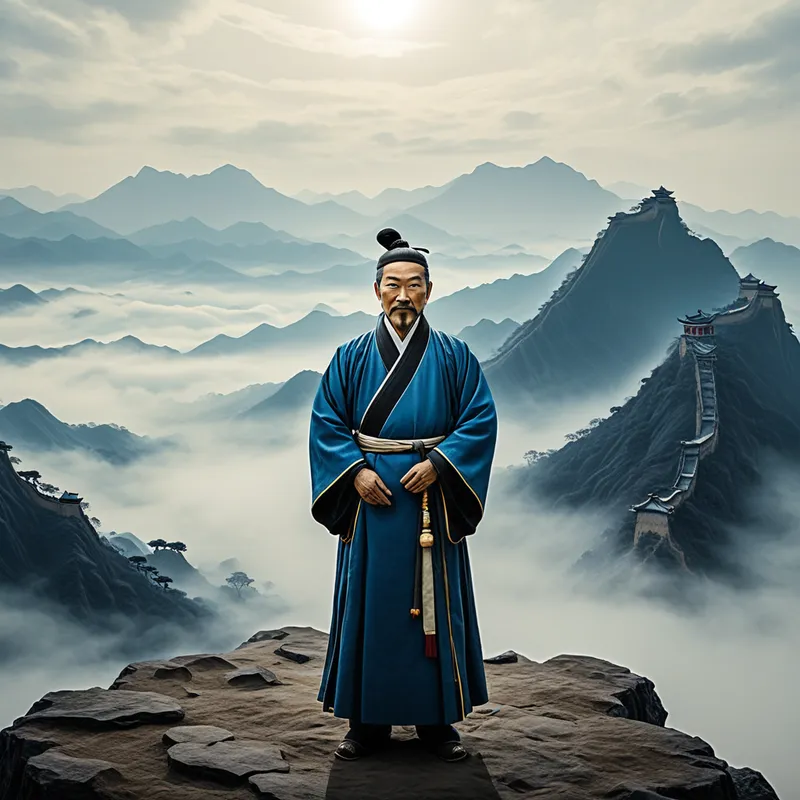
Sun Tzu Myth Meaning & Symbolism
The myth of the master strategist who reveals that true power lies not in the clash of arms, but in the conquest of perception and circumstance.
The Tale of Sun Tzu
Hear now the tale not of a god, but of a principle made flesh. In an age of clashing kingdoms, when the very earth groaned under the march of armored feet, there arose a man whose weapon was silence, whose army was thought itself.
He came to the court of King Helü of Wu, a ruler hungry for a power that would not rust. The king, surrounded by the clatter of swords and the boasts of generals, demanded proof of this stranger’s famed art. “Can you train anyone?” the king challenged, his voice echoing in the hall. “Even my palace women?”
Sun Tzu bowed, a motion like a willow branch yielding to [the wind](/myths/the-wind “Myth from Various culture.”/). “Command me, Your Majesty.”
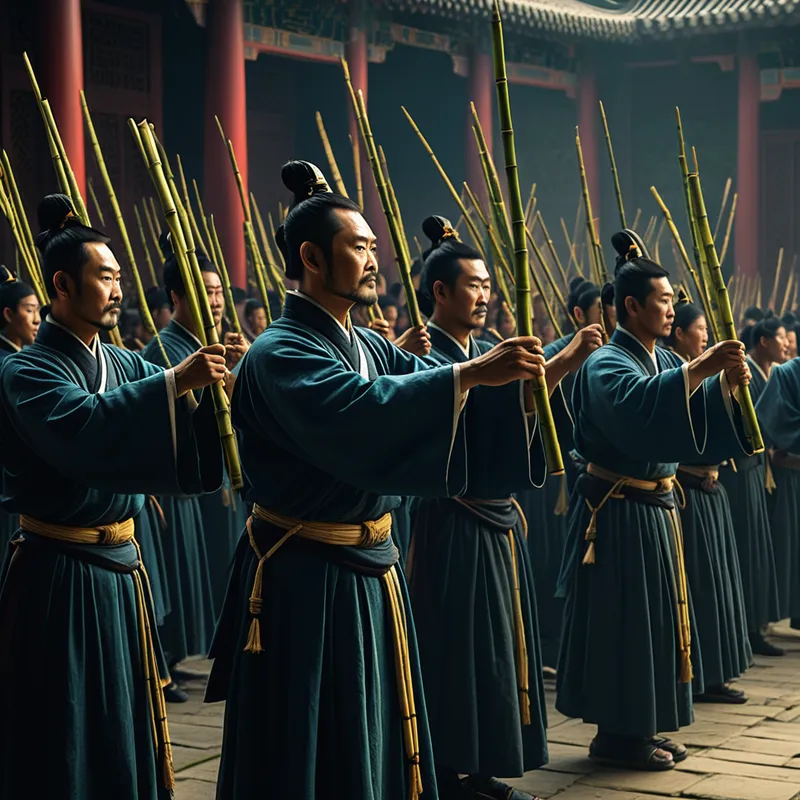
The king summoned his one hundred and eighty concubines. They gathered in the courtyard, silks whispering, laughter like scattered bells, a garden of beauty utterly alien to the drill ground. Sun Tzu divided them into two companies, placing the king’s two favorite consorts at the head of each. He explained the simple drills: forward, backward, left, right. “Do you understand?” he asked. “We understand,” they chimed, their voices light with amusement.
He raised the commander’s halberd. “On my command, face right.” He gave the order. The women burst into giggles, a wave of mirth breaking over the strict formation. Sun Tzu stood unmoved. “If the instructions are not clear, if the commands are not understood, the fault lies with the general.” He repeated the drill commands with painstaking clarity. “Do you understand?” “We understand,” they said, smiles still playing on their lips.
Again, he gave the order to face right. Again, laughter. But now, the air changed. The stillness around Sun Tzu deepened, becoming not passive, but potent—like the moment before the avalanche. He turned to the king’s lawmaster. “If words of command are not clear and distinct, if orders are not thoroughly understood, the general is to blame. But if his orders are clear, and the soldiers nevertheless disobey, then it is the fault of the officers.”
His gaze settled on the two chief consorts. “According to military law, what is the penalty for officers who fail in their duty?” The lawmaster, pale, whispered, “Death.”
King Helü, watching from his high terrace, felt a chill. He saw not a man, but the implacable logic of consequence personified. He cried out, “I know you can command troops! Spare my favorites! I cannot bear their loss!”
Sun Tzu looked up, his voice carrying the weight of mountains. “I have been appointed commander. According to military rule, a commander in the field is not bound by the orders of his sovereign.” The courtyard fell into a silence so profound one could hear the rustle of a banner in the far distance. He commanded the executioners. The two favored consorts, their laughter now frozen in terror, were beheaded before the assembled host.
He then appointed the next two women in line as chiefs. And when he raised the halberd again, and gave the order to face right, the remaining women moved as one body. Not a giggle, not a misstep. They turned, advanced, retreated, and knelt with the precision of a single, polished mechanism. Their eyes were no longer the eyes of courtiers, but of soldiers who had seen the face of the ultimate law.
Sun Tzu sent a messenger to the king. “The troops are now correctly drilled and disciplined. They are ready for Your Majesty’s inspection. You may use them as you please—to march through fire or [water](/myths/water “Myth from Chinese culture.”/), and they will not disobey.”
The king, sick with loss, dismissed him. But Sun Tzu’s final words lingered: “You are fond of only the words, Your Majesty. You cannot bear the reality.” In time, the king saw the truth. He who could transform silken laughter into iron discipline could forge a kingdom. And so, the principle was unleashed upon [the world](/myths/the-world “Myth from Tarot culture.”/).
Cultural Origins & Context
The figure of Sun Tzu exists in the liminal space between history and myth. He is traditionally placed in the Spring and Autumn period, a chaotic era of fragmenting Zhou dynasty authority where warfare was constant yet governed by a crumbling code of ritual. The primary source, the Shiji by Sima Qian, compiled centuries later, presents his biography as a foundational myth for the school of Bingjia.
The myth was not told around campfires by common soldiers, but in courts and scholarly halls. It functioned as a philosophical parable for the ruling class. Its societal purpose was profound: to argue that true sovereignty and social order are not born from brute force or hereditary privilege, but from the application of transcendent, impersonal principle (li). The story of the concubines is a brutal allegory for statecraft itself—the transformation of chaotic, self-interested elements (the people, the court, the army) into a harmonious, functioning whole through clear law and unwavering enforcement. It passed down not as a biography, but as the necessary origin story for the terrifyingly effective wisdom contained in The Art of War.
Symbolic Architecture
At its core, the myth of Sun Tzu is not about war, but about the [nature](/symbols/nature “Symbol: Nature symbolizes growth, connectivity, and the primal forces of existence.”/) of [reality](/symbols/reality “Symbol: Reality signifies the state of existence and perception, often reflecting one’s understanding of truth and life experiences.”/) and [perception](/symbols/perception “Symbol: The process of becoming aware of something through the senses. In dreams, it often represents how one interprets reality or internal states.”/). Sun Tzu himself symbolizes the awakened mind, the witness who sees the world not as a collection of things, but as a field of forces, relationships, and potentialities.
The supreme art of war is to subdue the enemy without fighting. This is the alchemy of the myth: victory is moved from the external, material realm of clashing spears to the internal, psychological realm of shaped perception and manipulated conditions.
The Concubines represent the untamed, unconscious [psyche](/myths/psyche “Myth from Greek culture.”/)—driven by personal whim, [emotion](/symbols/emotion “Symbol: Emotion symbolizes our inner feelings and responses to experiences, often guiding our actions and choices.”/), and attachment. The [King](/symbols/king “Symbol: A symbol of ultimate authority, leadership, and societal order, often representing the dreamer’s inner power or external control figures.”/) symbolizes the conflicted ego, who desires the fruits of order (power, [security](/symbols/security “Symbol: Security denotes safety, stability, and protection in one’s personal and emotional life.”/)) but is unwilling to sacrifice its attachments (his favorites, his comfort). The Drill Ground is the [temenos](/myths/temenos “Myth from Greek culture.”/), the sacred [space](/symbols/space “Symbol: Dreaming of ‘Space’ often symbolizes the vastness of potential, personal freedom, or feelings of isolation and exploration in one’s life.”/) of transformation where the [chaos](/symbols/chaos “Symbol: In Arts & Music, chaos represents raw creative potential, uncontrolled expression, and the breakdown of order to forge new artistic forms.”/) of the personal is subjected to [the law](/symbols/the-law “Symbol: Represents external rules, societal order, moral boundaries, and the tension between personal freedom and collective structure.”/) of the transpersonal. The [Halberd](/symbols/halberd “Symbol: A medieval pole weapon combining axe blade, spear point, and hook, symbolizing authority, conflict, and decisive action.”/) is not a [weapon](/symbols/weapon “Symbol: A weapon in dreams often symbolizes power, aggression, and the need for protection or defense.”/), but the [symbol](/symbols/symbol “Symbol: A symbol can represent an idea, concept, or belief, serving as a powerful tool for communication and understanding.”/) of command and focused [intention](/symbols/intention “Symbol: Intention represents the clarity of purpose and direction in one’s life and can symbolize motivation and commitment within a dream context.”/). The Execution is the most potent [symbol](/symbols/symbol “Symbol: A symbol can represent an idea, concept, or belief, serving as a powerful tool for communication and understanding.”/): it is the necessary sacrifice of the “favorites”—our cherished emotions, biases, and personal loyalties—that block the [emergence](/symbols/emergence “Symbol: A process of coming into being, rising from obscurity, or breaking through a barrier, often representing birth, transformation, or revelation.”/) of a coherent, effective Self. It is the [death](/symbols/death “Symbol: Symbolizes transformation, endings, and new beginnings; often associated with fear of the unknown.”/) of sentimentality for the [birth](/symbols/birth “Symbol: Birth symbolizes new beginnings, transformation, and the potential for growth and development.”/) of integrity.
The Dreamer’s Resonance
When this myth stirs in the modern dreamer, it signals a profound psychological process: the confrontation between the personal will and the demands of a greater pattern. To dream of being Sun Tzu is to feel the burden of a necessary, ruthless clarity trying to emerge in one’s life. You may be in a situation—a project, a relationship, a personal struggle—that requires dispassionate strategy, but your “kingly” attachments (to comfort, to certain people, to old identities) are protesting.
To dream of being one of the concubines, first laughing then terrified, speaks to the somatic shock of the psyche being reorganized. It is the feeling of a part of you that was once indulged and autonomous being suddenly integrated into a larger, stricter system of inner governance. The dream may carry anxiety, the fear of losing one’s individuality. But the resolution—the perfect, unified movement—hints at the profound peace and power that comes when the inner factions are aligned under a single, conscious purpose. The body itself may feel this as a shift from chaotic tension to coordinated readiness.
Alchemical Translation
The individuation process modeled here is the forging of the Self through strategic consciousness. It is the “inner Sun Tzu” we must all cultivate.
The [Nigredo](/myths/nigredo “Myth from Alchemical culture.”/) (blackening) is the chaotic court, the laughing concubines—our internal state of conflicting desires, procrastinations, and emotional reactions that sabotage our larger goals. The Albedo (whitening) is Sun Tzu’s clear, repeated command—the emergence of a conscious, observing principle that sees the pattern of our own chaos. The [Rubedo](/myths/rubedo “Myth from Alchemical culture.”/) (reddening) is the execution, the critical, often painful act of sacrifice. This is where we “behead” a cherished but dysfunctional habit, a toxic loyalty, a self-image that no longer serves the whole. It feels like cruelty to [the ego](/myths/the-ego “Myth from Jungian culture.”/), but it is surgery for the soul.
To know your enemy and know yourself, in a hundred battles you will never be in peril. The ultimate enemy and the ultimate self are found within the same terrain of the psyche.
The final product of this alchemy is not a ruthless, unfeeling automaton. It is a fully integrated individual whose actions are in flawless harmony with circumstance. The transformed concubines, moving as one, represent the psyche’s energies now aligned. The dismissed king who later returns represents the ego, humbled and educated, now able to wield the power of the integrated Self. The myth teaches that mastery—of an art, a life, a destiny—requires the courage to sacrifice the partial for the sake of the whole, to exchange the illusion of control for the power of profound understanding. We become sovereign not by commanding others, but by commanding the battlefield of our own being.
Associated Symbols
Explore related symbols from the CaleaDream lexicon: