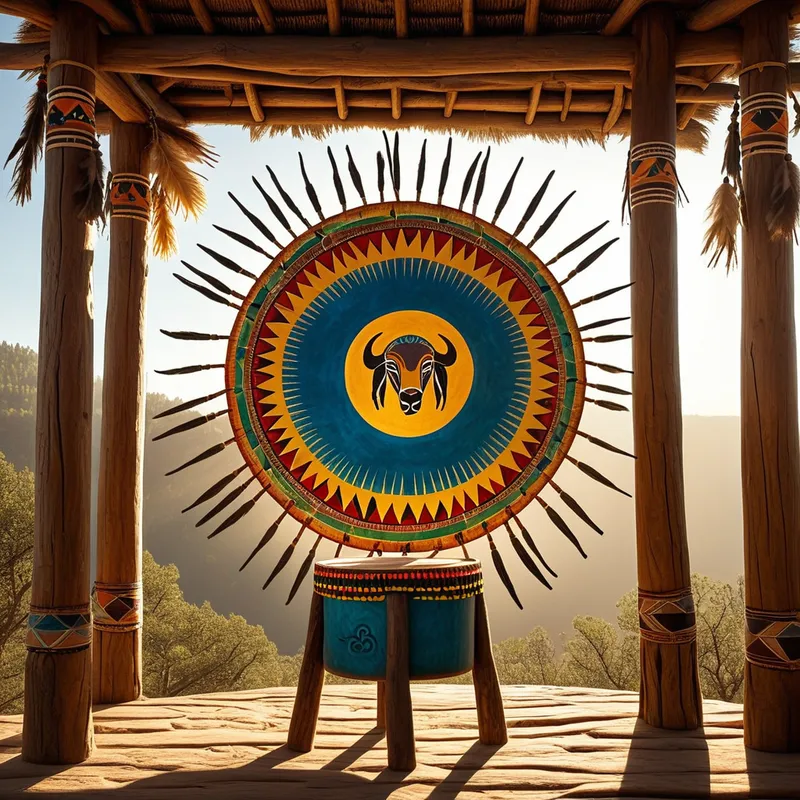
Sun Dance Drum Myth Meaning & Symbolism
A sacred drum is born from a warrior's sacrifice, becoming the heartbeat of the Sun Dance and the people's enduring connection to Wakan Tanka.
The Tale of Sun Dance Drum
In the time when the grass was a sea of whispering green and the sky was the breath of Wakan Tanka, the people walked with a longing. The sun, Wi, climbed high and hot, but its light felt distant, its warmth a memory held in stone. The buffalo were shadows on the plains, and a silence had fallen upon the hearts of the people—a silence deeper than winter, where even the prayers seemed to fall like stones into a dry well.
A man, a warrior whose name is remembered not for his victories in battle but for the battle within his soul, heard this silence. He took his pipe, filled it with the sacred canli wakan, and walked away from the circle of lodges. For four days and four nights, he climbed the breast of the world, a solitary figure against the immense dome of sky. He cried for a vision, his voice raw, his body a vessel of pure need. “Tunkasila,” he cried, “Grandfather, how do we speak to you when our voices are swallowed by the wind? How do we remember the song of our connection?”
On the fourth day, as the sun bled its light onto the western hills, the vision came. It was not a figure, but a sound. A deep, resonant, thrumming pulse that seemed to come from the very heart of the earth and the center of the sun at once. It was the heartbeat of Maka Ina. It was the rhythm of Skan. It was the steady, life-giving pulse of Wi himself. The sound entered the man’s chest and wrapped around his own heart, until the two beats became one.
A voice, older than stone, spoke without words: “You have heard the heartbeat of All That Is. To make this sound walk among the people, a vessel must be made. The vessel must be born of sacrifice, of something given wholly, not taken.”
The man returned to his people, his eyes holding the quiet fire of the vision. He explained what was required. From the sacred Tatanka, who gives his body so the people may live, would come the hide. From the standing people, the trees, would come the frame. But the voice, the living spirit of the drum, required more. It required a piece of a human heart, willingly offered.
Without hesitation, the warrior prepared. In a ceremony of profound solemnity, beneath the gaze of the sun and the witnessing earth, a small piece of flesh was ritually given. This offering was placed, still warm with life, at the center of the stretched hide as the drum was made. As the last lacing was pulled tight, a miracle unfolded. The drum did not need to be struck. A low, soft boom emanated from it, a sound that vibrated in the chests of all who stood near. It was the heartbeat they had forgotten.
They built the Inipi arbor. They raised the sacred tree at its center. And for the first time, with the drum pulsing its autonomous song, the people danced. They danced until their own individual hearts synchronized with that greater pulse. They danced until the boundary between person and prairie, between breath and wind, between dancer and sun, dissolved. The drum was no longer an object. It was the returned heartbeat of the world, and through its sound, the people were whole again.
Cultural Origins & Context
This profound narrative is woven into the spiritual tapestry of the Lakota, specifically within the context of the Wiwanyang Wacipi, or Sun Dance. It is not merely a story of origin for a ritual object, but a foundational explanation for the ceremony’s transformative power. The myth was traditionally held and transmitted by the Wicasa Wakan, the holy men and women, who understood the drum as a living entity, not a crafted instrument.
Its societal function was multifaceted. It sacralized the act of participation in the Sun Dance, framing the dancers’ sacrifices—of flesh, of comfort, of the self—as an echo of the primordial sacrifice that gave the drum its voice. It established the drum as the central axis of the ceremony, the literal and metaphorical heart around which the community regenerated itself, ensuring cosmic and ecological balance. The myth taught that true power and connection are not seized, but received through humble offering and aligned participation in a reality far greater than the individual.
Symbolic Architecture
At its core, the Sun Dance Drum is the symbol of the anima mundi—the world soul—made audible. It represents the hidden, sustaining rhythm that undergirds all of existence, the coherent pulse that organizes chaos into cosmos.
The drum is the point where the individual will surrenders to the universal rhythm, where personal pain is alchemized into communal sustenance.
The warrior’s quest symbolizes the human yearning for reconnection with the source, a profound spiritual hunger. His sacrifice is not one of loss, but of fusion; a piece of his own heart becomes the conductor for the heart of the universe. The autonomous sound of the drum signifies that this sacred connection, once authentically established, becomes self-sustaining and generative. It exists independently of human action, yet humans must align themselves with it to be healed and made whole.
Psychologically, the drum represents the Self in the Jungian sense—the central, organizing principle of the psyche that transcends the ego. The ego (the individual warrior) must make a sacrifice—of its grandiosity, its isolation, its control—to allow the voice of the deeper, transpersonal Self to be heard. The hide of the buffalo symbolizes the raw, instinctual body of the psyche, while the offered flesh represents the conscious ego’s willing participation in its own transformation.
The Dreamer's Resonance
When this mythic pattern surfaces in modern dreams, it often signals a profound somatic and psychological process of re-attunement. The dreamer may hear a deep, pervasive drumming with no visible source, or find themselves holding or becoming a drum. They may witness a heart transforming into a resonant object, or feel their own chest cavity vibrating with a powerful, external rhythm.
This dream imagery points to a crisis of disconnection. The dreamer’s psyche is signaling that their personal rhythm—their drives, ambitions, daily life—is out of sync with a deeper, soul-level pulse. The somatic sensation of vibration indicates the unconscious attempting to re-calibrate the nervous system, to shake loose the encrustations of the persona and modern alienation. It is an invitation, and sometimes a demand, to make a sacrifice: to willingly give up an outdated identity, a cherished wound, or a rigid pattern of control (the piece of the heart) to restore contact with the authentic, guiding core of the Self. The process can feel destabilizing, as the ego’s familiar beat is challenged by a more primordial and powerful one.
Alchemical Translation
The myth models the complete arc of psychic transmutation, or individuation. It begins with the nigredo, the blackening: the warrior’s—and the people’s—experience of spiritual dryness, silence, and disconnection. This is the necessary despair that initiates the quest.
The vision on the mountain represents the albedo, the whitening: the illuminating insight from the unconscious, the revelation of the hidden unifying principle (the cosmic heartbeat). This is the moment of divine knowledge.
The sacrifice is the pivotal rubedo, the reddening: the conscious, painful, yet willing enactment of the insight. This is the alchemical “fixing of the volatile.” The ego’s substance (the flesh) is offered to be integrated into a greater, enduring vessel. It is not destroyed, but transposed; its energy is essential to give form and voice to the transcendent.
Individuation is not about becoming a louder, more isolated note, but about tuning one’s entire being to the fundamental frequency of the Self, thereby becoming a clear resonator for a music that was always there.
Finally, the autonomous drum and the unifying dance represent the citrinitas, the yellowing or awakening: the establishment of a new, sustainable psychic structure. The connection is no longer a sought-after experience but a permanent, living reality. The individual, through their sacrifice, becomes a conduit for the nourishing power of the Self, which in turn regenerates their relationship to the community and the cosmos. The modern seeker’s journey mirrors this: from the alienation of the unexamined life, through the painful sacrifices of self-knowledge, to the discovery of an inner authority and rhythm that connects them meaningfully to the world.
Associated Symbols
Explore related symbols from the CaleaDream lexicon: