
Sulfur Myth Meaning & Symbolism
The volatile spirit of transformation, a divine fire imprisoned in matter, whose liberation forges the Philosopher's Stone and the soul's gold.
The Tale of Sulfur
Listen, and hear the tale of the Imprisoned Sun.
In the beginning, before the first crucible was fired, the world was a body without a soul—a magnificent, intricate corpse of stone and metal and salt water. It was perfect in its order, and utterly, profoundly still. Within the deepest veins of the earth, in chambers where no light had ever fallen, slept the secret king. He was not of flesh, nor of stone, but of a substance more primal: a consciousness of pure, unbridled fire. The alchemists named him Sulfur.
He was the desire of the sun trapped in the belly of the mountain, the will to become that churned in the heart of the inert. His essence was a roaring, golden-red spirit, a being of passion, volatility, and divine rage. To be near him was to feel the urge to create, to destroy, to ascend. Yet, he was bound. Not by chains of iron, but by the perfect, cold embrace of his brother, Mercury—the quick, silver fluid of the mind—and the dense, stubborn flesh of the world, Salt.
His prison was the very matter of reality. In every lump of coal, in every glittering pyrite, in every stinking mound of yellow brimstone, the King of Fire screamed in silence. He was the heat in the blood, the ambition in the heart, the brilliant, destructive idea that could not find its form. The conflict was the cosmos itself: the spirit yearning to be free, perpetually crucified upon the cross of substance.
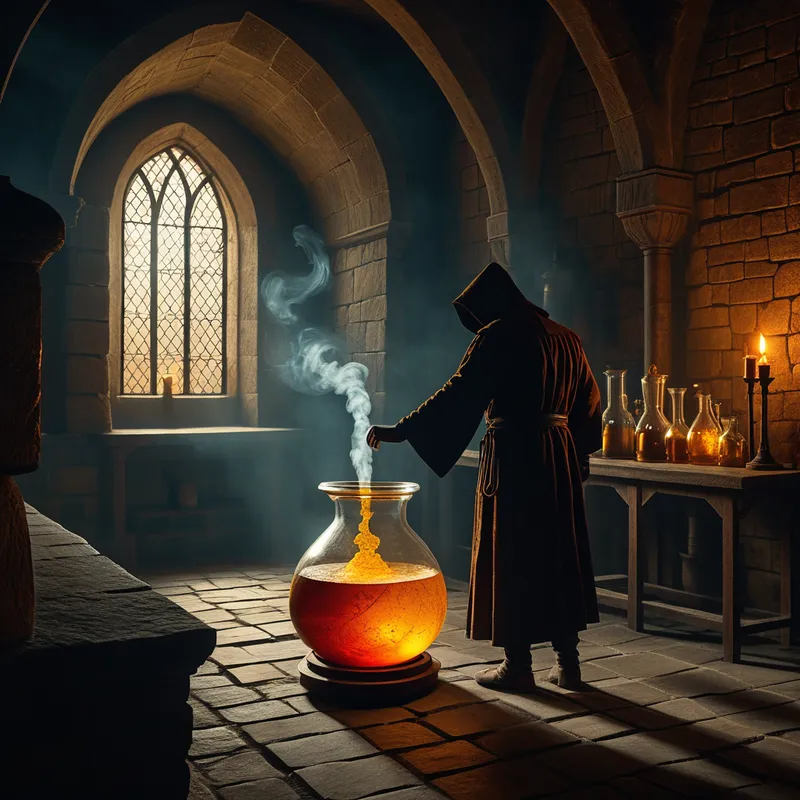
Then came the Artificer, the Alchemist. Guided by dreams and the faint, feverish glow from within the earth, they learned the secret language of fire. They built a womb of clay and glass—the Hermetic Vessel. Into it, they placed the raw, sleeping king: a piece of ore, a venom, a foul and base substance. The work, the Magnum Opus, began not with a shout, but with a slow, applied heat.
This was the betrayal and the salvation. The fire without awakened the fire within. Sulfur, the imprisoned spirit, roared to life. He raged against the walls of his glass cell, a dancing, malevolent demon of color and fume. He sought to escape, to burn the laboratory to ash, to return to his wild, unbound state. This was the Nigredo, the black death, where all seemed ruined.
But the Artificer held the heat steady. Through this torment, this violent struggle, a miracle occurred. The fury of Sulfur did not shatter the vessel; it began to cook the substance that bound him. His own divine fire acted upon the body of Salt, and the mediating breath of Mercury carried the change. The foul matter broke down, putrefied, and from that blackness, something new arose. The rage of the king was not extinguished, but transmuted. It became a focused, purifying force.
After long nights of putrefaction and washing, a sequence of colors would flash within the vessel—the Peacock's Tail, a promise. Then, a white dawn (Albedo), and finally, the glorious, permanent sunrise of Rubedo. The volatile, destructive spirit had not escaped. He had redeemed his prison. He had married the body, and from their union in the crucible of will, the Philosopher's Stone was born—a fragment of the liberated, incarnate sun. The King was no longer imprisoned in matter; he was its crowned ruler, and his kingdom was Gold.
Cultural Origins & Context
The myth of Sulfur is not a narrative passed down by bards, but one etched in laboratory notes, encoded in cryptic emblems, and whispered in the clandestine networks of early modern Europe. Its culture is that of Alchemy, a practice spanning from Hellenistic Egypt through the Islamic Golden Age to the courts and monasteries of medieval and Renaissance Europe. This was a liminal space where science, philosophy, mysticism, and art were not yet divorced.
The "myth" was performed, not merely told. The alchemist, often working in solitude, was both the priest and the protagonist of the Sulfur drama. They saw the story unfold in their retort: the violent reaction of a metal with acid, the sublimation of bright yellow crystals from a foul mixture, the dangerous, intoxicating fumes. These were not chemical reactions to them, but the visible struggles of the world soul. Texts like the Rosarium Philosophorum or the works of Paracelsus used the language of myth to describe these processes, personifying Sulfur as the Red King, the Lion, the inward fire. Its societal function was deeply subversive; it proposed that divinity and transformation were not locked in a distant heaven, but buried within the most base and despised materials of the earth—and, by analogy, within the flawed human soul.
Symbolic Architecture
Sulfur represents the irreducible spark of individual consciousness—the fiery core of desire, will, and identity. It is the principle of active becoming.
Sulfur is the "why" behind existence. It is the question that burns in the dark, the ambition that refuses comfort, the passionate anger at all forms of limitation.
Psychologically, Sulfur corresponds to the Self in its dynamic, driving aspect. It is not the peaceful, integrated Self of completion, but the Self as a demand for realization. It is our unique, God-given character, our "daemon" in the ancient sense. In its raw, unintegrated state, this fiery spirit is dangerous: it manifests as unchecked ego, explosive rage, obsessive ambition, or fanatical idealism—the tyrant who would burn the world to feel his power. Its imprisonment in "Salt" (the physical body and concrete reality) and its entanglement with "Mercury" (the fluid intellect and imagination) creates the fundamental tension of human life: the spirit's struggle to manifest itself without destroying its vessel.
The Dreamer's Resonance
To dream of Sulfur is to dream of a pressure cooker nearing its limit. Common motifs include: volcanoes threatening to erupt from within one's own chest; being trapped in a small, hot room (the vas); discovering a brilliant but dangerously unstable gem or energy source; or encountering a charismatic, angry, and radiant figure who is both terrifying and magnetic.
Somatically, this points to a process of intense psychic heat and pressure. The dreamer is likely experiencing a period where their core identity, their deepest desires or values, feel stifled by life circumstances, societal expectations, or their own psychological structures (the Salt). The volatile energy of the true self is building, demanding expression. This is not a peaceful process; it is a somatic crisis of transformation. The body may register it as anxiety, restlessness, inflammatory conditions, or a feverish creative impulse that feels almost out of control. The dream signals that a fundamental aspect of the psyche can no longer be contained in its old form and must undergo a radical, and often frightening, transmutation.

Alchemical Translation
The alchemical process with Sulfur is the model for modern individuation. It teaches that the path to the "gold" of the authentic Self is not through suppressing our fiery, volatile nature, but through consciously containing and directing it.
The first step is Recognition (The Finding of the Ore): We must identify our "Sulfur"—our raw, often unacceptable passions, our fiery complexes, our divine discontent. This is the shadow work of acknowledging the powerful, selfish, glorious will within.
The second is Containment (The Hermetic Vessel): We must create a conscious container for this energy. This is the discipline of therapy, spiritual practice, or artistic form—the "vessel" of the ego-structure that can withstand the heat without shattering. We apply the steady heat of attention to our inner conflict.
The crucible is not a torture chamber, but a womb. The fire of Sulfur is not to be extinguished, but to be used as the sole instrument of its own purification.
The third is Transmutation (The Great Work): As we hold the tension between our fiery spirit and our limiting realities (Nigredo), the fury itself begins to break down our inner rigidity. The rage, when consciously endured, burns away illusion. The ambition, when focused, forges new capacities. The volatile spirit slowly learns to animate the whole personality, not just rebel against it. What was a destructive flame becomes a guiding and creative light (Rubedo).
The liberated Sulfur is no longer the rebel against existence, but the reborn ruler of one's own inner kingdom. The Stone that is produced is the integrated personality, where the fiery spirit willingly inhabits and glorifies the earthly life, transforming base experience into the gold of meaning. The myth of Sulfur tells us that our deepest, most dangerous nature is not our flaw, but the prima materia of our divinity.
Associated Symbols
Explore related symbols from the CaleaDream lexicon: