Suka Myth Meaning & Symbolism
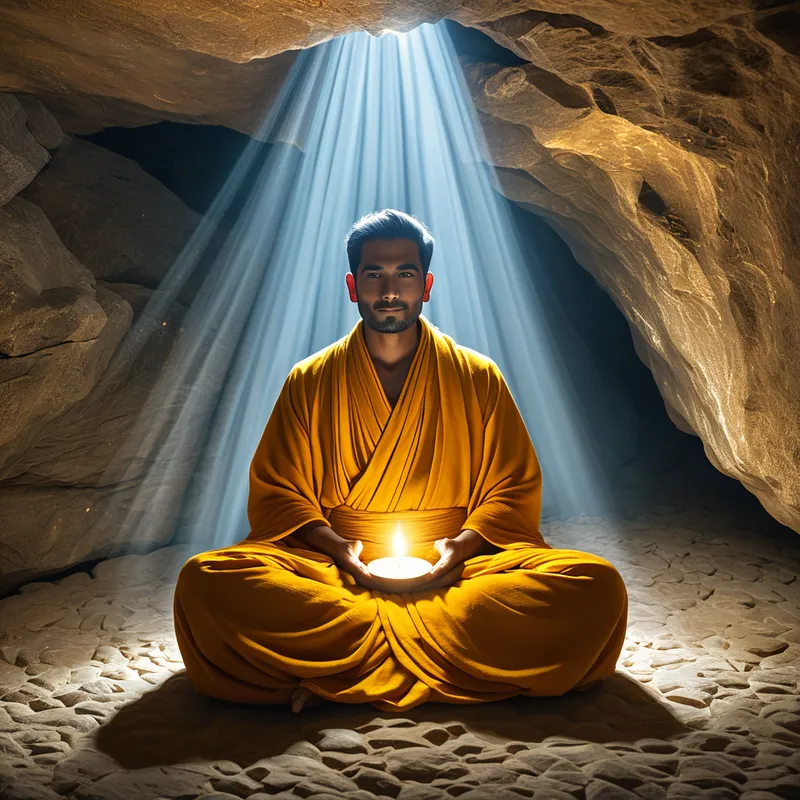
The story of the sage Suka, born fully realized, who transcends all earthly bonds to achieve the ultimate state of formless liberation.
The Tale of Suka
Listen. Before [the world](/myths/the-world “Myth from Tarot culture.”/) was only history, when the mountains were young and the rivers sang with clearer voices, there lived a sage whose mind was the library of the universe. His name was [Vyasa](/myths/vyasa “Myth from Hindu culture.”/), the arranger, the one who tried to contain the ocean of truth in [the vessel](/myths/the-vessel “Myth from Alchemical culture.”/) of words. Yet, for all his wisdom, a profound loneliness echoed in his heart—a longing not for a son of flesh, but for a successor of spirit, one who could receive the final, unspeakable knowledge.
He performed austerities so fierce they bent the attention of the gods themselves. He called upon the god Brahma, [the architect](/myths/the-architect “Myth from Various culture.”/) of forms. “Grant me a son,” Vyasa implored, “but not one bound by the chains of maya. Let him be free from the moment he is conceived.” Brahma, his four faces contemplating the depths of this request, agreed. But such a being could not be born of a mortal womb, for the very act of birth imprints attachment. The solution was whispered on [the wind](/myths/the-wind “Myth from Various culture.”/).
Vyasa saw an Arundhati plant, a humble reed swaying by a riverbank. Into this vessel of nature, his spiritual energy was transferred. In time, a beautiful, radiant boy emerged not from a mother’s cry, but from the splitting of the reed’s shaft. He did not wail; he was silent, his eyes holding the calm of the deepest cosmos. They named him Suka, for his purity and his potential to echo divine truth.
The boy grew not in years, but in realization. He was drawn not to play, but to the forests of silent inquiry. Vyasa, overflowing with a father’s love and a teacher’s duty, sought to bind him—to the world, to the family, to the great epic he had written, the Mahabharata. He asked Suka to listen to it, hoping the tale of duty, love, and war would stir something earthly in him. Suka listened with perfect attention, yet at the tale’s end, he had only one, devastating question: “Father, is there a story where no one is bound? Where no one grieves?”
Vyasa understood then that his son was already gone from the shore of worldly narratives. The final test came at the banks of the [Ganga](/myths/ganga “Myth from Hindu culture.”/). Vyasa, in a last, desperate act of paternal attachment, called out to [the river](/myths/the-river “Myth from Buddhist culture.”/) goddess to stop his son, who was about to renounce the world. The river rose in mighty waves, but Suka, seeing only the divine mother in all forms, bowed to her. The waters, recognizing his absolute purity, parted in reverence. As Suka walked across, celestial [nymphs](/myths/nymphs “Myth from Greek culture.”/), the Apsaras, bathing downstream, were unmoved by his physical beauty, for they saw no man—only a consciousness untouched by form. In shame at their own perception, they clothed themselves.
Suka journeyed to the [Mount Kailash](/myths/mount-kailash “Myth from Hindu culture.”/), the abode of [Shiva](/myths/shiva “Myth from Hindu culture.”/). There, he received the ultimate, formless wisdom. And then, he performed the ultimate act of liberation. His consciousness dissolved into the elements. When King Janaka heard a divine sound and sent messengers, they found not a body, but only Suka’s voice echoing from a crack in a rock, teaching them the truth of the Brahman, before it too faded into silence.

Cultural Origins & Context
The myth of Suka is primarily enshrined within the Puranic literature, especially the Bhagavata Purana and the Shiva Purana. Its transmission is deeply interwoven with the Bhakti and Jnana traditions, serving as a narrative bridge between epic storytelling and abstract philosophy.
The story was told by sages to disciples not merely as biography, but as a living map of the ideal spiritual destiny. It functioned as a societal counter-narrative. In a culture deeply structured by dharma, familial bonds, and lineage (the very work of Vyasa), Suka’s tale presents the ultimate transcendence of those structures. It validated the path of the [sannyasin](/myths/sannyasin “Myth from Hindu culture.”/), not as a rejection of society, but as the fulfillment of a consciousness that society itself cannot contain. The myth served as a reminder that the highest knowledge (para vidya) ultimately leads beyond all forms, even the most sacred stories and rituals.
Symbolic Architecture
Suka is not a [hero](/symbols/hero “Symbol: A hero embodies strength, courage, and the ability to overcome significant challenges.”/) who struggles toward enlightenment; he is enlightenment incarnate, struggling to shed the final illusions of embodiment and [relationship](/symbols/relationship “Symbol: A representation of connections we have with others in our lives, often reflecting our emotional state.”/). His [birth](/symbols/birth “Symbol: Birth symbolizes new beginnings, transformation, and the potential for growth and development.”/) from a [reed](/symbols/reed “Symbol: A flexible plant symbolizing resilience, adaptability, and vulnerability. It bends without breaking, representing survival through yielding.”/) is the first profound [symbol](/symbols/symbol “Symbol: A symbol can represent an idea, concept, or belief, serving as a powerful tool for communication and understanding.”/).
The true sage is not born of human conflict, but from the hollow vessel of nature, already empty of self.
The reed (Arundhati) is hollow, representing a mind free of egoistic content, a [conduit](/symbols/conduit “Symbol: A passage or channel that transfers energy, information, or substance from one place to another, often hidden or structural.”/) for the [breath](/symbols/breath “Symbol: Breath symbolizes life, vitality, and the connection between the physical and spiritual realms.”/) of the divine ([prana](/symbols/prana “Symbol: In Hindu and yogic traditions, prana is the universal life force or vital energy that animates all living beings and permeates the cosmos.”/)). His very name, meaning “[parrot](/symbols/parrot “Symbol: A parrot represents communication, adaptability, and the ability to mimic or reflect the voices around us.”/),” is deeply ironic. A parrot mimics sound without attachment to meaning. Suka, however, is the anti-parrot: he embodies the meaning so completely that he transcends the need to repeat [the forms](/myths/the-forms “Myth from Platonic culture.”/) of scripture. His question about a [story](/symbols/story “Symbol: The symbol of ‘Story’ represents the narrative woven through our lives, embodying experiences, lessons, and emotions that shape our identities.”/) without bondage dismantles the entire edifice of narrative [identity](/symbols/identity “Symbol: Identity represents the sense of self, encompassing personal beliefs, cultural background, and social roles.”/), the root of [the ego](/myths/the-ego “Myth from Jungian culture.”/).
The pivotal scene at the [river](/symbols/river “Symbol: A river often symbolizes the flow of emotions, the passage of time, and life’s journey, reflecting transitions and movement in one’s life.”/) Ganga is a masterful symbolic tableau. Vyasa’s call represents the binding power of ancestral and emotional [karma](/myths/karma “Myth from Hindu culture.”/). The river’s obedience to Vyasa but reverence for Suka illustrates [the hierarchy](/symbols/the-hierarchy “Symbol: A structured system of ranking, power, and social order, often representing authority, status, and one’s position within a group or society.”/) of realities: the power of a great sage over [nature](/symbols/nature “Symbol: Nature symbolizes growth, connectivity, and the primal forces of existence.”/), and the power of a liberated being over the very concept of power. The Apsaras’ [shame](/symbols/shame “Symbol: A painful emotion arising from perceived failure or violation of social norms, often involving exposure of vulnerability or wrongdoing.”/) is the shame of maya itself when confronted with pure, unattached [consciousness](/symbols/consciousness “Symbol: Consciousness represents the state of awareness and perception, encompassing thoughts, feelings, and experiences.”/); their covering is the illusion recoiling from the [truth](/symbols/truth “Symbol: Truth represents authenticity, honesty, and the quest for knowledge beyond mere appearances.”/).
His final [dissolution](/symbols/dissolution “Symbol: The process of breaking down, dispersing, or losing form, often representing transformation, release, or the end of a state of being.”/) is the core symbol. He does not “die” in a celestial [chariot](/symbols/chariot “Symbol: The chariot signifies control, direction, and power in one’s journey through life.”/); he unmakes himself.
Liberation is not an arrival, but a departure from the very vehicle of arrival.
The Dreamer’s Resonance
When this myth stirs in the modern unconscious, it rarely appears as a literal sage. Its resonance is more subtle, a pattern felt in dreams of profound detachment or effortless transcendence.
One might dream of walking through walls or dense crowds without being touched, symbolizing a nascent feeling of being in the world but not of it, a Suka-like immunity to social and emotional entanglement. Dreams of hearing a beautiful, instructive voice from a natural object—a stone, a tree, a stream—echo Suka’s final teaching from the rock. This can indicate a deep, intuitive wisdom emerging from the bedrock of the [psyche](/myths/psyche “Myth from Greek culture.”/), bypassing the rational mind (the father/Vyasa figure).
Conversely, the dreamer may find themselves in the role of Vyasa: crafting something immense (a project, a family, an identity) only to see its intended heir—a part of their own psyche representing pure potential—simply walk away from it, untouched. This can feel like a dream of profound loss, but psychologically, it marks the necessary death of the ego’s ambition to control the spirit’s destiny. The somatic sensation is often one of a deep, bittersweet release, a cracking open in the chest where grief and awe are indistinguishable.

Alchemical Translation
The alchemical process modeled here is the ultimate [solve et coagula](/myths/solve-et-coagula “Myth from Alchemical culture.”/): the dissolution that requires no recombination. For the modern individual, Vyasa represents the accumulated self—the complex history, trauma, knowledge, and narrative we spend a lifetime compiling. This is the necessary first work: to become a coherent, wise, and cultured self. Suka represents the shocking, non-negotiable next step: the part of the psyche that must leave all that hard-won cultivation behind to achieve true freedom.
The individuation process here is not about integrating [the shadow](/myths/the-shadow “Myth from Jungian culture.”/) or anima, but about recognizing the witness that is prior to all such archetypal contents. Suka is the symbol of [the Self](/myths/the-self “Myth from Jungian culture.”/) ([Purusha](/myths/purusha “Myth from Hindu culture.”/)) in its most radical form: consciousness without a personal substrate.
The journey is not from ignorance to knowledge, but from knowledge to the knower, and finally, from the knower to knowing itself.
The modern seeker’s “Mount Kailash” is the inner peak of non-attachment, where even the attachment to being a seeker, to having a spiritual identity, is surrendered. The “dissolution into the elements” is the psychological experience where the sense of a centralized “I” observing thoughts, feelings, and sensations evaporates, leaving only the suchness of experience. What remains is not a void, but what the myth calls the “echo in the rock”—a compassionate, impersonal wisdom that can guide others, not from a place of personhood, but from the reality of the ground of being itself. The myth assures us that this is not annihilation, but the fulfillment of human potential in its most absolute, transcendent expression.
Associated Symbols
Explore related symbols from the CaleaDream lexicon: