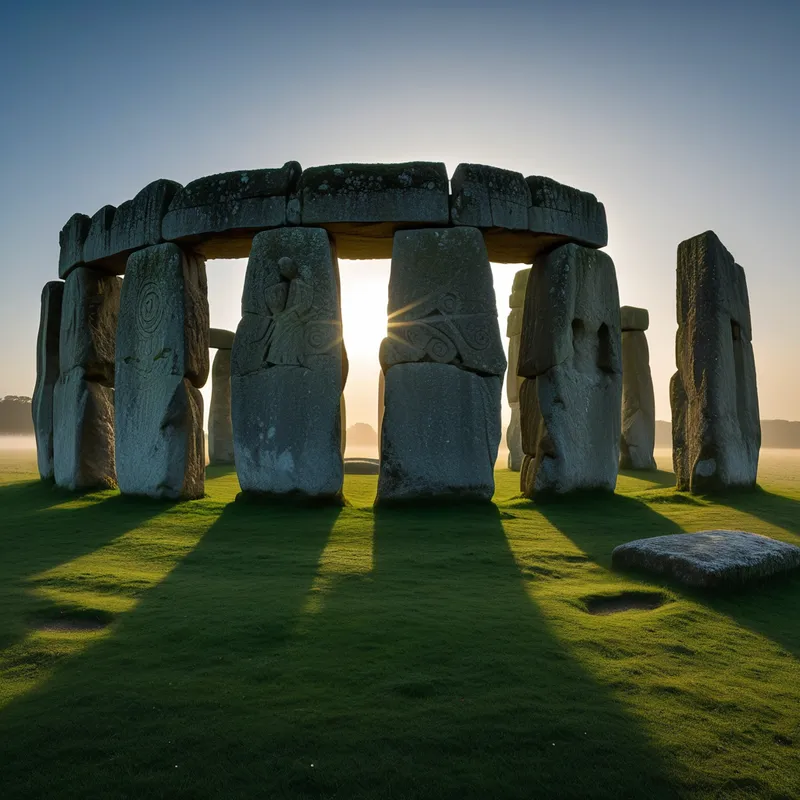
Stonehenge Myth Meaning & Symbolism
A tale of Merlin's magic, giants' stones, and a king's ambition, where a circle of stone is raised to heal a land and mark a covenant with the earth.
The Tale of Stonehenge
Listen, and hear the tale of the Giants’ Dance, the circle that was not built, but sung into being.
The land was sick. The blood of noble knights, spilled in treachery, soaked the earth of Salisbury Plain, and a curse of silence fell upon it. No crop would grow; the wind carried only the whispers of the dead. Uther Pendragon, newly crowned, felt the weight of this blight. His kingship was a hollow crown if the land itself rejected him. In his despair, he summoned the one soul who walked the threshold between worlds: Myrddin, whom we call Merlin.
Merlin came not as a courtier, but as a force of nature, his eyes holding the depth of forest pools and the cold fire of distant stars. “The land grieves,” he said, his voice like stone grinding on stone. “It remembers the sacrilege. To heal a wound of blood, you must make an offering of bone—the bone of the earth itself. We must raise a temple that mirrors the heavens, a circle to bind the curse and turn it into memory.”
Uther, desperate, agreed. But where to find such stones? Merlin smiled a thin, knowing smile. “Across the sea, in the land of Éire, on Mount Killaraus, the giants of old play. They dance in a great ring, stones that were hauled from the ends of the world when the earth was young. These stones hold the old magic, the song of creation.”
He led Uther’s mightiest warriors, not with maps, but with dreams. They crossed the treacherous sea, arriving on shores cloaked in mist. There stood the circle, the Chorea Gigantum—the Giants’ Dance. The Irish king, defending this sacred ground, laughed at their folly. “Take them if you can,” he jeered. “Not even my strongest five hundred men could budge the smallest.”
Then Merlin stepped forward. He did not call upon armies. He closed his eyes and began to hum, a low vibration that made the very air shimmer. He spoke words that were not words, sounds that unlocked the stones from their sleep in the earth. One by one, the colossal monoliths sighed, shuddered, and lifted themselves from their sockets as lightly as feathers. The warriors watched, breathless, as Merlin’s will wrapped around the stones like invisible hands. He guided them down to the ships, where they settled without a sound, and the fleet sailed back to Britain as if borne by a benevolent tide.
On the plain, Merlin directed the placing of each stone. He used no rope or oxen. With a gesture, the great sarsens rose and walked to their places. The smaller bluestones, humming with their journey from the western isles, were set within. He aligned the heel stone so that on the longest day, the sun’s first light would spear through the heart of the circle and strike the altar stone, a dagger of dawn. As the final stone settled into the earth, a deep, resonant tone echoed across the plain—a single, clear note that silenced the cursed whispers. The grass began to green at the circle’s edge. The curse was bound, transmuted by geometry and song. The Giants’ Dance now stood, not as a trophy, but as a covenant: a promise that kings would heed the wisdom of the land, and the land, in turn, would uphold the king.

Cultural Origins & Context
The primary source for this mythological narrative is the Historia Regum Britanniae (History of the Kings of Britain), written by Geoffrey of Monmouth around 1136. While Geoffrey wrote in Latin and his work is a pseudo-historical chronicle, it is a vital repository of Celtic mythic material, repackaged for a Norman audience. The tale of Merlin transporting the stones from Ireland is a classic example of the medieval fascination with explaining megalithic wonders through magical etiology.
Geoffrey drew upon older Welsh traditions and the figure of Myrddin Wyllt (Merlin the Wild), a bard and seer who lived in the forest, possessed of deep, archaic wisdom. By grafting this Celtic prophetic figure onto the monument of Stonehenge—which was already thousands of years old and of profound, mysterious significance to the Britons—Geoffrey created a powerful founding myth. It served a crucial societal function: it provided a glorious, magical origin for a pre-existing national monument, thereby claiming it for the British (specifically Celtic-British) cultural identity, rooting royal authority in a deep, enchanted past. It was a story told not around ancient fires, but in monastic scriptoria and royal courts, used to legitimize lineage and connect the present kingdom to a mythic age of giants and druids.
Symbolic Architecture
At its core, this is not a story of construction, but of translation and integration. The stones represent a primal, chthonic power—the raw, untamed magic of the giants and the old earth of Ireland. They are the unformed potential, the chaotic prima materia of the psyche and the land.
The circle is not a cage, but a crucible. It does not imprison power; it concentrates it, making transformation possible.
Merlin, the magician archetype, is the conscious mind, the guiding intelligence that can perceive the needed remedy and enact the impossible. He does not conquer the stones through brute force, but through understanding—he knows their true names, their song. His act of moving them is an act of psychological relocation: retrieving potent, buried complexes (the stones from a distant land) and bringing them to the center of one’s being (the plain of the self) to address a core wound (the cursed land).
The alignment with the solstice sun introduces the principle of cosmic order, of synchronizing human endeavor with celestial cycles. The completed Stonehenge symbolizes the achieved Self—a structure where inner chaos (giants’ dance) is reorganized into a meaningful, life-sustaining pattern (a healing temple). The curse of spilled blood represents unintegrated trauma, which festers and poisons the whole system until it is consciously addressed and ritualistically contained within a new, stable structure.
The Dreamer's Resonance
To dream of Stonehenge is to dream of the Self in its most architectural form. The dreamer may find themselves within a circle of towering stones, which could feel either sanctuary-like or imprisoning. The somatic feeling is often one of immense weight, awe, and a profound, vibrational hum—a sense of standing at an axis mundi, a center of the world.
Psychologically, this dream emerges during a phase of profound re-ordering. The psyche is attempting to integrate massive, seemingly immovable elements of one’s history or personality (“giants’ stones”). There is a feeling of being tasked with an impossible project: to heal a foundational wound or create lasting, meaningful structure in one’s life. The dream may highlight a “Merlin” aspect—an inner resource of deep intuition or knowledge that knows how to move these burdens without brute force. Alternatively, the absence of Merlin in the dream can signal a feeling of being overwhelmed by these monolithic life-issues, facing them with only one’s own inadequate strength. The dream is a call to find the enchanter within, to listen for the song that can unlock and relocate these burdens.

Alchemical Translation
The myth of Stonehenge is a perfect allegory for the alchemical opus, the great work of individuation. The nigredo, or blackening, is the cursed, barren plain—the state of depression, fragmentation, and meaninglessness following a trauma or life-shattering event.
The retrieval of the stones from Ireland is the albedo, the whitening. It is the conscious, often perilous journey into the unconscious (the misty isle of the Otherworld) to gather the scattered, primal components of the self. These are the “giant” parts of us: our immense capacities, our ancestral inheritances, our core complexes that seem foreign and unwieldy.
The miracle is not in the lifting, but in the listening. The stone moves when it is heard.
Merlin’s magic represents the citrinitas, the yellowing or enlightening. This is the application of conscious insight and symbolic understanding (the magical words, the alignment with cosmic patterns) to these raw materials. It is the insight that transforms burden into foundation.
Finally, the raising of the circle and the healing of the land is the rubedo, the reddening. This is the culmination: the creation of a durable, sacred structure for the psyche. The once-cursed blood of the past becomes the sacred ground of the present. The individual is no longer ruled by chaotic, giant forces, but has built a temple where those very forces are honored, placed, and given a purpose—to mark the seasons of the soul and let the light of consciousness strike true at the appointed hour. The Self stands complete, a stone circle in the vast plain of being, both a sanctuary and a beacon.
Associated Symbols
Explore related symbols from the CaleaDream lexicon: