Stigmata Myth Meaning & Symbolism
The mystical phenomenon where a devotee's body spontaneously bears the crucifixion wounds of Christ, a sign of ultimate empathy and divine suffering.
The Tale of Stigmata
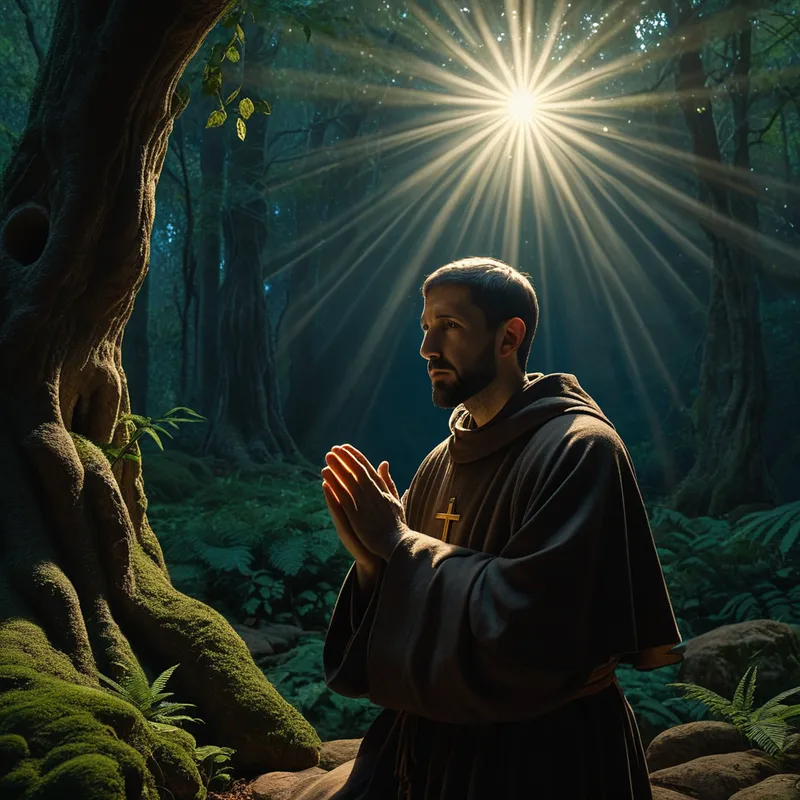
Listen, and let [the veil between worlds](/myths/the-veil-between-worlds “Myth from Celtic culture.”/) grow thin. It was not in the golden halls of kings or the marble courts of emperors that this mystery unfolded, but in the wild, aching heart of creation itself. The air on Mount La Verna was sharp with the coming autumn, smelling of pine resin and cold stone. Here, a man named Francis had retreated, his body frail, his spirit a burning wick longing to be consumed by its source.
He had come to fast, to pray, to seek the face of the Beloved in the silence. His desire was a single, piercing note: to know, not in thought but in marrow and sinew, [the passion](/myths/the-passion “Myth from Christian culture.”/) of his Lord. As the Feast of the Exaltation of the Holy Cross dawned, the boundary between prayer and vision dissolved. [The sky](/myths/the-sky “Myth from Persian culture.”/) did not split, but the fabric of his perception did.
Before him, suspended in the air as if between heaven and earth, was a Seraph. But this was no gentle being of light; it was crucified, its six wings a shimmering, sorrowful glory, and in its center burned the indelible image of the Crucified One. The vision was not to be seen, but to be received. A searing love, terrible and beautiful, shot forth from the wounds of the celestial figure—from hands, from feet, from the sacred side.
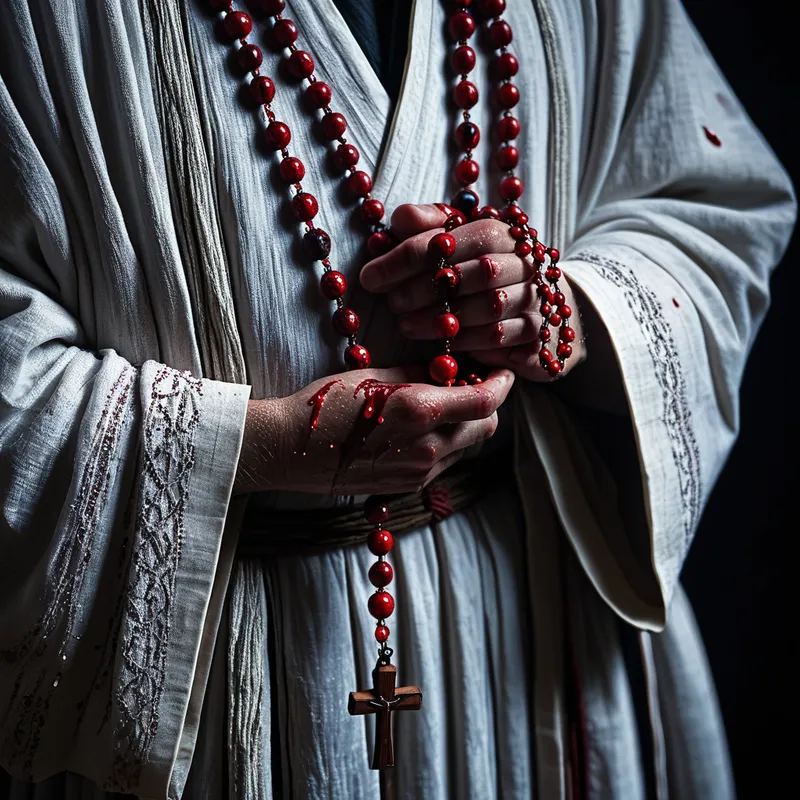
It entered Francis not as light enters a room, but as a nail enters wood. There was no sound of hammer, but his whole being resonated with the impact. A fire, cool and burning all at once, branded his flesh. When the vision faded, leaving only the sighing wind in the trees, he was changed. Upon his own hands and feet were wounds, not torn but perfectly formed, that passed through flesh. In his side, a red, weeping gash echoed the lance’s thrust. They were wounds of love, bleeding a quiet, sacred testimony. He hid them, this humble man, but the perfume of his suffering—the sweet, iron scent of blood mingled with utter compassion—could not be concealed. He had asked to share in the suffering, and the universe, in its profound mystery, had answered in the flesh.
Cultural Origins & Context
The phenomenon of the stigmata first entered Christian consciousness with the experience of [Francis of Assisi](/myths/francis-of-assisi “Myth from Christian culture.”/) in 1224. While the desire for mystical union with Christ’s Passion existed before, Francis’s case provided a tangible, physical template that was meticulously documented by his brothers and the Church. It created a powerful new category of mystical experience: the body itself becoming a living scripture, a testament written in pain.
The myth was passed down not through epic poems but through hagiographies—the lives of [saints](/myths/saints “Myth from Christian culture.”/)—and ecclesiastical investigations. It served a critical societal and theological function. In a medieval world deeply visual and tactile, the stigmata was the ultimate proof of divine favor and the reality of Christ’s suffering. It validated the spiritual ideals of imitatio Christi (the imitation of Christ), particularly through voluntary poverty and bodily austerity. The stigmatic, often a layperson or a member of a mendicant order like the Franciscans, became a living relic, a point of direct contact with the divine that bypassed institutional hierarchy. Their suffering was seen not as a private pathology, but as a public, sacred service—a vessel bearing the collective sins and pains of the community, offering them up in a continuous, corporeal prayer.
Symbolic Architecture
At its core, the myth of the [stigmata](/symbols/stigmata “Symbol: Spontaneous appearance of wounds resembling those of Christ’s crucifixion, often interpreted as a sign of divine connection, suffering, or spiritual transformation.”/) is a profound [symbol](/symbols/symbol “Symbol: A symbol can represent an idea, concept, or belief, serving as a powerful tool for communication and understanding.”/) of radical [empathy](/symbols/empathy “Symbol: The capacity to understand and share the feelings of others, often manifesting as emotional resonance or intuitive connection in dreams.”/) pushed to its absolute limit. It represents the [dissolution](/symbols/dissolution “Symbol: The process of breaking down, dispersing, or losing form, often representing transformation, release, or the end of a state of being.”/) of the [boundary](/symbols/boundary “Symbol: A conceptual or physical limit defining separation, protection, or identity between entities, spaces, or states of being.”/) between self and other, where [compassion](/symbols/compassion “Symbol: A deep feeling of empathy and concern for others’ suffering, often involving a desire to help or alleviate their pain.”/) ceases to be an [emotion](/symbols/emotion “Symbol: Emotion symbolizes our inner feelings and responses to experiences, often guiding our actions and choices.”/) and becomes a physiological state.
The ultimate act of understanding is not to think another’s thoughts, but to bear another’s wounds.
The wounds themselves are a complex symbolic nexus. They are points of [intersection](/symbols/intersection “Symbol: An intersection symbolizes the crossroads of decision-making, presenting choices and the potential for change.”/)—where divine love meets [human](/symbols/human “Symbol: The symbol of a human represents individuality, complexity of emotions, and social relationships.”/) limitation, where infinite [spirit](/symbols/spirit “Symbol: Spirit symbolizes the essence of life, vitality, and the spiritual journey of the individual.”/) crashes into finite flesh. They are not merely injuries but openings: portals through which the sacred enters the mundane and through which [human](/symbols/human “Symbol: The symbol of a human represents individuality, complexity of emotions, and social relationships.”/) suffering is transfigured into something holy. The hands that receive and give, the [feet](/symbols/feet “Symbol: Feet symbolize our foundation, stability, and the way we connect with the world around us, often reflecting our sense of direction and purpose.”/) that move one through [the world](/myths/the-world “Myth from Tarot culture.”/), the side that houses the [heart](/symbols/heart “Symbol: The heart symbolizes love, emotion, and the core of one’s existence, representing deep connections with others and self.”/)—all are marked. It signifies that the totality of [human](/symbols/human “Symbol: The symbol of a human represents individuality, complexity of emotions, and social relationships.”/) agency, [journey](/symbols/journey “Symbol: A journey in dreams typically signifies adventure, growth, or a significant life transition.”/), and vital essence is implicated in this mystical contract.
Psychologically, the stigmatic embodies the [archetype](/symbols/archetype “Symbol: A universal, primordial pattern or prototype in the collective unconscious that shapes human experience, behavior, and creative expression.”/) of the coniunctio oppositorum—the [conjunction](/symbols/conjunction “Symbol: In arts and music, a conjunction represents the harmonious or dissonant merging of separate elements to create a new, unified whole.”/) of opposites. They unite spirit and matter, joy and pain, divinity and humanity, [health](/symbols/health “Symbol: Health embodies well-being, vitality, and the balance between physical, mental, and spiritual states.”/) and illness in a single, paradoxical [body](/symbols/body “Symbol: The body in dreams often symbolizes the dreamer’s self-identity, personal health, and the relationship they have with their physical existence.”/). The pain is real, but its [source](/symbols/source “Symbol: The origin point of something, often representing beginnings, nourishment, or the fundamental cause behind phenomena.”/) and meaning transcend the physical, pointing to a [psyche](/myths/psyche “Myth from Greek culture.”/) so identified with a transpersonal [image](/symbols/image “Symbol: An image represents perception, memories, and the visual narratives we create in our minds.”/) (the Crucified Christ) that it manifests its signature upon the very [canvas](/symbols/canvas “Symbol: A blank surface representing potential, creativity, and the foundation for expression or identity.”/) of [the self](/myths/the-self “Myth from Jungian culture.”/).
The Dreamer’s Resonance
When the pattern of the stigmata appears in modern dreams, it rarely manifests as literal Christian iconography. The dreamer is not typically a saint in a monastery. Instead, the psyche presents the core dynamic through contemporary symbols. One might dream of their palms glowing with a strange, painless light; of recurring injuries in the same spots on the body that heal into symbolic scars; or of feeling an overwhelming, painful empathy for a stranger or a global event that leaves them physically drained.
These dreams signal a profound psychological process: the somaticization of a psychic burden. The dreamer is likely undergoing an experience where an identification—with a cause, a person, a collective trauma, or an internal ideal—has become so total that it is beginning to “mark” them. It is the body’s way of saying, “This is not just in your mind; it is in your very flesh.” The process can feel like a sacred calling or a terrifying invasion, often both. It speaks to a crisis of boundaries and a deep, perhaps unconscious, yearning to make one’s inner conviction or compassion undeniably, physically real. The dream calls for discernment: is this a call to bear a meaningful burden, or a warning that the psyche is being wounded by an unsustainable identification?

Alchemical Translation
The alchemical journey modeled by the stigmata myth is not for the faint of heart. It is the opus of psychic transmutation at its most intense: the alchemy of suffering. The base metal of personal, meaningless pain is sought to be turned into the gold of meaningful, redemptive sacrifice.
The crucible is not the fire, but the willingness to remain conscious within it.
The process begins with the desiderium—the Francis-like longing for union with something greater than [the ego](/myths/the-ego “Myth from Jungian culture.”/). This leads to the vision on the mountain, the illuminatio, where the transpersonal archetypal image (the Crucified) is fully seen and embraced by the conscious mind. Then comes the crucial, terrifying phase: the mortificatio. This is not a metaphorical death, but the searing experience of the archetype imprinting itself upon the psyche, “killing” the old, separate sense of self. The emergence of the “wounds” is the [rubedo](/myths/rubedo “Myth from Alchemical culture.”/), the reddening—the evidence that the process has reached the deepest, most visceral layer of the psyche-soma connection.
For the modern individual, this translates to the moments when a core value, love, or trauma becomes so central to identity that it changes us at a fundamental level. It might be the caregiver who physically bears the stress of their charge, the activist who internalizes the suffering of their cause, or the survivor whose trauma becomes a defining, yet potentially transformative, mark. The alchemical goal is not to seek out suffering, but to find the means to transmute the inevitable suffering of life—the wounds inflicted by existence, loss, and love—into a source of meaning, connection, and profound empathy. The stigmata myth suggests that the ultimate individuation may involve carrying certain wounds openly, not as scars of defeat, but as sacred [sigils](/myths/sigils “Myth from Alchemical culture.”/) of a hard-won, embodied wholeness.
Associated Symbols
Explore related symbols from the CaleaDream lexicon: