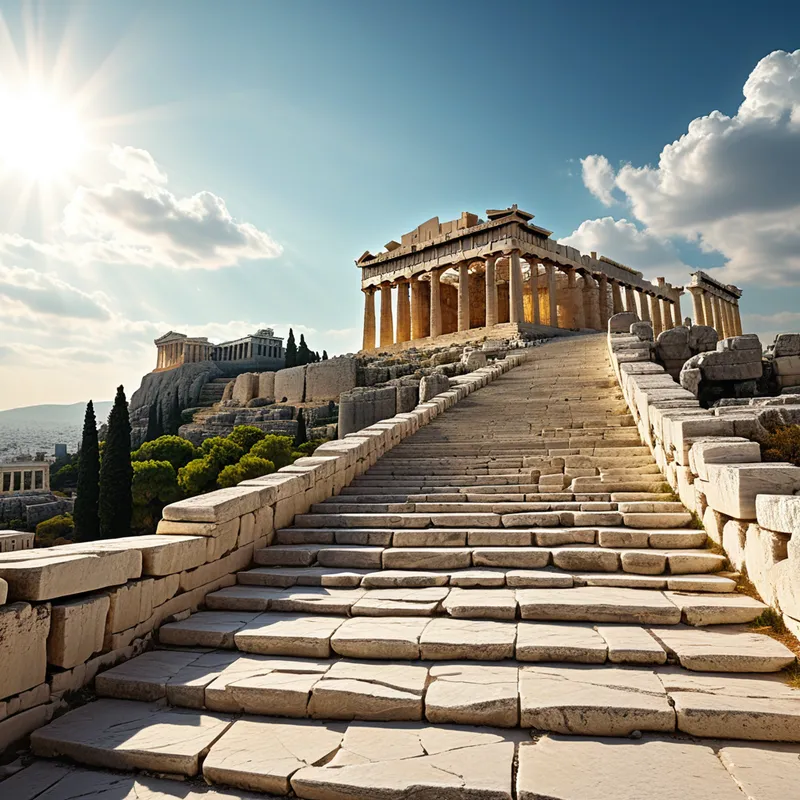
Steps of the Acropolis Myth Meaning & Symbolism
A mortal's arduous climb to the sacred rock, guided by the gods, to forge a covenant between the earthly and the divine.
The Tale of Steps of the Acropolis
Hear now, and let your spirit climb. In the age when gods walked with the scent of thyme and salt on the air, when the sun was a chariot wheel and the moon a silver bowl, there stood the holy rock—the Acropolis. But it was not always crowned with temples. Once, it was a raw, defiant crag, a fortress of nature, its summit speaking only in the language of eagles and thunder.
The people below, in their clay-brick homes, looked upon it with a mingling of awe and dread. It was a boundary stone between the world of toil and the realm of Athena. They knew the rock was sacred, but its face was sheer, its heights treacherous. To approach the divine was to risk a fall into oblivion. The city thrived, yet it was unanchored, its prayers rising like smoke but seeming to scatter against the stone before they could reach the ears of Zeus.
Then came a man named Cecrops, born of the earth itself. He was neither fully mortal nor fully divine, a bridge between soils. In a dream that tasted of ozone and olive leaves, Athena stood before him. She did not speak with words, but with a vision: a path of light, cut like a seam into the darkness of the rock, a staircase not of conquest, but of communion. “The rock must be met,” the vision whispered. “Not scaled by force, but ascended by step. Each step must be a breath. Each breath, an offering.”
Driven by this sacred charge, Cecrops gathered the people. Not with commands, but with a quiet, unwavering certainty. He took a hammer of bronze, not to break the mountain, but to ask it a question. He struck not the rock, but a measure of his own resolve against it. Where his will met the stone, the first step was revealed—not carved, but acknowledged. He labored under the sun until his skin blistered, under the moon until his bones ached. For every step he shaped from the living stone, he demanded a price of himself: a libation of water from his own cup, a lock of his hair buried in the dust, a silent vow.
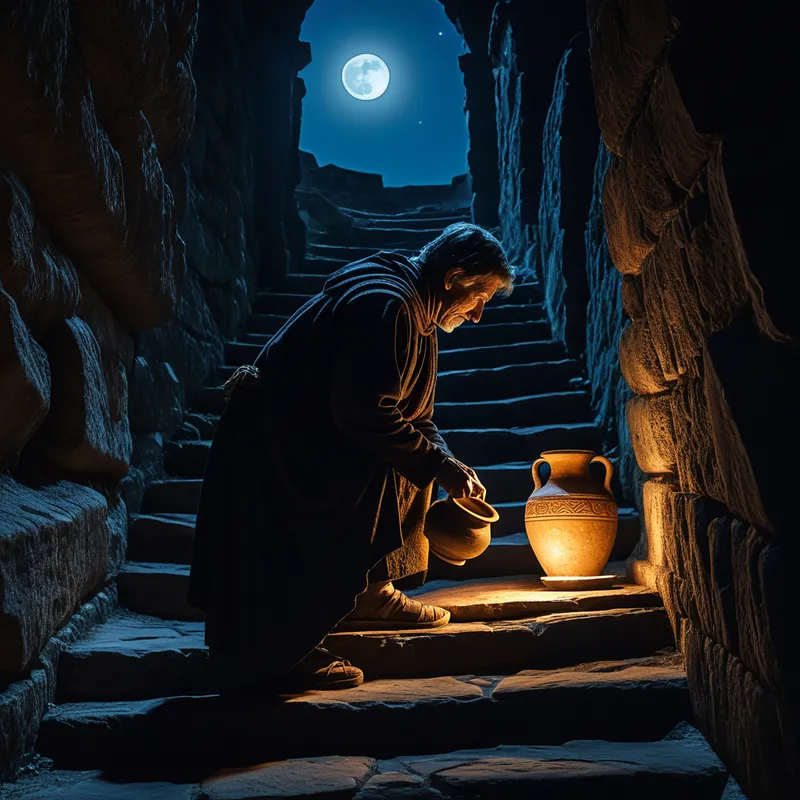
The climb became a ritual of stripping away. The heat of the day burned away pride. The weariness of the limbs burned away fear. The height burned away all thought of the world below. He carried nothing but a single, small amphora of sacred olive oil, pressed from the first tree Athena had given. As he climbed, the very air changed. It grew thinner, sharper, humming with a presence. The chatter of the agora faded, replaced by a profound silence that was itself a kind of hearing. He felt the gaze of the gods upon his back—not judging, but waiting.
Near the summit, where the wind sang a high, clear note, his strength finally failed. The last step was a sheer face of gleaming stone. Here, Cecrops did not raise his tools. Instead, he sank to his knees. He poured the last of the oil onto the stone at his feet, anointing the threshold. In that act of final surrender, of offering the very gift he had carried up, the stone sighed. The final expanse smoothed and leveled, not by his hand, but by the rock’s own consent, becoming a vast, level platform—the temenos, the sacred precinct. The covenant was sealed. The path was open. The Acropolis was no longer a forbidden height, but a destination. The steps remained, a testament that the way to the divine is built not in a day, but in a lifetime of deliberate, offering-filled breaths.
Cultural Origins & Context
The myth of the Steps is not a single, codified story from a text like Hesiod’s Theogony, but a foundational narrative stratum woven into the very identity of Athens. It is an etiological myth that explains the origin of the Panathenaic Way and the ritual ascent central to the Panathenaia. It was passed down not by epic poets alone, but by the priests of the Erechtheion, the guides for initiates, and the citizens themselves who performed the annual procession.
Its societal function was multifaceted. Primarily, it sacralized the civic space. The Acropolis was not just a defensive position; it was the spiritual axis mundi of the polis. The myth provided a ritual blueprint: to approach the gods, one must engage in a physical and psychological anodos (ascent). It modeled the ideal of ponos (toil, labor) as a sacred act, transforming raw effort into a pious offering. Furthermore, it established the principle of xenia (ritualized hospitality) on a cosmic scale: the steps were the prepared path by which the city welcomed the divine into its midst, and by which the people could, in turn, approach the divine in an orderly, respectful manner.
Symbolic Architecture
The Steps are far more than a physical pathway. They are the quintessential symbol of the mediated journey. The raw, natural rock represents the unconscious, chaotic, and untamed potentials of the psyche and the world. The carved, orderly steps represent consciousness, culture, and the ego’s structuring principle.
The step is the unit of transformation. It is the conscious decision made against the inertia of the old ground. It is the threshold between who you were and who you are becoming.
Cecrops, the earth-born king, symbolizes the nascent ego-consciousness that emerges from the primal matrix (Earth/Gaia). His task is not to conquer the unconscious (the rock) but to establish a dialogue with it, to forge a lasting connection between the earthly realm of human concerns and the celestial realm of archetypal patterns (the gods). His exhaustion and final offering at the summit signify the necessary dissolution of the purely ego-driven will. True attainment requires the sacrifice of the very tool—the conscious intention—that began the climb, making way for a grace that comes from alignment with a larger order.

The Dreamer’s Resonance
When the Steps of the Acropolis appear in modern dreams, they signal a profound process of psychic integration is underway. The dreamer is often at a point of seeking higher perspective, order, or meaning—a “calling” to something greater than their current daily life.
The somatic experience in the dream is telling. Feeling strong and capable on the steps suggests the conscious ego is adequately resourced for the coming integration. Feeling exhausted, slipping, or finding the steps impossibly steep points to resistance, perhaps an unconscious fear of what one will have to leave behind or become. The steps may be broken, overgrown, or endless, reflecting the dreamer’s perception of the path to their goal: obstructed, neglected, or dauntingly long.
The key is what happens at the summit—or if it is ever seen. Reaching a bright, open space suggests successful navigation towards a new level of consciousness. Being stuck on a landing or seeing the path vanish into clouds indicates a current blockage, often where the conscious mind’s plans meet the mystery of the unconscious. The dream is an internal rehearsal for the soul’s ascent, mapping the inner obstacles and resources.
Alchemical Translation
In the alchemy of individuation, the myth models the opus—the great work. The base material (prima materia) is the unrefined self, living in the “lower city” of complexes, instincts, and social personas. The sacred rock is the Self, the total, archetypal potential of the psyche, initially perceived as distant, majestic, and intimidating.
The climb is the nigredo, the blackening. It is the arduous, often despairing work of confronting one’s own shadow with every step—the parts of oneself left in the dust of previous ascents.
Carving each step is the process of conscious differentiation—making distinctions, setting boundaries, developing a disciplined life (the citrinitas or yellowing). The offerings at each stage are the non-negotiable sacrifices: outdated self-images, comforting illusions, and petty desires that must be left behind to move upward.
The final pouring out of the oil is the albedo, the whitening. It is the surrender of the ego’s final claim to control the process. This surrender is not a defeat, but the precise condition for the rubedo, the reddening or enlightenment. The transformed summit—the sacred platform—symbolizes the achieved connection to the Self. The individual is now grounded in both worlds: capable of functioning in the earthly realm while being permanently oriented toward the guiding archetypal center. The steps, now behind them, remain as the testament to the journey, the permanent structure of a life lived intentionally, connecting the depths to the heights.
Associated Symbols
Explore related symbols from the CaleaDream lexicon: