
Stella Maris Myth Meaning & Symbolism
A celestial being descends into the abyss to become the guiding light for all lost souls, sacrificing her form to become a beacon of hope.
The Tale of Stella Maris
Listen, and hear the tale that is whispered on the salt-wind and written in the paths of the wandering stars.
Before the world knew its name, when the Prima Materia churned in a silent, starless dark, there was a being of pure light. She was not of the earth, nor bound to any sphere. She was a thought of the cosmos given form, a single, perfect note of radiance singing in the void. They called her Stella Maris. Her domain was the infinite black, and her joy was to dance between the unborn constellations.
Yet, from the abyss below the vault of heaven, a sound began to rise. It was not a roar, but a weeping—a low, ceaseless sigh of profound sorrow. It was the Oceanus Noctis, the Ocean of Night, a realm of formless potential and unbearable loneliness. In its depths swam the Sparks Adrift, fragments of consciousness that had fallen from the great design, swirling in confusion and despair. Their lost light flickered, a faint, dying phosphorescence in the crushing dark.
Stella Maris paused her celestial dance. Her light, which had known only the company of distant suns, bent towards the sound. Peering into the abyss, she saw the swirling chaos, felt the pull of that bottomless grief. The other lights of the firmament counseled her to turn away. “That is the realm of dissolution,” they hummed. “Your song will be swallowed, your light extinguished. You are made for the heights, not the depths.”
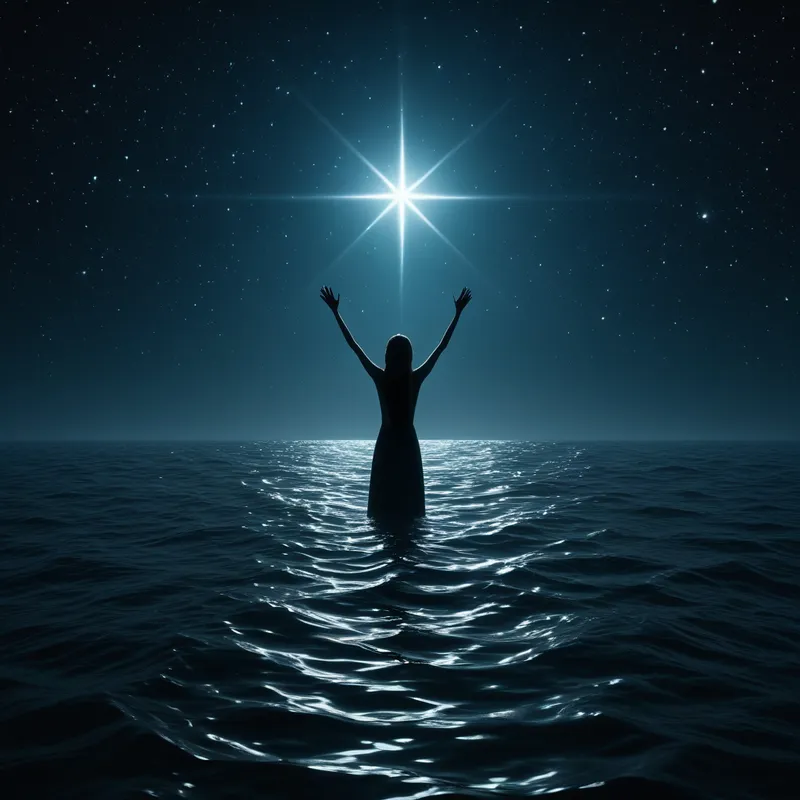
But the weeping echoed in her core, a dissonance she could not unhear. One night, as the sigh from the deep grew into a tempest of anguish, she made her choice. With a grace that tore at the fabric of the sky, she began her descent. She fell not as a meteor in fury, but as a slow, deliberate sacrifice, a single thread of silver light stitching the heavens to the hell of the waters.
The moment her light touched the black waves, a scream of steam and resistance shattered the silence. The Oceanus Noctis recoiled, then engulfed her. Her stellar form, never meant for such density, began to unravel. The brilliant, singular point of her being dissolved into a million shimmering particles. The salt water, heavy with forgotten dreams and primal fear, sought to quench her forever.
This was the great crisis. For an acon, there was only chaos—light fighting liquid, form battling formlessness. The Sparks Adrift swarmed around the fading glow, drawn by a memory of warmth they could not name.
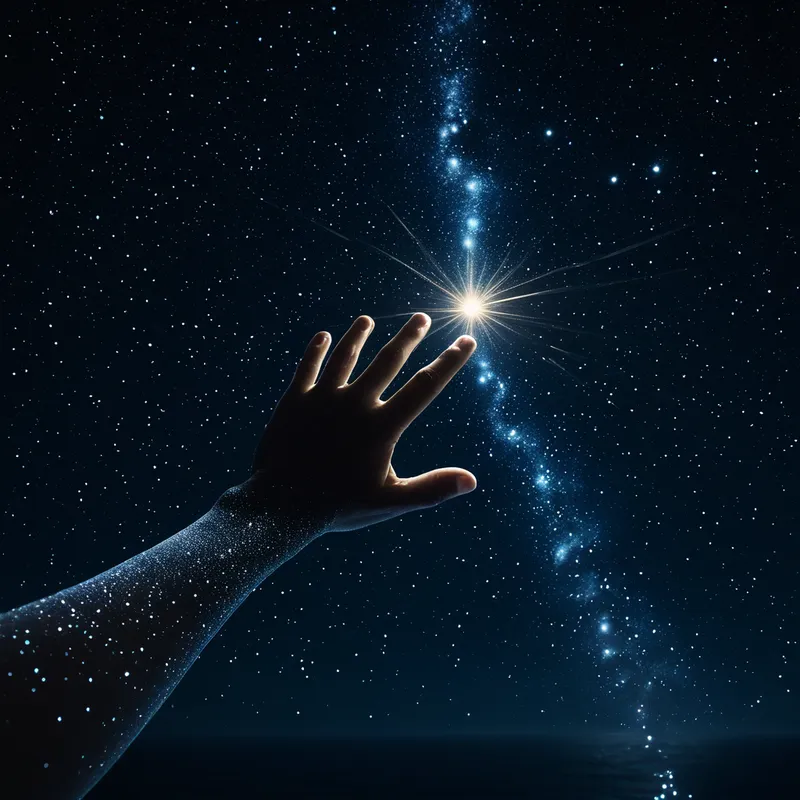
Then, from the very center of the dissolution, a new song began. It was not the clear note of the star, but a deeper, resonant hum that vibrated through every drop of the ocean. The scattered particles of her light did not die; they transformed. They became a subtle, pervasive luminescence within the water itself. And at the point where she had first been swallowed, a new light coalesced—not a distant star, but a beacon. A steady, guiding radiance that shone from within the storm-tossed sea.
She had become the Polaris Maris, the Pole Star of the Sea. No longer a dancer in the void, she was now the fixed point all sailors of the soul could steer by. Her light did not repel the darkness; it permeated it, offering direction from the heart of the abyss itself. The weeping did not cease, but now, within it, there was a promise. Any Spark Adrift, lost in the inner tempest, need only look into the blackest water to see her reflection—a star not above, but within, guiding them home.
Cultural Origins & Context
The myth of Stella Maris is not a folktale of a single people, but a core narrative of the Alchemical culture, a tradition concerned with the transmutation of the soul. It was preserved not in epic poems, but in emblemata, laboratory journals, and the oral teachings passed from Adept to Tyro.
Its primary function was initiatory. The story was told at the threshold of the Nigredo, the “blackening” phase of the alchemical work. This is the stage where the seeker’s old identity, certainties, and conscious structures must dissolve in the “water of suffering.” The myth served as a map and a solace. It taught that the descent into the chaotic, depressive, and frightening unconscious was not a meaningless failure, but a necessary, sacred sacrifice. The storyteller—often the guiding Adept—would embody the role of the beacon, assuring the Tyro that even in total dissolution, a guiding principle exists, but one that can only be found by surrendering one’s previous, celestial form.
Symbolic Architecture
At its heart, the myth is a profound map of a specific psychic movement: the descent of consciousness into the unconscious for the purpose of healing and integration.
The Celestial Stella represents the untethered spirit, the intellect, or the conscious ego in its pure, ungrounded state. It is brilliant but distant, self-contained but ultimately unrelated to the suffering and complexity of the embodied, psychic depths.
The Oceanus Noctis is the unconscious in its totality—the personal shadow, the ancestral memory, the collective psyche, and the womb of all potential. Its “weeping” is the symptom of unintegrated trauma, lost potentials, and orphaned parts of the self crying out for recognition.
The Descent symbolizes the ego’s voluntary sacrifice of its superior position. It is the decision to engage with one’s own depression, confusion, and primal fear instead of spiritually bypassing it.
The light that fears the water remains a lonely star. The light that consents to drown becomes the lantern of the world.
The Dissolution (Nigredo) is the critical ordeal. The old, rigid structure of the self must “die” or be taken apart. This is often experienced psychologically as a crisis of meaning, a dark night of the soul, or a period of profound disorientation.
The Transformation into Polaris Maris is the birth of the Inner Guide or the Axiom of the Heart. The guiding light is no longer an external ideal (a star “above”), but an internal compass forged in the crucible of personal suffering. It represents the birth of a new, more resilient psychic center that includes, rather than rejects, the depths.
The Dreamer’s Resonance
When this myth stirs in the modern dreamer, it signals an imminent or active process of profound psychic reorientation. The somatic experience is often one of weight, pressure, or drowning—a feeling of being pulled down into overwhelming emotion or circumstance.
Dreams may feature:
- Falling stars or lights descending into water.
- Being lost at sea in darkness, then spotting a single, unwavering light on the horizon.
- The sensation of dissolving or melting, especially in a body of water.
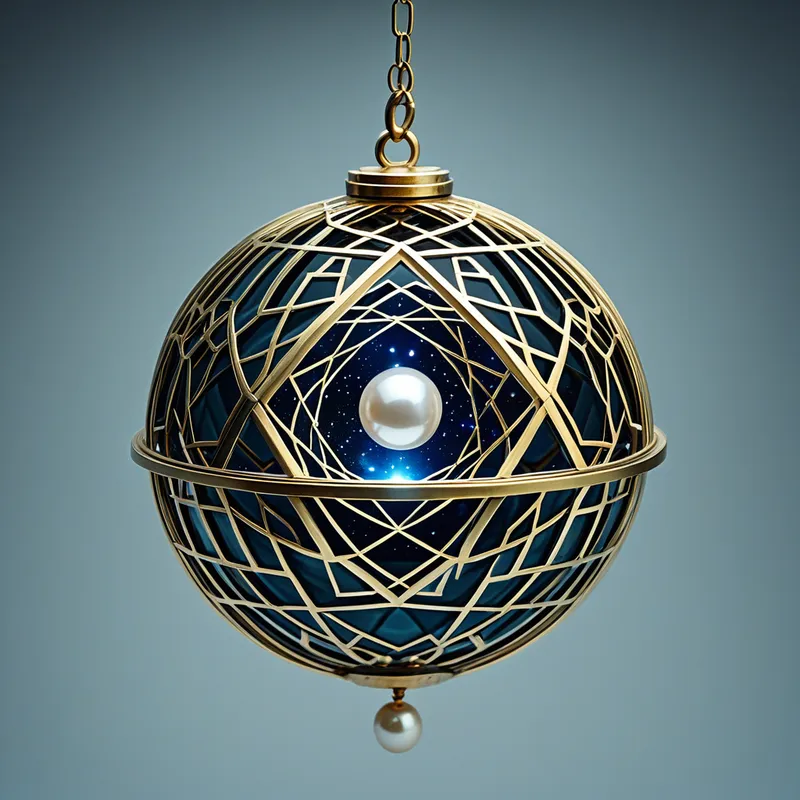
- Finding a luminous pearl or stone in deep, murky water.
Psychologically, this indicates the ego’s confrontation with material it can no longer manage from its “high” position. It is the psyche’s imperative to descend—to feel the grief, rage, or fear that has been held at bay. The dream is not a warning, but a depiction of the alchemical process itself. The beacon (Stella Maris) in the dream is the emerging symbol of the dreamer’s own nascent inner guidance, which only becomes visible and functional after the courage to descend is shown.
Alchemical Translation
For the modern individual, the myth of Stella Maris models the path of Individuation through the archetype of the Caregiver. However, this care is first and foremost directed inward.
The initial “stellar” state is our identification with achievements, personas, and ideals that keep us above the messy, emotional, and irrational parts of ourselves. We are bright, but disconnected. The call of the “weeping ocean” is the symptom—burnout, relationship patterns, anxiety, a sense of emptiness—that signals this disconnect.
The alchemical work begins with the descent: the conscious decision to enter therapy, to sit with meditation, to journal into the pain, to stop numbing and start feeling. This is the voluntary Sacrificium.
The dissolution is the painful, non-negotiable middle phase where old identities crumble. The professional, the perfect partner, the eternal optimist—these constructs may dissolve in the waters of failure, grief, or vulnerability. It feels like ruin.
The pearl is not found by searching the shore, but by enduring the irritation within the shell at the bottom of the sea.
The transmutation occurs when, from within this state, a new kind of knowing arises. It is not the knowing of the star (intellect), but the knowing of the beacon (embodied wisdom). You develop an internal compass. Your compassion for others deepens because it is rooted in the felt experience of the abyss. Your guidance becomes authentic because it speaks from the heart of darkness, not from a sermon on a hill. You become your own Stella Maris—a light born from the courageous embrace of your own depths, now capable of guiding not only yourself but, by reflection, others who are adrift in their own nights.
Associated Symbols
Explore related symbols from the CaleaDream lexicon: