Starry Sky / Milky Way Myth Meaning & Symbolism
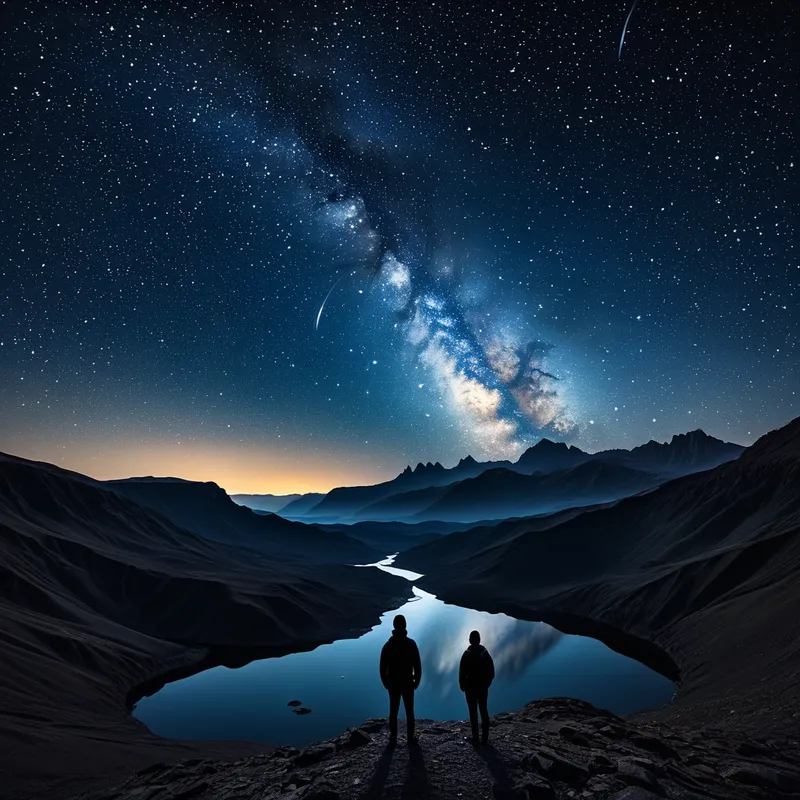
A luminous scar across the night, woven from countless stories of love, loss, and divine journeys, connecting humanity to the infinite.
The Tale of Starry Sky / Milky Way
Listen. Before maps, before cities, before the first word was written on clay, there was the dark. And in that dark, a wound of light.
It began not with a bang, but with a longing. In the high, cold halls of [the sky](/myths/the-sky “Myth from Persian culture.”/), a Zhinu, daughter of the [Jade Emperor](/myths/jade-emperor “Myth from Chinese culture.”/), grew weary of immortal perfection. Her eyes, used to the tapestry of constellations, fell upon a mortal cowherd, Niulang, whose simple labor held a warmth the heavens lacked. Their love was immediate, a spark against [the void](/myths/the-void “Myth from Buddhist culture.”/). They built a life on the green earth, a harmony of sky and soil, and were blessed with two children.
But the cosmos abhors a mixed marriage. The Jade Emperor’s wrath was not fire, but a cold, irrevocable decree. With a sweep of his sleeve, he carved a raging, star-flecked river across the firmament—a barrier of impossible width and depth. On one bank stood Zhinu, her silver shuttle falling from numb fingers. On the other, Niulang, clutching their children, his call echoing into the silent vacuum between worlds.
Their despair was so pure, so vast, that it moved the heart of a magpie. Once a year, on the seventh day of the seventh moon, every magpie in [the world](/myths/the-world “Myth from Tarot culture.”/) would take wing, their bodies forming a living, trembling bridge of feathers and faith across the terrible star-river. For one night, the lovers would cross, their footsteps light upon the backs of loyal birds, to meet in the very center of the sky. Their tears, falling from that high bridge, became the summer rain. And [the river](/myths/the-river “Myth from Buddhist culture.”/) they crossed? We see its pale, ghostly flow every clear night. We call it [the Milky Way](/myths/the-milky-way “Myth from Greek culture.”/).
Elsewhere, the story wears different skins. In the frozen north, the Sámi see it as Loddebálgá, the path for souls to migrate to the next world. For the Cherokee, it is the Gi’li’ Utsun’stanun’yi, where a dog spilled stolen meal in its flight. The ancient Greeks saw the spilled milk of the goddess Hera, a divine nourishment turned to stars. But always, it is a story written in light and absence—a seam in the cosmos where longing has been made permanent.
Cultural Origins & Context
This is not one myth, but a chorus. The tale of the starry river is a primordial story, emerging independently across continents, from the rice paddies of East Asia to the tundra of Scandinavia and the plains of North America. It was not authored by a single poet but whispered by the night itself into the ears of shepherds, sailors, and shamans staring into the void.
Its primary function was cartography of the soul and the cosmos. Before GPS, the Milky Way was the most reliable road in the world—a constant north-south highway used for navigation by Polynesian voyagers and desert nomads alike. Mythologically, it served a parallel purpose: it mapped the journey after death, the seasonal cycles (like the East Asian Qixi Festival), and the fundamental human experience of separation and the hope for reunion. It was told around fires to explain the inexplicable splash of stars, to give comfort that even the gods knew heartache, and to teach that loyalty, be it from magpies or dogs, can sometimes bend the laws of heaven.
Symbolic Architecture
The [Milky Way](/symbols/milky-way “Symbol: The Milky Way represents both the vastness of the universe and the interconnectedness of existence, serving as a metaphor for the journey of life and cosmic consciousness.”/) is the ultimate [symbol](/symbols/symbol “Symbol: A symbol can represent an idea, concept, or belief, serving as a powerful tool for communication and understanding.”/) of the [unus mundus](/myths/unus-mundus “Myth from Alchemical culture.”/)—the one world where [spirit](/symbols/spirit “Symbol: Spirit symbolizes the essence of life, vitality, and the spiritual journey of the individual.”/) and matter, divine and mortal, [eternity](/symbols/eternity “Symbol: The infinite, timeless state beyond human life and measurement, often representing the ultimate or divine.”/) and time, intersect. It is not merely a [thing](/myths/thing “Myth from Norse culture.”/) in the sky; it is a [relationship](/symbols/relationship “Symbol: A representation of connections we have with others in our lives, often reflecting our emotional state.”/) made visible.
The celestial river is the visible scar of separation, and the luminous proof that what is separated still yearns to be whole.
Psychologically, the [river](/symbols/river “Symbol: A river often symbolizes the flow of emotions, the passage of time, and life’s journey, reflecting transitions and movement in one’s life.”/) represents the conscious ego’s [perception](/symbols/perception “Symbol: The process of becoming aware of something through the senses. In dreams, it often represents how one interprets reality or internal states.”/) of an unbridgeable gap—between who we are and who we love, between our earthly selves and our higher potential, between the conscious mind and the unconscious. Zhinu and Niulang embody archetypal opposites: the celestial [anima](/symbols/anima “Symbol: The feminine archetype within the male unconscious, representing soul, creativity, and connection to the inner world.”/) (spirit, artistry, the divine feminine) and the earthly [animus](/symbols/animus “Symbol: In Jungian psychology, the masculine inner personality in a woman’s unconscious, representing logic, action, and spiritual guidance.”/) (groundedness, labor, the [human](/symbols/human “Symbol: The symbol of a human represents individuality, complexity of emotions, and social relationships.”/) masculine). Their union represents psychic completeness, which is invariably challenged by the ruling principle (the [Jade](/symbols/jade “Symbol: A precious stone symbolizing purity, protection, and spiritual connection, often associated with wisdom, longevity, and harmony.”/) Emperor, or the super-ego), which insists on maintaining order and [separation](/symbols/separation “Symbol: A spiritual or mythic division between realms, states of being, or consciousness, often marking a transition or loss of connection.”/).
The [magpie bridge](/myths/magpie-bridge “Myth from Chinese culture.”/) is the critical symbol of the transcendent function—the psychic process that arises from the [tension](/symbols/tension “Symbol: A state of mental or emotional strain, often manifesting physically as tightness, pressure, or unease, signaling unresolved conflict or anticipation.”/) of opposites to create a new, reconciling third. It is not a permanent state but a miraculous, fleeting [connection](/symbols/connection “Symbol: Connection symbolizes relationships, communication, and bonds among individuals.”/) made possible by sacrifice and instinct (the birds).
The Dreamer’s Resonance
When the starry river flows through modern dreams, it rarely appears as an astronomical fact. It manifests as a feeling and a landscape. You may dream of a radiant highway you are forbidden to cross, a shimmering chasm dividing a city, or a loved one standing on the opposite shore of a lake of liquid light. The somatic experience is often one of awe mixed with profound ache—a tightening in the chest, a reaching gesture.
This dream signals a profound experience of psychological separation. You are encountering a gap between two vital parts of your self: perhaps your creative spirit feels exiled from your daily life (Zhinu on her shore), or your grounded body feels disconnected from your aspirations (Niulang below). The dream is the [psyche](/myths/psyche “Myth from Greek culture.”/) making this inner schism as vast and beautiful as the cosmos, showing you its true scale. The longing you feel is not a problem to be solved, but the very engine of potential union. The dream asks: What in your life are the magpies? What small, instinctual, loyal acts could form a bridge?
Alchemical Translation
The myth models the alchemical coniunctio oppositorum, the central goal of individuation. The process begins with the [separatio](/myths/separatio “Myth from Alchemical culture.”/): the clear, often painful, recognition of inner divisions (the carved river). We must first see the gap between our [persona](/myths/persona “Myth from Greek culture.”/) and our shadow, our logic and our intuition, before we can hope to cross it.
The lovers’ enduring fidelity represents the essential work of holding both sides in consciousness without abandoning either. Niulang does not stop being a father; Zhinu does not forget her weaving. They tend their respective shores. This is the cultivation of the tension that makes the transcendent function possible.
The miracle is not that the bridge appears, but that the longing for it mobilizes the entire world—the instinctual, animal soul (the magpies)—to enact the impossible.
For the modern individual, the alchemical translation is this: Your “Milky Way” is any core, painful split in your identity. The “annual crossing” is the conscious, ritualized effort to create moments of inner dialogue, creative synthesis, or active imagination where those opposites can meet. You do not erase the river; you learn to build temporary bridges across it. The river itself, once a symbol of despair, becomes the beautiful, necessary backdrop against which your wholeness is periodically, miraculously, achieved. It becomes the luminous record of your journey toward yourself, a scar turned into a galaxy.
Associated Symbols
Explore related symbols from the CaleaDream lexicon: