Starlight of Aphrodite Myth Meaning & Symbolism
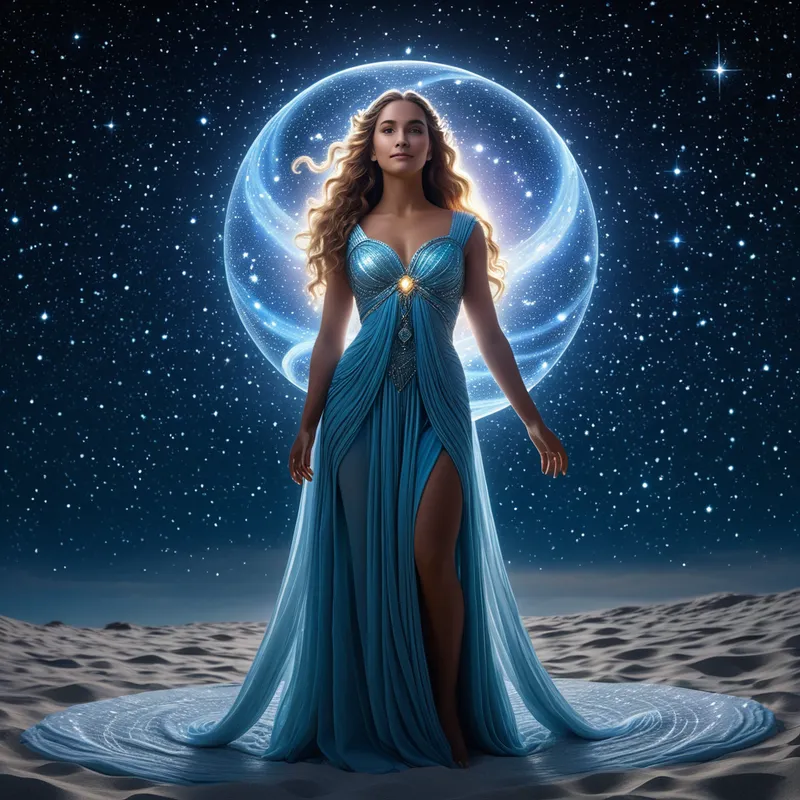
A myth of celestial light descending, where the longing of a mortal soul calls forth a divine, transformative spark from the goddess of love.
The Tale of Starlight of Aphrodite
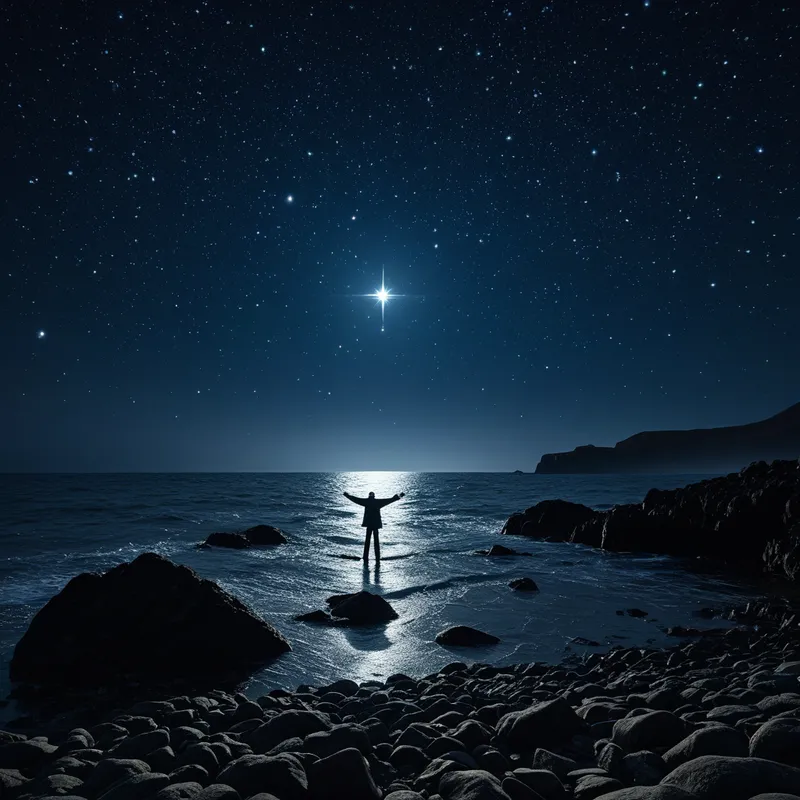
Hear now a tale not of heroes and monsters, but of a silence so profound it became a prayer, and a light that answered. It begins not on sun-drenched Olympus, but on a forgotten stretch of shoreline, where the black sea whispers to the blacker sky. Here, under the cold gaze of a thousand indifferent stars, stood a man whose name the waves have long since stolen. He was a poet, or perhaps a madman—in those days, the line was thin as a [spider](/myths/spider “Myth from Native American culture.”/)’s thread.
His heart was a hollow bell, cast not of bronze, but of yearning. The songs of earth—of harvest, of battle, of human love—rang false against its emptiness. His eyes were turned perpetually upward, not in worship, but in a desperate search. He sought a love that was not of flesh, a beauty not born of form, but of essence. Night after night, he stood sentinel on the rocks, his soul a naked, aching question flung into [the void](/myths/the-void “Myth from Buddhist culture.”/).
On this night, the air was still as held breath. The constellation of the Ouranian Aphrodite hung low over the wine-dark sea, pulsing with a soft, persistent light. The poet did not chant. He did not sacrifice. He simply stood, his longing a tangible force, a vortex of silent need that pulled at the fabric of the dark. He was not calling for a goddess to come to him in splendor. He was calling for a fragment of her nature, for the very principle of her being.
And the cosmos stirred.
From the heart of that distant constellation, a single point of light detached itself. It was not a falling star, for it moved with purpose, not haste. It was a seed of pure Eros. It descended, a slow, silent comet, weaving through the tapestry of the night. As it drew near, [the world](/myths/the-world “Myth from Tarot culture.”/) fell away. The sound of [the sea](/myths/the-sea “Myth from Greek culture.”/) vanished. The poet felt the heat of it before he saw its core—not a fire that burns, but a fire that vivifies.
The light did not strike him. It entered him. It passed through his chest as if his body were mist, and came to rest where his hollow heart had been. There was no explosion, no cataclysm. There was a filling. A completion. The light unfolded within him, not as a foreign presence, but as a memory of a home he had never known. He saw, in that instant, the love that binds atom to atom, star to star, soul to soul. He saw the beauty in the curve of spacetime, in the spin of galaxies, in the desperate, beautiful struggle of all living things.
When dawn’s grey fingers finally crept over [the horizon](/myths/the-horizon “Myth from Various culture.”/), the poet was gone. Some say he dissolved into the morning mist. Others say he walked into the sea, now a brother to its depths. But on the stones where he stood, a new, faint star was said to gleam in the daylight—a testament that for one mortal, the distance between longing and having was bridged by a gift of pure, celestial light.
Cultural Origins & Context
This tale lives in the liminal spaces of Greek myth, more a whispered tradition than a canonical epic recorded by Hesiod or [Homer](/myths/homer “Myth from Greek culture.”/). It belongs to the strand of thought that distinguished between Aphrodite Pandemos and Aphrodite Ourania. The latter, the “Heavenly” one, was a far more abstract and philosophical force, linked to the cosmos itself. This myth likely emerged from mystery cults and poetic circles that pondered the soul’s ascent and its desire for transcendental union.
It was a story told not to explain natural phenomena, but to map an inner, spiritual one. Its function was initiatory. It served as a narrative vessel for the experience of the seeker who finds the earthly realm insufficient, whose desire (pothos) is for something beyond the material. It validated a specific kind of melancholy—the “divine homesickness” described by later philosophers. The myth was a beacon, suggesting that such profound longing was not a pathology, but a homing signal, and that the cosmos, personified in Ourania, might just answer.
Symbolic Architecture
The myth’s power lies in its stark, alchemical [symbolism](/symbols/symbolism “Symbol: The use of symbols to represent ideas or qualities, often conveying deeper meanings beyond literal interpretation. In dreams, it’s the language of the unconscious.”/). The mortal poet represents the [human](/symbols/human “Symbol: The symbol of a human represents individuality, complexity of emotions, and social relationships.”/) ego-[consciousness](/symbols/consciousness “Symbol: Consciousness represents the state of awareness and perception, encompassing thoughts, feelings, and experiences.”/) that has exhausted the offerings of the personal and collective world. His hollow [heart](/symbols/heart “Symbol: The heart symbolizes love, emotion, and the core of one’s existence, representing deep connections with others and self.”/) is not a deficiency, but a prerequisite—a vas or [vessel](/symbols/vessel “Symbol: A container or structure that holds, transports, or protects something essential, representing the self, emotions, or life journey.”/) that must be emptied of worldly attachments to receive a divine content.
The most profound longing is not a sign of absence, but the shape of the thing to come, carved into the soul.
The Ouranian Aphrodite is the [archetype](/symbols/archetype “Symbol: A universal, primordial pattern or prototype in the collective unconscious that shapes human experience, behavior, and creative expression.”/) of the [anima](/symbols/anima “Symbol: The feminine archetype within the male unconscious, representing soul, creativity, and connection to the inner world.”/) mundi, the world [soul](/symbols/soul “Symbol: The soul represents the essence of a person, encompassing their spirit, identity, and connection to the universe.”/)—[the principle](/symbols/the-principle “Symbol: A fundamental truth, law, or doctrine that serves as a foundation for a system of belief, behavior, or reasoning, often representing moral or ethical standards.”/) of connective, creative, spiritual love that permeates the [universe](/symbols/universe “Symbol: The universe symbolizes vastness, interconnectedness, and the mysteries of existence beyond the individual self.”/). Her [starlight](/symbols/starlight “Symbol: Starlight represents distant guidance, celestial inspiration, and the connection between cosmic order and human creativity, often symbolizing hope, beauty, and artistic vision.”/) is the scintilla, [the divine spark](/myths/the-divine-spark “Myth from Gnostic culture.”/). Its descent is the [moment](/symbols/moment “Symbol: The symbol of a ‘moment’ embodies the significance of transient experiences that encapsulate emotional depth or pivotal transformations in life.”/) of grace, the hieros gamos (sacred [marriage](/symbols/marriage “Symbol: Marriage symbolizes commitment, partnership, and the merging of two identities, often reflecting one’s feelings about relationships and social obligations.”/)) between the finite human [spirit](/symbols/spirit “Symbol: Spirit symbolizes the essence of life, vitality, and the spiritual journey of the individual.”/) and the infinite animating principle of [life](/symbols/life “Symbol: The symbol of ‘Life’ represents a journey of growth, interconnectedness, and existential meaning, encompassing both the joys and challenges that define human experience.”/). The poet’s [dissolution](/symbols/dissolution “Symbol: The process of breaking down, dispersing, or losing form, often representing transformation, release, or the end of a state of being.”/) is not a [death](/symbols/death “Symbol: Symbolizes transformation, endings, and new beginnings; often associated with fear of the unknown.”/), but [the ego](/myths/the-ego “Myth from Jungian culture.”/)’s surrender to a state of identification with this cosmic principle. He becomes what he beholds.
The Dreamer’s Resonance
When this myth stirs in the modern dreamer, it announces a critical juncture in the [psyche](/myths/psyche “Myth from Greek culture.”/). To dream of standing under a vast, starry sky, feeling a profound and wordless yearning, points to a soul-level hunger. The somatic sensation is often one of a chest-cavity opening, a feeling of emptiness that is simultaneously painful and full of potential.
This is the psyche preparing for an infusion of meaning from [the Self](/myths/the-self “Myth from Jungian culture.”/), the central archetype of wholeness. The dreamer is in a state of nettoyage—a psychic cleansing. The old, personal complexes and identities are being stripped away, creating an inner vacuum. The dream is a reassurance: this painful hollowing is not an end, but the creation of a vessel. The appearance of a specific, descending light—especially if it is silvery, Venusian, or rose-gold—is the unconscious symbolizing the imminent arrival of this transformative energy. The dreamer is being initiated into a love that is impersonal, boundless, and creative.

Alchemical Translation
For the modern individual, the myth models the pinnacle of the individuation process: the integration of the Self. The poet’s nightly vigil is the disciplined work of introspection and shadow-work, confronting the emptiness of a life lived solely on the surface. His unwavering focus on the celestial is the “directedness” of consciousness toward its own deepest source.
The descent of the starlight is the alchemical albedo and [rubedo](/myths/rubedo “Myth from Alchemical culture.”/) combined—the whitening and reddening. It is the illumination (illuminatio) that follows [the dark night of the soul](/myths/the-dark-night-of-the-soul “Myth from Christian Mysticism culture.”/) ([nigredo](/myths/nigredo “Myth from Alchemical culture.”/)). The light does not just fill; it transmutes. The base metal of personal longing is turned into the gold of cosmic belonging.
The ultimate transformation is not becoming something new, but remembering your native substance as a fragment of the star-stuff that dreams the world into being.
The poet’s disappearance is the final, crucial stage. The ego does not “get” the starlight and become enlightened. It is replaced by it. The conscious personality surrenders its central position to the authority of the Self. In practical terms, this translates to a life no longer driven by personal desire or fear, but guided by a sense of participation in a larger, meaningful pattern. One becomes a conduit for a creative, connective force—the starlight of Aphrodite—expressing it through art, compassion, or simply a profound, unshakable peace amidst the chaos of the world. The myth tells us that our deepest longing is the universe calling a part of itself back home.
Associated Symbols
Explore related symbols from the CaleaDream lexicon: