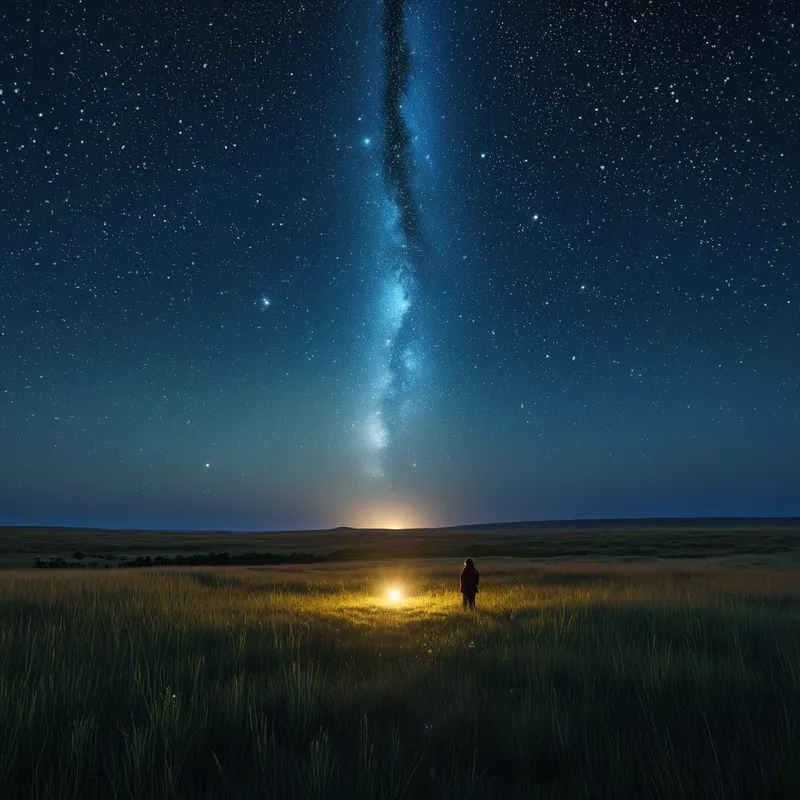
Star People Myth Meaning & Symbolism
A myth of celestial beings who descended to teach humanity, embodying the soul's journey from the cosmos to earthly life and back to the stars.
The Tale of Star People
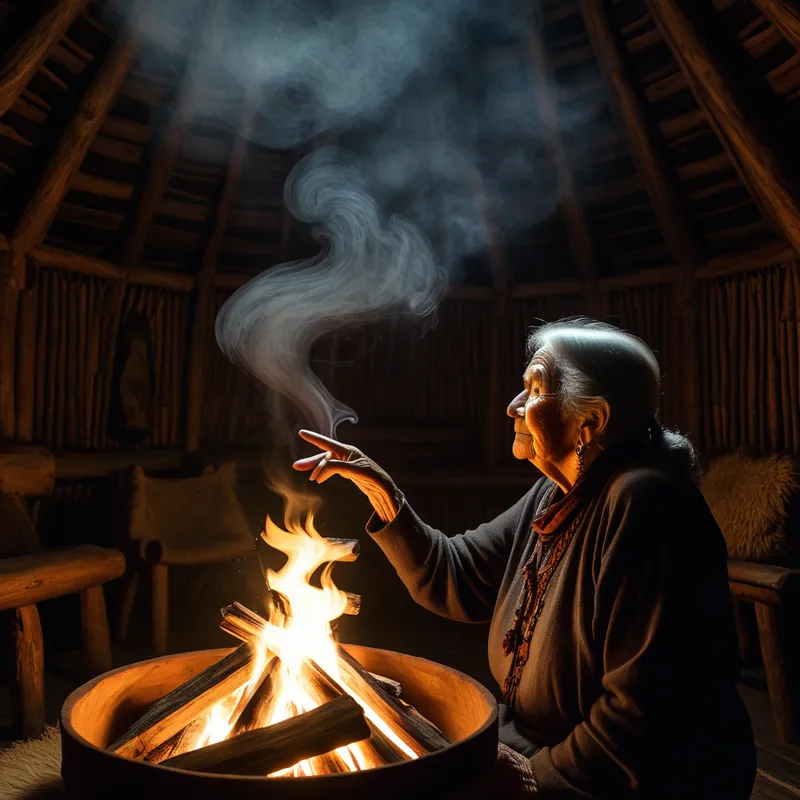
Listen. The fire is low, and [the world](/myths/the-world “Myth from Tarot culture.”/) outside this circle of light is a deep, velvet black, pierced by a million silver eyes. The old one draws her blanket close, and her voice becomes [the wind](/myths/the-wind “Myth from Various culture.”/), becomes the memory of the world before this one.
In the time when [the earth](/myths/the-earth “Myth from Hindu culture.”/) was soft and new, the People walked, but they walked in silence. They knew the path of the deer and the language of [the river](/myths/the-river “Myth from Buddhist culture.”/), but their hearts were heavy with a loneliness they could not name. They looked up at the night, at the great river of light we call the Spirit Road, and felt a longing, a homesickness for a place their feet had never touched.
Then, one night, when [the moon](/myths/the-moon “Myth from Tarot culture.”/) was a sliver and the darkness was complete, a new star was born. It did not hold its place, but began to fall. It fell not as a streak of fire, but as a slow, deliberate descent—a seed of light drifting down from the Wanáǧi Thacháŋku. It touched the earth not with a crash, but with the sound of a whisper taking form.
From that point of contact, a figure arose. It was shaped like a person, but its skin held the cool light of [moonstone](/myths/moonstone “Myth from Various culture.”/), and its eyes were deep pools reflecting entire galaxies. This was a Star Person. More followed, descending on strands of starlight, until a council of these luminous beings stood upon the prairie.
They did not come with weapons or commands. They came with open hands. With a touch, they could make a dormant seed sprout. With a song, they could calm the raging storm. They showed the People how to read the stories written in the seasons, how to speak to the plant and animal nations with respect, and how to build the Inípi, the sweat lodge, a womb of earth and steam where one could pray and remember one’s true nature. They taught [the sacred circle](/myths/the-sacred-circle “Myth from Various culture.”/), where all things are connected—the above and the below, the seen and the unseen.
For a time, [the Star](/myths/the-star “Myth from Tarot culture.”/) People walked among the human people. The world was in balance. But the time of their walking was always meant to be a season, not an age. The People had to learn to stand on their own, to hold the teachings in their own hearts, not just in the presence of the teachers.
And so, one evening, as the sun bled into the west, the Star People gathered on a high hill. They turned their faces to the emerging stars. And as the first star of the evening shone bright, their earthly forms began to soften, to become translucent. They became like smoke, then like mist, then like pure, rising light. One by one, they streamed upward, returning their essence to the specific points of light in the Wanáǧi Thacháŋku from which they had come.
They were gone. But as the People wept, the old one who had watched it all pointed to [the sky](/myths/the-sky “Myth from Persian culture.”/). “They are not gone,” she said. “They have gone home. And now, their light is a promise. We remember where we come from. And we know the path we must walk, until we too return.”
Cultural Origins & Context
The narrative of the Star People is not a single, monolithic story from one nation, but a profound archetypal motif woven through the oral traditions of many Indigenous peoples across North America, including the Lakota, Cree, Hopi, and others. It belongs to the rich tapestry of Creation Stories and Cosmogonies.
These stories were not “mythology” in the sense of mere fiction; they were, and are, living maps of reality. They were transmitted by Hunka and grandmothers around winter fires, in ceremonies, and during rites of passage. Their function was multifaceted: to explain the origins of sacred knowledge (medicine, astronomy, ethics), to establish humanity’s place within a cosmic order, and to provide a spiritual compass. The Star People myth specifically addresses the source of wisdom, framing it not as a human invention, but as a gift from the cosmos itself, embedding a sense of sacred responsibility in its stewardship.
Symbolic Architecture
At its [heart](/symbols/heart “Symbol: The heart symbolizes love, emotion, and the core of one’s existence, representing deep connections with others and self.”/), the myth is a profound [allegory](/symbols/allegory “Symbol: A narrative device where characters, events, or settings represent abstract ideas or moral qualities, conveying deeper meanings through symbolic storytelling.”/) for the [journey](/symbols/journey “Symbol: A journey in dreams typically signifies adventure, growth, or a significant life transition.”/) of [consciousness](/symbols/consciousness “Symbol: Consciousness represents the state of awareness and perception, encompassing thoughts, feelings, and experiences.”/). The Star People represent the unincarnated [soul](/symbols/soul “Symbol: The soul represents the essence of a person, encompassing their spirit, identity, and connection to the universe.”/), pure [awareness](/symbols/awareness “Symbol: Conscious perception of self, surroundings, or internal states. Often signifies awakening, insight, or heightened sensitivity.”/), or the Self in its primordial, cosmic state. Their descent is the act of incarnation—the [spirit](/symbols/spirit “Symbol: Spirit symbolizes the essence of life, vitality, and the spiritual journey of the individual.”/) taking on the “[clay](/symbols/clay “Symbol: Clay symbolizes malleability, creativity, and the potential for transformation, representing the foundational aspect of life and the ability to shape one’s destiny.”/)” of [material](/symbols/material “Symbol: Material signifies the tangible aspects of life, often representing physical resources, desires, and the physical world’s influence on our existence.”/) existence.
The descent of light into matter is the fundamental drama of existence. We are the Star People, forgetting our origin to learn the sacred grammar of earth.
The teachings they bring—the circle, the [connection](/symbols/connection “Symbol: Connection symbolizes relationships, communication, and bonds among individuals.”/) to [nature](/symbols/nature “Symbol: Nature symbolizes growth, connectivity, and the primal forces of existence.”/), the ceremonial [life](/symbols/life “Symbol: The symbol of ‘Life’ represents a journey of growth, interconnectedness, and existential meaning, encompassing both the joys and challenges that define human experience.”/)—symbolize the innate, archetypal [knowledge](/symbols/knowledge “Symbol: Knowledge symbolizes learning, understanding, and wisdom, embodying the acquisition of information and enlightenment.”/) buried within the [collective unconscious](/symbols/collective-unconscious “Symbol: The Collective Unconscious refers to the part of the unconscious mind shared among beings of the same species, embodying universal experiences and archetypes.”/). This is the “knowing” we are born with but must spend a lifetime remembering and integrating. Their eventual return to the stars is not an [abandonment](/symbols/abandonment “Symbol: A dream symbol representing feelings of being left behind, isolated, or emotionally deserted, often tied to primal fears of separation and loss of support.”/), but a demonstration of the ultimate goal: the return of the individuated consciousness to its [source](/symbols/source “Symbol: The origin point of something, often representing beginnings, nourishment, or the fundamental cause behind phenomena.”/), enriched by the experiences of earthly [life](/symbols/life “Symbol: The symbol of ‘Life’ represents a journey of growth, interconnectedness, and existential meaning, encompassing both the joys and challenges that define human experience.”/). The earthly [human](/symbols/human “Symbol: The symbol of a human represents individuality, complexity of emotions, and social relationships.”/) represents [the ego](/myths/the-ego “Myth from Jungian culture.”/), the localized self that must learn to [host](/symbols/host “Symbol: The symbol of a ‘host’ often represents nurturing, hospitality, or the willingness to offer support and guidance to others.”/) and embody this celestial wisdom.
The Dreamer’s Resonance
When this myth pattern activates in the modern [psyche](/myths/psyche “Myth from Greek culture.”/), it often manifests in dreams of celestial visitations, benevolent aliens, or finding mysterious, luminous objects. It can also appear as a profound sense of “cosmic homesickness”—an aching nostalgia for a place one has never been, often accompanied by feelings of isolation or of being a “stranger on Earth.”
Somatically, this may feel like a pressure in [the crown](/myths/the-crown “Myth from Various culture.”/) of the head, a sense of being ungrounded, or conversely, a sudden, electrifying feeling of connection when gazing at the night sky. Psychologically, this dream-complex signals a critical phase: the ego is being contacted by a transpersonal content, a piece of the Self. The dreamer is being asked to acknowledge a part of their identity that is not personal, not biographical, but archetypal and cosmic. It is the psyche’s call to remember a larger origin story.
Alchemical Translation
The myth models the full arc of Individuation. The descent (the Star People coming to earth) is the [nigredo](/myths/nigredo “Myth from Alchemical culture.”/)—the initial immersion in the unconscious, the “darkening” as pure spirit enters the chaos of matter and human life. The teaching period is the albedo—the purification and learning, where the ego struggles to understand and apply the cryptic wisdom of [the Self](/myths/the-self “Myth from Jungian culture.”/).
The crisis of the Star People’s departure is the citrinitas, the “yellowing” or awakening. The external guide vanishes, forcing the human (the ego) to internalize the teachings. One must become one’s own sage. This is often the most difficult transition, where we feel spiritually abandoned and must find the light within.
The teacher must vanish for the teaching to become flesh. The star must set for its light to be remembered in the heart’s own sky.
Finally, the ascent—the return to the stars—is the [rubedo](/myths/rubedo “Myth from Alchemical culture.”/), the “reddening” or culmination. It represents the achievement of a conscious, living connection between the ego and the Self. The individual no longer just receives wisdom from an externalized archetype (the Star Person); they have integrated it. They embody the connection between earth and cosmos. They become a living bridge, a human who carries the starlight within, whose very presence reminds others of their own celestial origin. The journey ends where it began, but the consciousness that returns is transformed, having fully lived the mystery of the descent and the return.
Associated Symbols
Explore related symbols from the CaleaDream lexicon: