
Star of Bethlehem Myth Meaning & Symbolism
A celestial beacon guides seekers to a divine birth, symbolizing the luminous call to a profound inner journey and the dawn of a new psychic reality.
The Tale of Star of Bethlehem
Listen. In the time when empires were stones and kings were dust, under a sky so deep it drank the soul, a new light was kindled. It was not like the other lights. It was a [herald](/myths/herald “Myth from Greek culture.”/), a puncture in the fabric of the mundane night. In the east, where the old wisdom sleeps in the sands, men who read the language of the cosmos saw its rising. They were the Magi, keepers of forgotten [sigils](/myths/sigils “Myth from Alchemical culture.”/) and celestial maps. And this star spoke a word they had long awaited.
It was a call. A summons written in pure radiance. So they gathered their treasures—gold for a king, frankincense for a god, myrrh for a mortal—and turned their faces toward the west, leaving the certainty of their towers for the uncertainty of a road dictated by heaven. For nights uncounted, [the star](/myths/the-star “Myth from Tarot culture.”/) moved before them, a fixed point in the wheeling dark. It was their only compass, a celestial shepherd leading them through wilderness and past sleeping kingdoms. It asked for faith with every league; to follow a light that obeyed no chart, to seek a king not in a palace, but wherever this beacon chose to rest.
Their journey brought them to the seat of earthly power, to Herod, whose crown was fear. They asked of the star’s promise, and in his court, a chill entered the air. The scribes whispered from ancient scrolls of a Messiah to be born in Bethlehem. Herod’s smile was a thin crack in stone. “Go,” he said, “and find him. That I may also come and worship.” The words hung, poisoned.
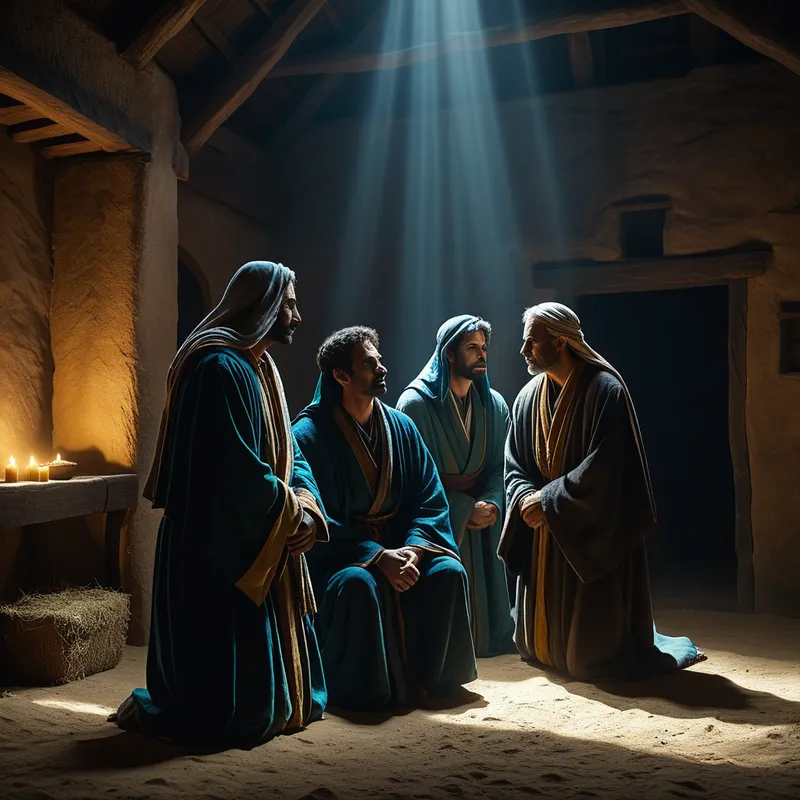
But the star, undimmed by political shadows, led them on. Out of [Jerusalem](/myths/jerusalem “Myth from Biblical culture.”/), down the road to the little town. And there, it stopped. Not over towers or temples, but over a place of humble shelter. The light, which had crossed the firmament, now poured itself down upon a simple scene: a mother, a father, and a newborn child laid in a feeding trough. The cosmic signifier had found its signified in utter vulnerability. In that moment, the wisdom of the East met the mystery of the West. The seekers knelt. They offered their gifts—symbols of a paradox they could scarcely comprehend—and then, warned in a dream of Herod’s treachery, they departed by another way. The star faded from the tale, its work complete. It had connected heaven to earth, prophecy to presence, and the questing intellect to the beating heart of a new beginning.
Cultural Origins & Context
The story of the Star is found solely in the Gospel of Matthew, a text composed for a primarily Jewish audience grappling with the cosmic implications of [Jesus](/myths/jesus “Myth from Christian culture.”/). Its function is profoundly theological and political. It is not a report of an astronomical event, but a narrative assertion woven from the fabric of Jewish scripture and the broader Hellenistic world. The star fulfills the prophecy of Balaam in the Book of Numbers: “A star shall come out of [Jacob](/myths/jacob “Myth from Biblical culture.”/), and a scepter shall rise out of Israel.”
By having Gentile astrologers—figures from the pagan world of “science”—recognize and honor the Jewish Messiah, Matthew’s narrative dramatically expands the scope of the divine drama. It signals that this birth is a universal event, a pivot for all nations, not just Israel. The star is the divine “hook” that draws the wider world into the story. Societally, for early Christian communities under Roman rule, this myth served as a powerful identity marker: their faith was the true fulfillment of both Jewish prophecy and Gentile wisdom, all guided by a celestial sign no earthly power could control or comprehend.
Symbolic Architecture
The Star is not merely a [plot](/symbols/plot “Symbol: A plot symbolizes the unfolding of a story, representing personal narratives and life direction.”/) [device](/symbols/device “Symbol: A device in dreams often symbolizes the tools or mechanisms that we use to navigate our inner or outer worlds.”/); it is the central symbolic [organ](/symbols/organ “Symbol: An organ symbolizes vital aspects of life and health, often representing one’s emotional or physical state.”/) of the narrative. It represents the numinous call—that sudden, undeniable, and often disruptive intrusion of meaning from the transcendent into the personal [psyche](/myths/psyche “Myth from Greek culture.”/). It is the luminous signal that the old, known world is insufficient, and a [journey](/symbols/journey “Symbol: A journey in dreams typically signifies adventure, growth, or a significant life transition.”/) must begin.
The star is the psyche’s own North Star, appearing when the conscious mind is ready to be led toward its own nascent, vulnerable wholeness.
The journey of the Magi models the conscious ego’s [response](/symbols/response “Symbol: Response in dreams symbolizes how one reacts to situations, often reflecting the subconscious mind’s processing of events.”/) to this call. They represent the intellect, tradition, and worldly [knowledge](/symbols/knowledge “Symbol: Knowledge symbolizes learning, understanding, and wisdom, embodying the acquisition of information and enlightenment.”/) setting out in service of a higher, intuitive [truth](/symbols/truth “Symbol: Truth represents authenticity, honesty, and the quest for knowledge beyond mere appearances.”/). Their gifts symbolize the [integration](/symbols/integration “Symbol: The process of unifying disparate parts of the self or experience into a cohesive whole, often representing psychological wholeness or resolution of internal conflict.”/) of this new [consciousness](/symbols/consciousness “Symbol: Consciousness represents the state of awareness and perception, encompassing thoughts, feelings, and experiences.”/): gold (the value of the worldly self), [frankincense](/symbols/frankincense “Symbol: A sacred resin used historically in religious rituals and healing, symbolizing purification, spiritual connection, and divine offering.”/) (the [spirit](/symbols/spirit “Symbol: Spirit symbolizes the essence of life, vitality, and the spiritual journey of the individual.”/)’s aspiration), and [myrrh](/symbols/myrrh “Symbol: A fragrant resin historically used in incense, perfumes, and embalming, symbolizing purification, sacrifice, and the sacred.”/) (the [acceptance](/symbols/acceptance “Symbol: The experience of being welcomed, approved, or integrated into a group or situation, often involving validation of one’s identity or actions.”/) of [mortality](/symbols/mortality “Symbol: The awareness of life’s finitude, often representing transitions, impermanence, or existential reflection in dreams.”/) and suffering). The star’s final resting place over [the manger](/myths/the-manger “Myth from Christian culture.”/) is the ultimate symbolic [revelation](/symbols/revelation “Symbol: A sudden, profound disclosure of truth or insight, often through artistic or musical means, that transforms understanding.”/): the divine, the [king](/symbols/king “Symbol: A symbol of ultimate authority, leadership, and societal order, often representing the dreamer’s inner power or external control figures.”/), the [savior](/symbols/savior “Symbol: A figure representing rescue, redemption, or deliverance from crisis, often embodying hope and external intervention in times of need.”/) is found not in splendor, but in the humble, animal, and profoundly [human](/symbols/human “Symbol: The symbol of a human represents individuality, complexity of emotions, and social relationships.”/) [condition](/symbols/condition “Symbol: Condition reflects the state of being, often focusing on physical, emotional, or situational aspects of life.”/). The light leads to the [shadow](/symbols/shadow “Symbol: The ‘shadow’ embodies the unconscious, repressed aspects of the self and often represents fears or hidden emotions.”/), the cosmic to the [crib](/symbols/crib “Symbol: A crib symbolizes safety, nurturing, and the beginnings of life, often connected to childhood and parental care.”/), the [symbol](/symbols/symbol “Symbol: A symbol can represent an idea, concept, or belief, serving as a powerful tool for communication and understanding.”/) to the flesh.
The Dreamer’s Resonance
When this mythic pattern stirs in the modern dreamer, it signals a profound moment of psychic orientation. To dream of a uniquely bright, guiding star or light suggests the unconscious is activating a process of seeking. The dreamer may be feeling spiritually adrift or intellectually stagnant, and [the Self](/myths/the-self “Myth from Jungian culture.”/) is providing a beacon.
Somatically, this can feel like a pull in the chest, a quiet but persistent sense of “direction” unrelated to logic. Psychologically, it is the process of hearkening—of learning to listen to and trust an inner guidance system that operates on symbolic, not linear, logic. The conflict appears if the dream also contains Herodian figures—authorities, internal critics, or old belief systems that seek to co-opt or destroy the new life being sought. The dream’s resolution lies in the act of offering one’s own “gifts” (talents, vulnerabilities, experiences) to the newly discovered center of meaning, and then finding a “new way home”—a transformed path back into life, having integrated the revelation.
Alchemical Translation
The myth of the Star is a perfect map of the alchemical opus, the process of individuation. The [prima materia](/myths/prima-materia “Myth from Alchemical culture.”/)—the raw, leaden state of the soul—is the darkness of the pre-dawn world, a life of routine meaning. The star is the coniunctio of heaven and earth, the first flash of the lumen naturae (light of nature) that initiates the work.
The journey through the desert, guided only by the star, is the long and often isolating stage of separatio and mortificatio, where the old conscious attitudes are stripped away.
The seeker must leave the familiar “East” of their entrenched worldview. The confrontation with Herod represents the resistance of [the ego](/myths/the-ego “Myth from Jungian culture.”/), which wishes to control and possess the nascent Self for its own purposes. The ultimate destination—the humble [manger](/myths/manger “Myth from Biblical culture.”/)—is the vas ([the vessel](/myths/the-vessel “Myth from Alchemical culture.”/)) where the divine child, the filius philosophorum, is discovered. This is the birth of the transcendent function, the new center of personality that unites opposites: divine and human, cosmic and earthly, king and pauper. The offering of gifts is the final stage of conscious participation and sacrifice, where [the ego](/myths/the-ego “Myth from Jungian culture.”/) willingly subordinates itself to the greater reality of the Self. The return by “another way” signifies the irreversible transformation; one cannot live by the old maps after such a journey. The star’s light is now internalized, becoming the inner compass of a life re-oriented toward its own profound and humble center.
Associated Symbols
Explore related symbols from the CaleaDream lexicon: