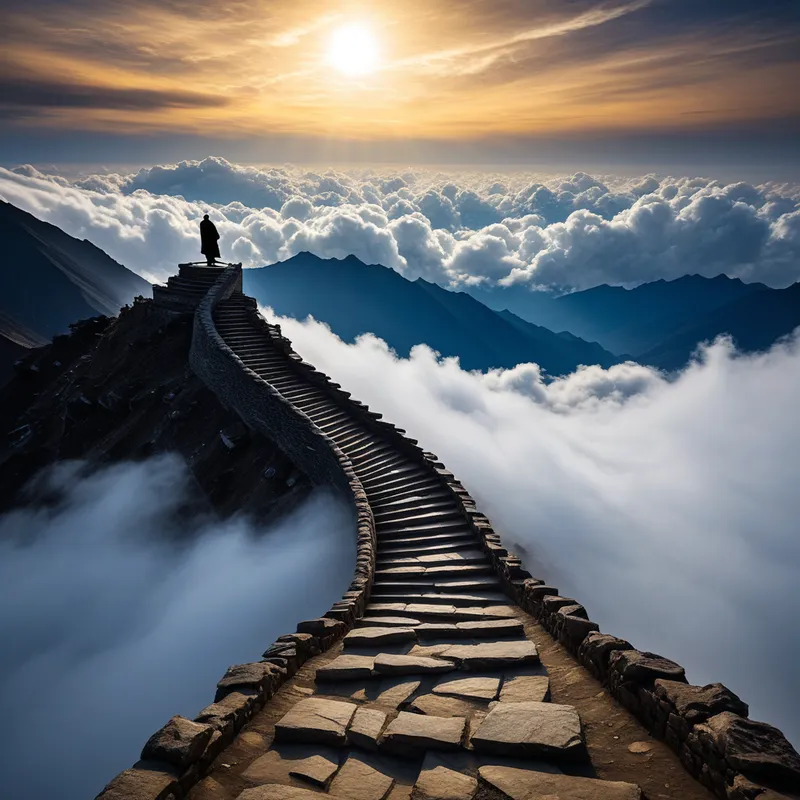
Stairway to Enlightenment Myth Meaning & Symbolism
A mythic journey of a seeker ascending a celestial stairway, facing inner demons to attain the luminous wisdom of enlightenment.
The Tale of Stairway to Enlightenment
In the high, silent places where the air is thin and the stars press close, there exists a story whispered by [the wind](/myths/the-wind “Myth from Various culture.”/) and carved into the heart-mind. It speaks of a time when a seeker, weary of [the world](/myths/the-world “Myth from Tarot culture.”/)‘s endless turning, came to the foot of a mountain that was not a mountain. It was a spire of reality, a axis piercing [the veil](/myths/the-veil “Myth from Various culture.”/) between the realms of form and formlessness. And upon its face was a stairway.
This was no stairway built by human hands. Each step was hewn from a different quality of being—the rough granite of doubt, the slick ice of fear, the warm sandstone of fleeting insight. It spiraled upward into [the mist](/myths/the-mist “Myth from Celtic culture.”/), vanishing into a luminosity that was neither sun nor moon, but the very source of perception. The seeker, whose name is lost, for it could be any name, stood at the base. Their heart was a tumult of longing and terror. Above, the promise of the Dharmakaya. Below, the familiar suffering of [Samsara](/myths/samsara “Myth from Buddhist culture.”/).
With a breath that was both a prayer and a farewell, they placed a foot upon the first step. As they did, the world below did not recede, but intensified. The chatter of mind, the ache of old wounds, the seductive whispers of memory—all rose like a chorus. This was the first test: the weight of [the self](/myths/the-self “Myth from Jungian culture.”/).
The climb was an eternity measured in heartbeats. On one turn of [the spiral](/myths/the-spiral “Myth from Celtic culture.”/), they were assailed by visions of terrifying Dharmapalas, their roars the sound of the seeker’s own repressed rage and passion. On the next, they were tempted by blissful Deva realms, where every desire was instantly mirrored, a paradise of [the ego](/myths/the-ego “Myth from Jungian culture.”/). The stairway itself seemed to shift, steps crumbling into abysses of doubt or stretching into impossible distances.
The pivotal moment came not at the top, but in the terrible, silent middle. Exhausted, the seeker halted. They had fought demons and resisted heavens, but now they faced a more profound emptiness: the sheer, vertiginous pointlessness of the climb itself. “Why ascend?” [the void](/myths/the-void “Myth from Buddhist culture.”/) seemed to ask. “What is above that is not already here?” In that moment of absolute surrender, of the ego’s final, weary gasp, something broke. Not their resolve, but the illusion of the climber separate from the climb.
They looked at the step beneath their feet. They saw not an obstacle, but the ground of being. They looked at their own trembling hand and saw it woven from the same starlight that illuminated the peak. The conflict dissolved. The seeker, the stairway, and the goal ceased to be three things. With this non-action, this profound acceptance, the remaining stairs unfolded not as a struggle, but as a natural unfurling, like a [lotus](/myths/lotus “Myth from Hindu culture.”/) reaching for the sun. They did not so much arrive at [the summit](/myths/the-summit “Myth from Taoist culture.”/) as realize they had never left it. The luminous wisdom, the Bodhicitta, was not a distant light, but the very nature of their perceiving.
Cultural Origins & Context
This myth, while not a single canonical scripture, is a narrative distillation of core principles found in Tibetan Vajrayana Buddhism. It is the kind of tale told by a Lama to a disciple during retreat, or woven into the explanatory narratives of mandalas and deity yoga. Its function is not historical but pedagogical and initiatory.
It belongs to the genre of dohas and journey allegories that populate Tibetan literature, such as the spiritual biographies of Mahasiddhas. The stairway is a potent metaphor for the Lamrim (Stages of the Path) teachings, which outline a sequential progression from a beginner’s mind to Buddhahood. The myth served to internalize this abstract progression, making it a visceral, personal odyssey for the practitioner. It was a map of the inner landscape, passed orally to prepare the [psyche](/myths/psyche “Myth from Greek culture.”/) for the rigors of meditation and the direct confrontation with the nature of self and reality.
Symbolic Architecture
The myth is a masterful [blueprint](/symbols/blueprint “Symbol: A blueprint represents the foundational plan or design for something, often symbolizing potential, structure, and the mapping of one’s inner self or future.”/) of the psyche’s transformation. The [stairway](/symbols/stairway “Symbol: A stairway symbolizes progress, ascension, and the journey through different stages of life.”/) itself is the central [symbol](/symbols/symbol “Symbol: A symbol can represent an idea, concept, or belief, serving as a powerful tool for communication and understanding.”/)—not a [linear](/symbols/linear “Symbol: Represents order, predictability, and a direct, step-by-step progression. It symbolizes a clear path from cause to effect.”/) ladder, but a spiral. This represents the paradoxical [nature](/symbols/nature “Symbol: Nature symbolizes growth, connectivity, and the primal forces of existence.”/) of the [path](/symbols/path “Symbol: The ‘path’ symbolizes a journey, choices, and the direction one’s life is taking, often representing individual growth and exploration.”/): one moves through progressive stages while circling the same central [truth](/symbols/truth “Symbol: Truth represents authenticity, honesty, and the quest for knowledge beyond mere appearances.”/), seeing it from ever-deeper perspectives.
The stairway is not climbed by moving forward, but by letting go of the ground behind.
The [seeker](/symbols/seeker “Symbol: A person actively searching for meaning, truth, or a higher purpose, often representing the dreamer’s own quest for identity or fulfillment.”/) represents the individual ego-[consciousness](/symbols/consciousness “Symbol: Consciousness represents the state of awareness and perception, encompassing thoughts, feelings, and experiences.”/), the sense of a solid “I” that undertakes spiritual practice. The terrifying and tempting visions are the projections of the [shadow](/symbols/shadow “Symbol: The ‘shadow’ embodies the unconscious, repressed aspects of the self and often represents fears or hidden emotions.”/) and the ego. They are not external demons but the personified contents of one’s own mind—attachment, aversion, pride, and ignorance. The crumbling steps symbolize the necessary [dissolution](/symbols/dissolution “Symbol: The process of breaking down, dispersing, or losing form, often representing transformation, release, or the end of a state of being.”/) of cherished beliefs and securities. The midpoint [crisis](/symbols/crisis “Symbol: A crisis symbolizes turmoil, urgent challenges, and the need for immediate resolution or change.”/) of meaning is the crucial encounter with the [Sunyata](/myths/sunyata “Myth from Buddhist culture.”/), the void that underlies all constructs.
The final realization—the non-[separation](/symbols/separation “Symbol: A spiritual or mythic division between realms, states of being, or consciousness, often marking a transition or loss of connection.”/) of climber, path, and goal—symbolizes the direct experience of Rigpa or the nature of mind. Enlightenment is not an acquisition, but a recognition of what has always been present.
The Dreamer’s Resonance
When this mythic pattern stirs in the modern dreamer, it signals a profound somatic and psychological process of integration. To dream of an endless, arduous stairway is to feel the psyche’s imperative to ascend—to grow, to heal, to understand. The physical sensation of effort, of leaden legs and burning lungs in the dream, mirrors the real psychological labor of confronting repressed material or undertaking a difficult life transition.
The demons that appear are tailor-made by the unconscious. A dream of a bureaucratic demon blocking the stairs may point to shadow issues around authority or rigid self-criticism. A tempting, seductive figure on a landing may represent an addictive pattern or a comfort zone the ego is reluctant to leave. The dream is a nightly sadhana, rehearsing the confrontation with these aspects of self. The feeling of being stuck, or the step giving way, often correlates with a waking-life insight that has destabilized an old self-concept. The dream is the psyche’s way of metabolizing this change, building the neural and emotional architecture for a new level of consciousness.
Alchemical Translation
For the modern individual, the myth models the alchemy of individuation. The base metal of the conditioned personality—with its complexes, traumas, and social masks—is the seeker at the stair’s base. The long, spiraling ascent is the often non-linear, frustrating, and revelatory work of therapy, introspection, shadow-work, and creative expression.
The peak is not a place to reach, but a perspective to inhabit—the Self looking upon the ego with compassion, knowing it was both the obstacle and the vehicle.
Each confrontation with a “demon” (a triggered emotion, a painful memory, a destructive habit) is an opportunity for psychic transmutation. We do not slay these parts in a heroic battle; that would be repression in another form. Instead, we do as the seeker ultimately did: we stop, turn, and face them fully. In that full facing, in the acceptance of their energy without identification, they lose their solid, threatening form. Anger, when fully felt without acting out, reveals itself as passionate energy. Fear, when sat with, unveils its protective intent. This is the alchemical dissolution.
The final realization is the culmination of the work: the experience of the observing consciousness that is not defined by any of the contents it witnesses. This is the psychological correlate of enlightenment—the relatively integrated Self, capable of holding paradox, bearing uncertainty, and engaging with the world from a center that is no longer brittle but fluid and compassionate. The stairway, in the end, is revealed to be the spine of our own awareness, and each step, a vertebra of lived experience, supporting the awakening to our true nature.
Associated Symbols
Explore related symbols from the CaleaDream lexicon: