
St. Francis of Assisi Myth Meaning & Symbolism
A wealthy merchant's son renounces everything to wed Lady Poverty, preaching to birds and wolves, becoming a mirror for the divine in all creation.
The Tale of St. Francis of Assisi
Listen. There was a boy born under the warm sun of Umbria, a son of silk and coin. His name was Francesco, and his world was one of bright fabrics, laughter in the piazza, and the clinking weight of his father’s wealth. He dreamed of glory, of knighthood, and wore fine clothes like a second skin. But the soul has its own geography, and his was a land about to be shaken by a divine earthquake.
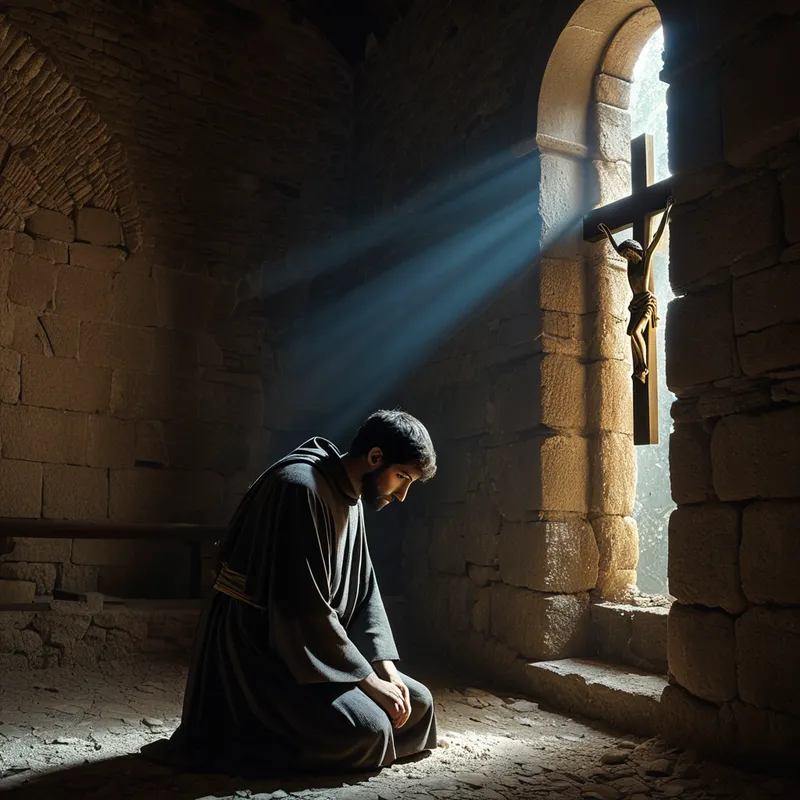
It began not with a shout, but with a silence. In the crumbling, forgotten chapel of San Damiano, the air thick with dust and neglect, he knelt. Before him hung a painted crucifix, stern and ancient. And then, the wood seemed to breathe. A voice, gentle yet tectonic, spoke from that space between heartbeats: “Francis, go and repair my house, which, as you see, is falling into ruin.” The command was literal, but its meaning was a seed that would crack the stone of the world. He felt the foundations of his life—the merchant’s son, the knight’s ambition—dissolve into sand.
He began with stones, rebuilding the physical chapel with his own hands, selling his father’s bolts of cloth to pay for the work. This was the first rupture. His father, Pietro, a man of ledger and law, dragged him before the Bishop of Assisi to demand restitution and renunciation. In the public square, under the gaze of God and gossip, Francis performed his ultimate act. He stripped himself naked, casting the fine garments back at his father, saying, “Until now I have called you my father on earth. Henceforth I can truly say, ‘Our Father who art in heaven.’” He stood there, vulnerable to the elements, clothed only in the Bishop’s rough cloak. He was no longer a son of Pietro, but a newborn of the spirit.
Thus began his sacred marriage to Lady Poverty. He wandered the roads, begging for alms, singing of Brother Sun and Sister Moon. The world, once a marketplace, became a living cathedral. In a field, he preached to a flock of birds, who listened in perfect stillness before scattering to the four winds. At Gubbio, he confronted a wolf that terrorized the town, not with a sword, but with brotherhood, making a pact between the beast and the people. He bore the sacred wounds, the Stigmata, on his own body, becoming a living icon of divine love. At the end, lying on the bare earth, he welcomed Sister Bodily Death, his final and most intimate sibling. He passed from a world he had taught to sing, leaving behind not a monument, but a footprint of perfect joy in the mud.
Cultural Origins & Context
This story emerged from the specific ferment of 12th and 13th century Italy, a time of burgeoning mercantile wealth, urban growth, and perceived corruption within the institutional Church. Francis was a historical figure (c. 1181–1226), but his life was almost immediately mythologized. The primary sources—the official biographies by Thomas of Celano and the legendary Fioretti (“Little Flowers”)—were not dry histories. They were legenda, “things to be read,” crafted for spiritual edification and to define the identity of the rapidly growing Franciscan Order.
The myth was passed down orally by the first friars and formally codified to guide the order’s mission. Its societal function was multifaceted: it was a radical critique of materialistic culture, a model of apostolic purity, and a stabilizing narrative for a movement that threatened to destabilize ecclesiastical hierarchies. The myth served as a charter, illustrating the “correct” way to be a poor, preaching friar in imitation of Christ. It offered a new spiritual ideal accessible outside monasteries, in the very towns and roads of a changing Europe.
Symbolic Architecture
At its core, the myth of Francis is a map of radical psychic reversal. The central symbol is not a object, but an act: The Renunciation. It represents the utter deconstruction of the socially-constructed personality—the persona of the wealthy merchant’s son—to contact the authentic Self.
The stripping naked in the piazza is the ultimate psychodrama: to become nothing in the eyes of the world is to become everything in the soul.
Lady Poverty is the archetypal bride of this transformed consciousness. She represents not deprivation, but a sacred emptiness that allows the world to flow in as relationship, not possession. His preaching to the birds and taming of the wolf symbolize the redemption of the instinctual and “wild” psyche. The animals are not allegories; they are the anima mundi, the world soul, recognizing its kin in a human who has shed his alienation. The culminating symbol, the Stigmata, signifies the final identification of the individual psyche with the archetypal pattern of transformative suffering and love—the Christ archetype—imprinted directly onto the flesh of lived experience.
The Dreamer’s Resonance
When this myth stirs in modern dreams, it often signals a profound crisis of values. One may dream of quitting a lucrative but soul-deadening job, of giving away prized possessions, or of finding deep communion with an animal in an urban landscape. The somatic feeling is often one of simultaneous terror and exhilarating lightness—the vertigo of the piazza moment.
Psychologically, this is the process of the ego confronting the Self’s demand for authenticity. The “father” in the dream—whether a boss, a tradition, or an internalized voice of pragmatic security—is being symbolically defied. The dream animals (birds, wolves, even insects) represent instinctual energies and untamed wisdom seeking reconciliation with the conscious mind. To dream of embracing a leper, as Francis did, points to the urgent need to integrate one’s own rejected and reviled aspects—the personal shadow. The dream is an invitation to a radical re-ordering of priorities, where worth is divorced from wealth and self is found in service to a larger, animate reality.

Alchemical Translation
The Francis myth is a perfect allegory for the individuation process. The initial state (nigredo) is the dark confusion of the wealthy youth, whose glittering life is actually a spiritual poverty. The call from the crucifix is the stirring of the Self. The renunciation and stripping bare is the solutio, the dissolution of all previous forms.
The alchemical vessel is not a flask of glass, but the hollow space of a life emptied of worldly projections.
His wandering and begging constitute the circulatio, a wandering engagement with the world in a new, receptive mode. The preaching to creatures is the coniunctio, the sacred marriage between human consciousness and the natural psyche—the union with anima mundi. Finally, the Stigmata represent the rubedo, the reddening, the full incarnation of the transcendent principle into the mortal body. The goal is not ascension out of the world, but a deeper, sanctified immersion in it. For the modern individual, the transmutation is from a consciousness of ownership and separation to one of kinship and participation. The “Canticle of the Creatures” is not a poem, but the song a fully integrated psyche naturally sings to a universe it now calls family.
Associated Symbols
Explore related symbols from the CaleaDream lexicon: