St. David Myth Meaning & Symbolism
The story of a humble monk whose quiet faith moves mountains, defeats falsehood, and founds a spiritual kingdom in the wilds of Wales.
The Tale of St. David
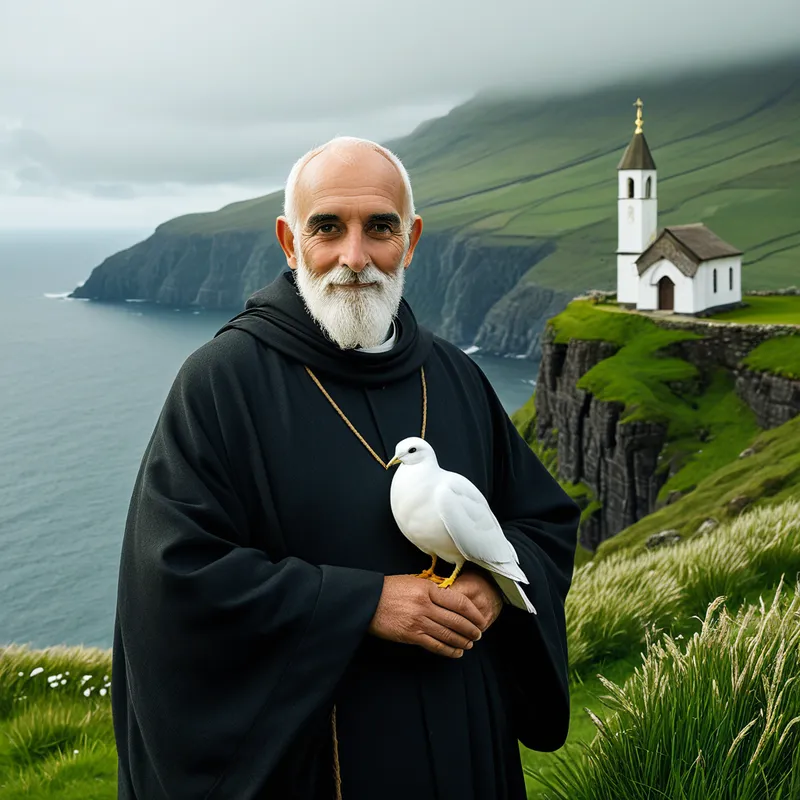
Listen now, and let the mists of Cymru gather around you. In a time when the old gods still whispered in the oak groves and the new faith was a fragile flame in [the wind](/myths/the-wind “Myth from Various culture.”/), a child was born in a storm. They say his birth was heralded by prophecy and portent, and that his mother, Non, gave birth to him on a clifftop in the wilds of Pembrokeshire, where [the sea](/myths/the-sea “Myth from Greek culture.”/) roared and the stones themselves bore the mark of her fingers. They named him Dewi.
From his first breath, he was marked not for battle, but for a different kind of struggle. He grew not into a warrior of the sword, but a monk of the soil and the spirit. He drank [water](/myths/water “Myth from Chinese culture.”/), never ale. He ate bread and leeks, and his community knew only the simplest fare. His monastery at Tyddewi was not a fortress of stone, but a humble collection of wattle cells, where the rule was labor, study, and prayer. The brothers plowed the fields yoked to the oxen themselves, knowing that to work the land was to pray with the body.
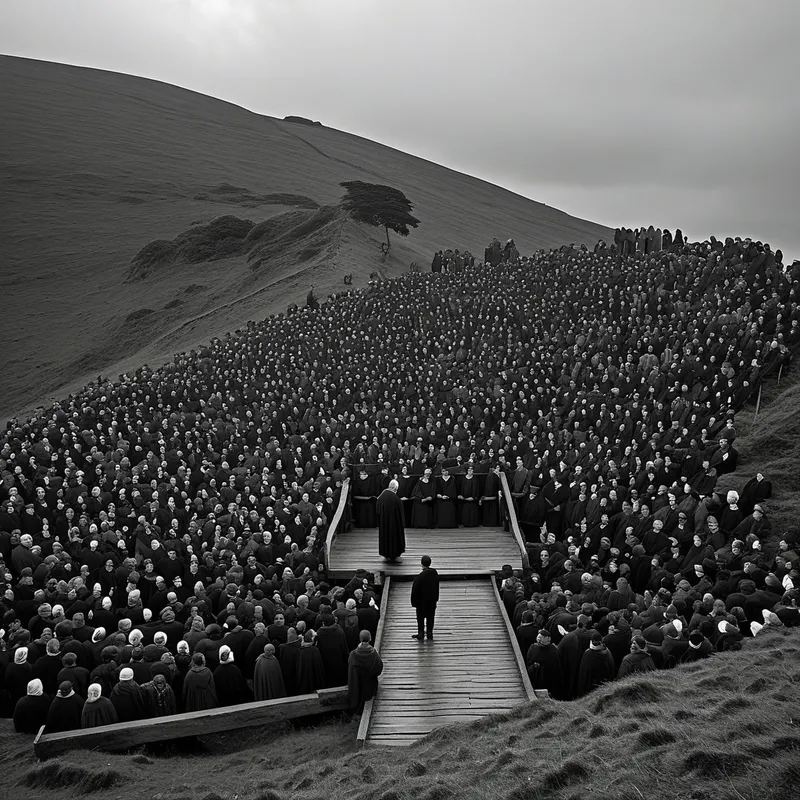
But [the world](/myths/the-world “Myth from Tarot culture.”/) of men is not so simple. Falsehood grew like a weed, and a proud teacher named Boi, with silvered tongue and twisted doctrine, gathered a great synod at Llanddewi Brefi. The air was thick with argument and pride. Dewi came, this quiet man in simple robes, accompanied only by his faithful scribe. As Boi held forth, his voice ringing with empty authority, the ground would not hold him. The platform upon which he stood began to sink into the bog.
Then Dewi stepped forward. He placed his simple leather wallet upon the ground. And as he began to speak—not to shout, but to speak with a clarity that cut through the noise like a cold, clear stream—[the earth](/myths/the-earth “Myth from Hindu culture.”/) itself listened. The ground beneath his feet rose, lifting him up so all could see and, more importantly, hear. A snow-white dove, descended from the heavens, settled upon his shoulder, a living testament to the purity of his words. The falsehood was unmasked not by force, but by truth made manifest. The synod was his. The foundation was laid.
His greatest miracle was one of seeing. He journeyed to the holy land in [Jerusalem](/myths/jerusalem “Myth from Biblical culture.”/), not in body, but in spirit, while his physical form remained at prayer in Wales. He saw the sacred sites, and in return, the ground of his homeland was consecrated. At the end of his long years, he gathered his heartbroken community. His final sermon was not of fear, but of joyful steadfastness. “Brothers and sisters,” he said, his voice thin but firm as an old root, “Be joyful, keep your faith and your creed, and do the little things.” With those words—Gwnewch y pethau bychain—the saint who moved mountains with his quiet voice passed from the green land, leaving behind not monuments, but a living wellspring.
Cultural Origins & Context
The figure of St. David, or Dewi Sant, is the patron saint of Wales, and his story exists in the liminal space between late Brittonic history and early medieval hagiography. The primary source is the 11th-century Buchedd Dewi (Life of David) by Rhygyfarch. This was not a dispassionate history, but a political and spiritual document, composed to assert the independence and prestige of the Welsh church against Norman encroachment and the influence of Canterbury.
The myth was passed down by the monastic communities he founded, becoming a cornerstone of Welsh national identity. He was not a martyr who died violently, but a confessor—one who witnessed through a life of asceticism and foundational labor. His feast day, March 1st (Dydd Gŵyl Dewi), became and remains a potent cultural rallying point. The telling of his tale functioned as a societal anchor: it validated a specifically Welsh, Celtic expression of Christianity that was humble, connected to the land, and resilient. He was the spiritual father who proved that greatness could emerge from simplicity and that truth could [triumph](/myths/triumph “Myth from Roman culture.”/) without empire.
Symbolic Architecture
St. David is the [archetype](/symbols/archetype “Symbol: A universal, primordial pattern or prototype in the collective unconscious that shapes human experience, behavior, and creative expression.”/) of the [foundation](/symbols/foundation “Symbol: A foundation symbolizes the underlying support systems, values, and beliefs that shape one’s life, serving as the bedrock for growth and development.”/) [stone](/symbols/stone “Symbol: In dreams, a stone often symbolizes strength, stability, and permanence, but it may also represent emotional burdens or obstacles that need to be acknowledged and processed.”/), not the towering [spire](/symbols/spire “Symbol: A tall, tapering structure pointing skyward, symbolizing aspiration, spiritual connection, and reaching beyond earthly limits.”/). His myth is a masterclass in the power of essence over [appearance](/symbols/appearance “Symbol: Appearance in dreams relates to self-image, perception, and how you present yourself to the world.”/), of substance over spectacle.
The true mountain-moving faith is not a shout that echoes off cliffs, but a quiet word that causes the earth to rise from within.
His asceticism—the [water](/symbols/water “Symbol: Water symbolizes the subconscious mind, emotions, and the flow of life, representing both cleansing and creation.”/), the [bread](/symbols/bread “Symbol: Bread symbolizes nourishment, sustenance, and the daily essentials of life, often representing fundamental needs and comfort.”/), the manual labor—is not mere deprivation, but a radical simplification. It strips away [the ego](/myths/the-ego “Myth from Jungian culture.”/)’s need for comfort and recognition, paring [the self](/myths/the-self “Myth from Jungian culture.”/) down to its essential, functional core. The [wallet](/symbols/wallet “Symbol: A wallet in dreams symbolizes personal values, security, and the management of resources.”/) he places on the ground is the [symbol](/symbols/symbol “Symbol: A symbol can represent an idea, concept, or belief, serving as a powerful tool for communication and understanding.”/) of this pared-down [life](/symbols/life “Symbol: The symbol of ‘Life’ represents a journey of growth, interconnectedness, and existential meaning, encompassing both the joys and challenges that define human experience.”/); it contains everything he needs, and from this modest anchor, miraculous [stability](/symbols/stability “Symbol: A state of firmness, balance, and resistance to change, often represented by solid objects, foundations, or steady tools.”/) grows.
The central miracle of the rising ground is profoundly symbolic. It represents the [emergence](/symbols/emergence “Symbol: A process of coming into being, rising from obscurity, or breaking through a barrier, often representing birth, transformation, or revelation.”/) of authentic, grounded [truth](/symbols/truth “Symbol: Truth represents authenticity, honesty, and the quest for knowledge beyond mere appearances.”/) in the face of inflated falsehood. Boi, on his collapsing [platform](/symbols/platform “Symbol: A platform symbolizes a stage for expression, support, or a foundation upon which something is built.”/), is the ego built on shaky, unsustainable premises. David does not attack the platform; he simply embodies a different principle. His [truth](/symbols/truth “Symbol: Truth represents authenticity, honesty, and the quest for knowledge beyond mere appearances.”/) is so integral, so aligned with the foundational order of things, that the very [earth](/symbols/earth “Symbol: The symbol of Earth often represents grounding, stability, and the physical realm, embodying a connection to nature and the innate support it provides.”/) supports and elevates it. The white dove confirms this alignment with a higher, reconciling principle.
His final instruction, “Do the little things,” is the key. It translates the grand spiritual struggle into the [alchemy](/symbols/alchemy “Symbol: A transformative process of purification and creation, often symbolizing personal or spiritual evolution through difficult stages.”/) of daily, conscious [action](/symbols/action “Symbol: Action in dreams represents the drive for agency, motivation, and the ability to take control of situations in waking life.”/). The “little things” are the small, consistent choices that build a [character](/symbols/character “Symbol: Characters in dreams often signify different aspects of the dreamer’s personality or influences in their life.”/)—and a world—from the ground up.
The Dreamer’s Resonance
When this myth stirs in the modern [psyche](/myths/psyche “Myth from Greek culture.”/), it often manifests in dreams of quiet confrontation or foundational shifts. You may dream of being in a chaotic meeting or a loud, contentious crowd. A figure of false authority (a boss, a parent, a charismatic guru) holds sway, but their platform feels unstable. In the dream, you do not argue. You simply step forward, perhaps place a simple, personal object (a notebook, a stone from your garden) on the floor, and begin to speak your clear, unadorned truth. As you speak, you feel the floor become solid beneath you, or you find yourself standing on a small, stable hillock in the midst of the chaos.
Somatically, this dream pattern correlates with a release of tension from the upper body—the clenched jaw, the tight shoulders from carrying the weight of others’ expectations or one’s own performative [persona](/myths/persona “Myth from Greek culture.”/). The energy drops into the legs and feet, a grounding process. Psychologically, it marks a critical moment of differentiation: the dreamer is separating their authentic voice from the internalized cacophony of external demands and false doctrines. The miracle in the dream is the felt sense of being supported by one’s own integrity.

Alchemical Translation
The individuation process modeled by St. David is the alchemy of grounding. It is the opus contra naturam (work against one’s own fallen nature) of resisting the temptation to build a towering, impressive persona, and instead, laboriously cultivating the humble, fertile soil of the Self.
[The first stage](/myths/the-first-stage “Myth from Alchemical culture.”/) is the ascetic distillation: the conscious simplification of one’s life. This is not poverty for its own sake, but the intentional stripping away of psychic clutter—addictive behaviors, hollow social obligations, the constant noise of entertainment and opinion—that clouds the inner wellspring. One drinks only “water,” seeking the unadulterated truth of one’s own experience.
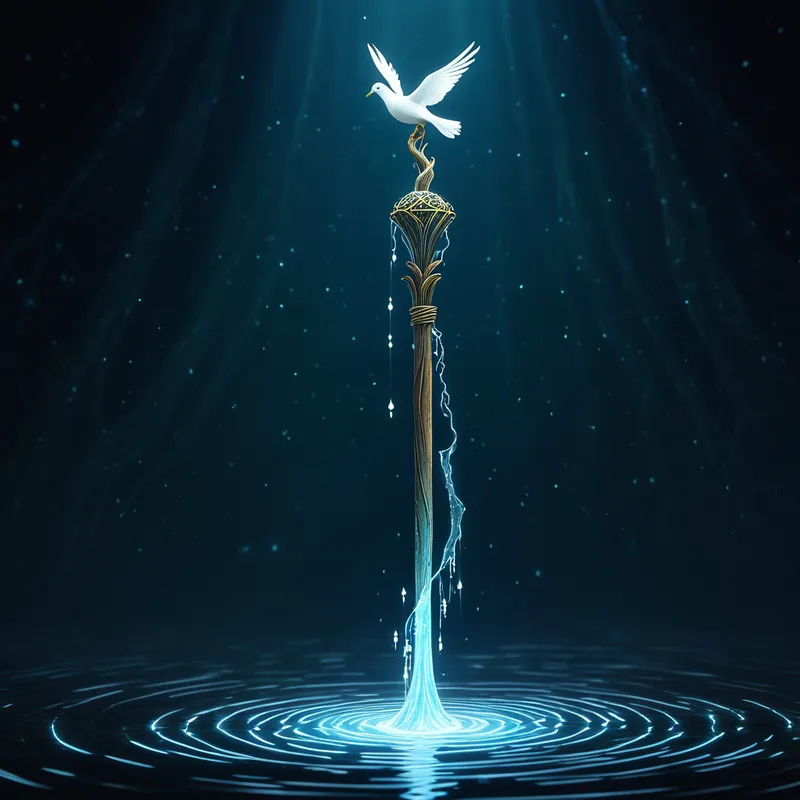
The conflict at the synod represents the inevitable confrontation with the inner Boi—the complex of inherited beliefs, cultural conditioning, and personal pride that speaks loudly but has no foundation. The alchemical work here is not to fight this voice directly, but to embody its opposite. One must plant the staff of one’s simple, lived truth into the bog of collective confusion.
The hill that rises is the nascent, integrated Self, emerging into consciousness not through grandiosity, but through humble, consistent alignment.
The final teaching, “Do the little things,” is the formula for the [Magnum Opus](/myths/magnum-opus “Myth from Alchemical culture.”/) in everyday life. The gold is not manufactured in a single blast of insight, but is patiently deposited in the tiny, daily acts of integrity, kindness, and attention. To found a monastery is to build a structured, disciplined inner life (the [temenos](/myths/temenos “Myth from Greek culture.”/)) where this work can proceed. The blessing David wins for his land is the ultimate alchemical prize: the realization that the sacred center (Jerusalem) is not a distant geography, but the very ground of one’s own being, once it has been consecrated by a life of authentic, humble labor. The patron saint of Wales thus becomes, for the modern soul, the patron of the quietly sovereign inner kingdom.
Associated Symbols
Explore related symbols from the CaleaDream lexicon: