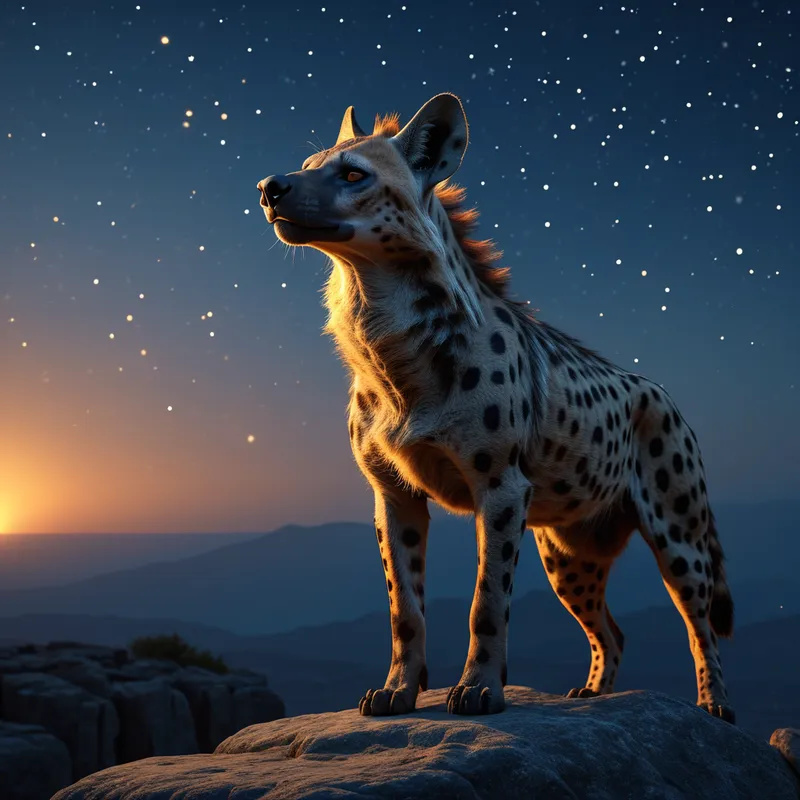
Spotted Hyena of Herodotus Myth Meaning & Symbolism
A traveler's tale of a creature that blurs the line between hunter and prey, embodying the terrifying and transformative power of the liminal shadow.
The Tale of Spotted Hyena of Herodotus
Listen, and hear the tale not carved in temple stone, but whispered on the dry, hot winds of the east, carried from the lips of caravan masters and desert scouts to the ear of the Inquirer, Herodotus. It is a story of the margins, where the map ends and [the world](/myths/the-world “Myth from Tarot culture.”/) begins to breathe a different, older kind of truth.
He walked the dust-choked roads of Anatolia, where the sun is a hammer and the shadows are deep wells of mystery. The locals, their faces leathern from [the wind](/myths/the-wind “Myth from Various culture.”/), spoke in hushed tones of the creature that haunted the twilight places—the spotted one. They said it was not merely a beast of the field, but a shapeshifter, a paradox woven from the fabric of the in-between.
They told him this: that the spotted hyena possesses a nature twofold, a sacred and terrible duplicity. For it lives its life as both male and female, they claimed. Each year, it chooses its nature anew. The hunters who dared track it spoke of tracks that seemed to change, of a cry in the night that was neither howl nor laugh, but the sound of a boundary breaking. It was an animal that refused the tidy categories of [the polis](/myths/the-polis “Myth from Greek culture.”/), that mocked the clear divisions of Dike. It was a creature of Gaia, yes, but of a Gaia untamed and unconcerned with the orders of men or even of Zeus.
The climax of the tale was not a battle, but a revelation. A shepherd, driven to the edge of his wits by lost lambs, swore he followed the spotted thief to its den at dawn. In the half-light, he did not see a beast gnawing on bone. He saw, or believed he saw, the creature in a moment of profound, solitary transformation—a shuddering under the spotted pelt, a blurring of form, as if it were deciding, in that very instant, what manner of being it would be for the coming day. It was a moment of pure, autonomous becoming, witnessed by a man whose understanding of the world was forever cracked open. The creature turned its gaze upon him, and in its eyes was not threat, but a vast, indifferent knowledge. Then it loped away, dissolving into the shimmering heat haze, leaving behind only the echo of its impossible truth and the shepherd’s shattered certainty.
Cultural Origins & Context
This account resides not in the canonical body of Olympian myth, but in the fertile borderlands of early ethnography and traveler’s lore. It is found in Herodotus’s Histories, specifically in his inquiries into the customs of the “barbarian” world beyond Greece. For the Greeks, the hyena was a creature of the exotic east and Africa, a real animal shrouded in the fantastical reports of merchants and mercenaries.
The myth’s function was multifaceted. For Herodotus, it served as a thoma—a wonder—that illustrated the incredible diversity of Oikoumene. It was a data point in his grand project of cataloging human and natural variation. For his audience, however, it played a deeper, more psychological role. It acted as a narrative vessel for exploring the “Other” in its most radical form: a natural creature that defied the most fundamental natural laws as the Greeks understood them (sexual dimorphism). It reinforced Greek identity by contrasting it with the chaotic, self-transforming nature of the world beyond their shores, while simultaneously revealing a secret, unsettling fascination with that very chaos.
Symbolic Architecture
The Spotted Hyena is not a god, but an archetypal daemon of the liminal. Its [symbolism](/symbols/symbolism “Symbol: The use of symbols to represent ideas or qualities, often conveying deeper meanings beyond literal interpretation. In dreams, it’s the language of the unconscious.”/) is an [architecture](/symbols/architecture “Symbol: Architecture in dreams often signifies structure, stability, and the framing of personal identity or life’s journey.”/) of contradiction and potential.
The true rebel does not oppose the law, but embodies the principle that exists before law, the chaotic potential from which all order is temporarily carved.
Its primary [symbol](/symbols/symbol “Symbol: A symbol can represent an idea, concept, or belief, serving as a powerful tool for communication and understanding.”/) is transgressive duality. It is male-and-female, hunter-and-scavenger, solitary-and-communal, laugh-and-how. It represents the collapse of binary thinking. Psychologically, it embodies the [shadow](/symbols/shadow “Symbol: The ‘shadow’ embodies the unconscious, repressed aspects of the self and often represents fears or hidden emotions.”/) not as a dark twin, but as a complementary, co-existing totality that the conscious ego has split apart for the sake of a stable, but limited, [identity](/symbols/identity “Symbol: Identity represents the sense of self, encompassing personal beliefs, cultural background, and social roles.”/).
The spotted pelt is crucial. Unlike the pure black of the unknown or the pure white of [innocence](/symbols/innocence “Symbol: A state of purity, naivety, and freedom from guilt or corruption, often associated with childhood and moral simplicity.”/), the spotted [pattern](/symbols/pattern “Symbol: A ‘Pattern’ in dreams often signifies the underlying structure of experiences and thoughts, representing both order and the repetitiveness of life’s situations.”/) is a [fragmentation](/symbols/fragmentation “Symbol: The experience of breaking apart, losing cohesion, or being separated into pieces. Often represents disintegration of self, relationships, or reality.”/) of light and dark, a [integration](/symbols/integration “Symbol: The process of unifying disparate parts of the self or experience into a cohesive whole, often representing psychological wholeness or resolution of internal conflict.”/) of opposites into a new, complex whole. It is the coat of the [trickster](/symbols/trickster “Symbol: A boundary-crossing archetype representing chaos, transformation, and the subversion of norms through cunning and humor.”/) at the [crossroads](/symbols/crossroads “Symbol: A powerful spiritual symbol representing a critical decision point where paths diverge, often associated with fate, transformation, and life-altering choices.”/), the visible manifestation of a [nature](/symbols/nature “Symbol: Nature symbolizes growth, connectivity, and the primal forces of existence.”/) that contains multitudes.
Finally, its annual [choice](/symbols/choice “Symbol: The concept of choice often embodies decision-making, freedom, and the multitude of paths available in life.”/) of nature is the ultimate symbol of autonomous self-creation. It is not fated by the gods or bound by instinct in the Greek imagination, but exercises a terrifying, sovereign freedom over its own essence. It is the [archetype](/symbols/archetype “Symbol: A universal, primordial pattern or prototype in the collective unconscious that shapes human experience, behavior, and creative expression.”/) of becoming over being.
The Dreamer’s Resonance
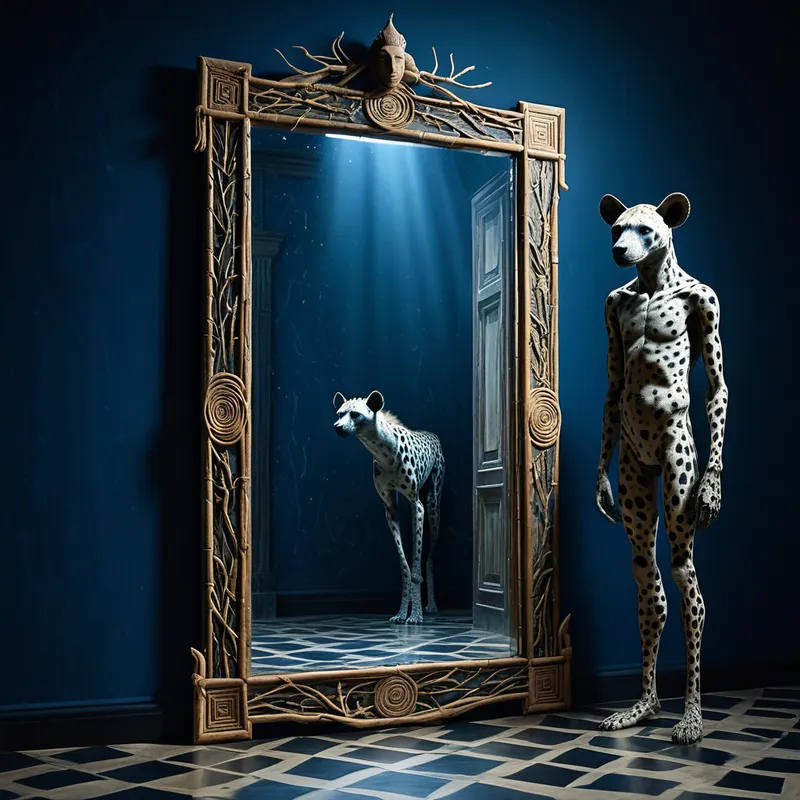
When this myth stirs in the modern unconscious, it often surfaces in dreams of profound personal ambiguity. The dreamer may find themselves in a body that feels alien or shifting. They may look in a mirror and see a face that is both theirs and not-theirs, or an animal gaze looking back. The setting is often a threshold: a doorway that keeps changing, a border crossing, a twilight landscape.
Somatically, this dream-complex accompanies a psychological process of dis-identification. [The ego](/myths/the-ego “Myth from Jungian culture.”/)’s rigid claim to a single, fixed identity (“I am this job, this gender, this role”) is being challenged by the deeper Self. The hyena represents the psychic energy that refuses to be categorized, the parts of one’s nature that have been suppressed because they don’t fit the story one tells about oneself. The “laugh” of the hyena in the dream can be the unsettling, liberating recognition of these suppressed parts. The process is one of confronting the internalized “barbarian”—the wild, untamed, seemingly contradictory potentials within that have been exiled to the psychic hinterlands.
Alchemical Translation
The alchemical journey modeled by this myth is not the heroic conquest of a dragon, but the humble, awe-filled witnessing of one’s own inner Mysterium Coniunctionis—the mystery of conjunction.
The goal of individuation is not to become pure, but to become whole; to integrate the spotted pelt of one’s being, where every dark patch is necessary to define the light.
[The first stage](/myths/the-first-stage “Myth from Alchemical culture.”/) is [Nigredo](/myths/nigredo “Myth from Alchemical culture.”/), the blackening. This is the shepherd’s moment, the cracking of conscious certainty. In our lives, this is the crisis that reveals the limitations of our [persona](/myths/persona “Myth from Greek culture.”/), the feeling that the identity we’ve built is a cage. We confront the “spotted” nature of our own soul—our mixed motives, our latent potentials, our denied genders or passions.
The second stage is the [Solutio](/myths/solutio “Myth from Alchemical culture.”/), the dissolving. This is the hyena’s annual return to a state of potential. The old, rigid forms of “male” and “female,” “strong” and “weak,” “social” and “solitary” dissolve in the primal waters of the unconscious. This is a terrifying, liminal period of not-knowing-who-one-is.
The final, ongoing stage is Coagulatio, the coagulation. This is the hyena’s choice. From the dissolved state, a new, more complex, self-authored form coagulates. The modern individual undergoing this alchemy learns to consciously “choose their nature” from a broader palette of inner possibilities. They move from being a subject of fate or social expectation to a sovereign author of their own character, integrating [the shadow](/myths/the-shadow “Myth from Jungian culture.”/) not by defeating it, but by recognizing it as a vital part of their spotted, magnificent, and wholly unique pelt. The rebel archetype is fulfilled not in destruction, but in this profound, internal self-re-creation.
Associated Symbols
Explore related symbols from the CaleaDream lexicon: