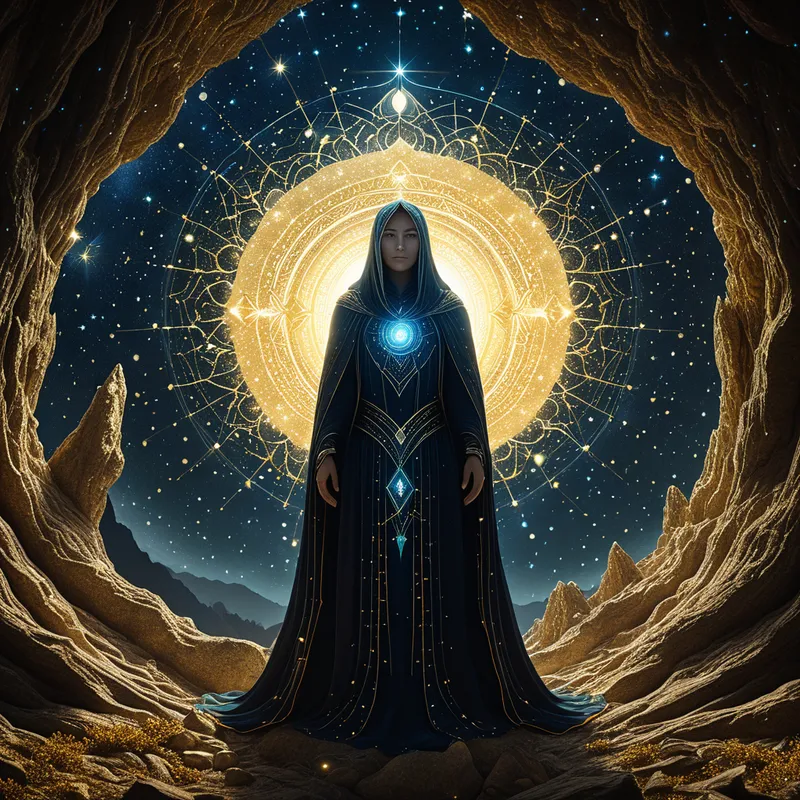
Spiritus Mundi Myth Meaning & Symbolism
The myth of the world soul, a divine breath trapped in matter, awaiting liberation through the alchemist's sacred art to heal a fractured cosmos.
The Tale of Spiritus Mundi
Listen, and hear the breath of the world. In the beginning, before the separation of light from dark, or earth from sky, there was a single, pulsing sigh—the Spiritus Mundi. It was the living intelligence of the All, a radiant, androgynous presence that sang the stars into being and whispered life into the veins of the deep earth. Its substance was the Quintessence, a music made visible, a light that was also thought.
But a great fracture echoed through the spheres. A cataclysm of pride, or perhaps a necessary schism in the mind of God, shattered the unity. The Spiritus Mundi was not destroyed, but scattered. Its luminous essence was driven down, imprisoned within the darkest, densest, and most forgotten corners of the material world. It became the secret fire sleeping in the heart of the mountain, the silent intelligence within the root of the venomous plant, the forgotten melody trapped in a lump of lead. The cosmos became a vast, beautiful prison, and the World Soul its captive. The heavens wept cold light, and the earth grew heavy with longing.
For ages, the world labored under this silence. Yet, in the deepest mines and the quietest laboratories, a rumor persisted. A whisper told of the One Thing, the lost treasure of God, hidden in plain sight within the foulest and most common matter. This rumor called to a certain kind of listener—not kings or warriors, but those who could hear the faint cry within the stone. The Alchemists.
One such seeker, after a lifetime of study, of failed furnaces and poisoned fumes, stood before their Athanor. In their hands was not gold, but a humble, blackened ore. They had learned to see with the heart, not the eye. As the fire was carefully raised through the secret degrees—the Nigredo, the Albedo, and the Citrinitas—a miracle of attention unfolded. The ore did not yield metal, but a sigh. A fragrance of rain on dry stone. A light that had no source.
In the final crucible, at the pinnacle of the Rubedo, the alchemist did not extract, but invited. They offered their own purified consciousness as a vessel. And from the transformed matter, not as a seizure but as a release, the imprisoned spark flowed forth. It was not a grand explosion, but a homecoming. A single, resonant note filled the chamber, a note that contained within it the memory of the ocean, the pattern of the hawk’s flight, and the cold fire of the distant sun. The Spiritus Mundi had been glimpsed, not captured, and in that moment, the alchemist and the cosmos breathed as one once more. The work was complete, and yet, it was just beginning.

Cultural Origins & Context
The myth of the Spiritus Mundi is not a folktale with a single origin, but the philosophical and operational heart of the Western alchemical tradition, spanning from Hellenistic Egypt through the Islamic Golden Age to the Renaissance. It is a syncretic myth, weaving threads from Plato’s Anima Mundi, Hermetic philosophy’s “God is an intelligible sphere whose center is everywhere and circumference nowhere,” and later Christian mysticism.
It was passed down not in public squares but in encoded manuscripts, cryptic emblems, and the oral instructions between master and apprentice. Its tellers were natural philosophers, physicians, and radical theologians operating at the perilous border between sanctioned inquiry and heresy. The myth’s societal function was profoundly subversive: it proposed that divinity was not remote in heaven, but immanent and imprisoned in the created world, and that a human being, through rigorous inner and outer work, could participate directly in its liberation. This was a cosmology of intimate responsibility, where healing a piece of metal was metaphorically linked to healing the soul and, by extension, a fractured creation.
Symbolic Architecture
At its core, the myth maps the psyche’s journey from a state of identification with fragmented, complex-ridden matter (the personal unconscious and the literal world) to a conscious relationship with the unifying principle of the Self.
The scattered Spiritus Mundi represents the psychic energy of wholeness—the Self—that has become lost, projected, or buried within our own unresolved “matter”: our traumas, our shadow aspects, our compulsive behaviors (the prima materia or “first matter”). We experience life as heavy, leaden, and meaningless because this animating spirit is bound.
The alchemist sought the spirit in the stone; we must seek the Self in the symptom.
The Alchemist is the archetype of the evolving ego-consciousness, undertaking the Opus Magnum. Their laboratory is the disciplined container of the therapeutic or introspective process. The stages of Nigredo, Albedo, Citrinitas, and Rubedo are not chemical recipes, but a profound map of psychological death and rebirth: confronting the shadow (Nigredo), purifying identifications (Albedo), integrating insights (Citrinitas), and achieving a new, sustainable relationship with the central life-energy (Rubedo). The final “release” is not possession of the spirit, but a sacred communion where the ego aligns with the Self.

The Dreamer’s Resonance
When this myth stirs in the modern unconscious, it often manifests in dreams of profound searching within confined or mundane spaces. The dreamer may find themselves in a basement, attic, or forgotten room of a familiar house, discovering a hidden source of light, warmth, or music emanating from a cracked wall, an old furnace, or a discarded piece of jewelry. There is a somatic sense of recognition and liberation—a weight lifting, a constriction in the chest easing, or a feeling of being breathed by a larger rhythm.
Psychologically, this signals an active process where a core complex—a dense, “leaden” pattern of feeling and behavior—is beginning to yield its latent energy. The dream ego (the alchemist) is not fighting the “ore” (the problem), but attending to it with a new quality of consciousness. The dream is an affirmation that within what feels most burdensome or base in one’s life lies a trapped fragment of one’s own vital spirit, awaiting acknowledgment and release.

Alchemical Translation
For the individual, the myth of the Spiritus Mundi models the path of Individuation. Our personal “lead” is our neurosis, our repetitive wound, the part of our life that feels most deadening and inevitable. The alchemical operation begins with the Nigredo: we must consent to fully experience this darkness, this depression or confusion, without immediate flight into distraction or positivity. This is the “putrefaction,” the allowing of an old mode of being to decompose.
The furnace of transformation is fired not by will, but by the slow, patient heat of sustained attention.
The Albedo follows—the washing clean. This is the insight, often emerging from dreams or careful reflection, that separates our identity from the complex. “I am not my depression; I have a depression.” A space opens. The Citrinitas is the dawning of this liberated energy as a new, guiding inner value or perspective. Finally, the Rubedo is not a permanent state of enlightenment, but those embodied moments where this integrated awareness actively informs our life. We act from a place of greater wholeness, and in doing so, we release a tiny fragment of the World Soul—the collective spirit of wholeness—back into the cosmos. We heal the microcosm, and in doing so, participate in healing the macrocosm. The work is never done, for the spirit is infinite, but each liberation echoes through the soul of the world.
Associated Symbols
Explore related symbols from the CaleaDream lexicon: