
Spirit Fish Myth Meaning & Symbolism
A myth of a great fish that offers its body to save a starving people, becoming a timeless symbol of sacred sacrifice and cyclical renewal.
The Tale of Spirit Fish
In the time before memory, when [the world](/myths/the-world “Myth from Tarot culture.”/) was young and the people were few, a great shadow fell upon the land. The rains forgot [the sky](/myths/the-sky “Myth from Persian culture.”/). The rivers, once proud and singing, shrank to whispers in their beds. The corn withered before it could dream of tassels, and the game fled to distant, unseen mountains. Hunger walked among the lodges, a gaunt and silent visitor whose touch turned strong hunters hollow and made the laughter of children a ghost of a sound.
The people prayed. They danced until their feet were raw upon the parched earth, sending their pleas spiraling up to the Great Mystery. But the sky remained a hard, blue bowl, empty of answer.
In this despair, a young woman named Still [Water](/myths/water “Myth from Chinese culture.”/) walked to the last deep pool of the great river. Her heart was a heavy stone within her. She looked into the murky [water](/myths/water “Myth from Chinese culture.”/), not seeking her reflection, but seeking an end to the suffering of her people. As her tears fell, joining the scant water, a ripple moved against the current.
From the profound darkness of the pool, a shape emerged. It was a Fish, but such a fish as had never been seen. Its scales were like plates of hammered copper and polished obsidian, catching the last light of day. Its eye was a deep, knowing orb, holding the patience of the deep places. It did not speak with a human tongue, but its voice flowed into Still Water’s mind, cool and clear as a spring.
“I have heard the hunger of the land,” the Spirit Fish said. “I have felt the dryness in the soul of [the river](/myths/the-river “Myth from Buddhist culture.”/). Your people’s prayers have sunk to my bed like stones.”
Still Water fell to her knees. “Great One, can you bring the rain?”
“I am not of the sky,” the Fish replied. “I am of the water, the blood of [the earth](/myths/the-earth “Myth from Hindu culture.”/). The rain will come in its own time, from its own journey. But I can offer a bridge between the hunger of now and the abundance of then.”
The Fish then presented a terrible, beautiful choice. “Take my body. Let your people feed upon my flesh. Do not waste a single part. My bones, my scales, my spirit—all must be returned to the water from which I came, with gratitude and sacred ceremony.”
Horror and hope warred within Still Water. To take the life of such a being felt like a profound sacrilege. Yet the Fish’s gaze held no fear, only a solemn purpose. It was an offering, not a surrender.
With a heavy heart and guided by the Fish’s silent instructions, Still Water called her people. What happened next was not a hunt, but a sacred acceptance. The [great Spirit](/myths/great-spirit “Myth from Native American culture.”/) Fish gave itself willingly. Its flesh, when cooked, was more nourishing than any buffalo, a single bite filling the belly and strengthening the heart. The people ate, and [the shadow](/myths/the-shadow “Myth from Jungian culture.”/) of hunger lifted.
But they remembered the covenant. As the last morsel was consumed, they gathered every bone, every glimmering scale. With songs of profound thanks, they processed back to the riverbank. Under Still Water’s guidance, they placed the remains back into the deep pool, weaving their gratitude into the water itself.
That night, the first thunder rumbled in the distance. By morning, gentle rain was falling. And in the pool where the bones had been laid, a miracle shimmered. Where each scale had sunk, a new fish darted—silver, fat, and abundant. The river began to sing again, and from that day forward, the people never took from the water without giving thanks, knowing the spirit of the great gift swam within every current.

Cultural Origins & Context
The myth of the Spirit Fish is a foundational narrative found, with variations, among numerous Coastal and Riverine tribes across North America. It is a classic etiological myth, explaining the origin of sustainable fishing practices and the sacred covenant between humans and the aquatic world.
Passed down through oral tradition by elders and storytellers, often during the long winter nights or at important communal gatherings, its function was multifaceted. Primarily, it encoded a vital ecological and survival ethic: take only what you need, use all that you take, and honor the source. The ritualistic return of the bones and scales is a direct mythological blueprint for practical taboos and ceremonies observed to ensure the cyclical return of salmon, sturgeon, and other crucial fish species.
Furthermore, it served as a theological cornerstone, illustrating that the animate world is not merely a resource, but a community of conscious beings capable of profound sacrifice and relationship. The Spirit Fish is not a god to be worshipped from afar, but a powerful personhood to be engaged with through reciprocity.
Symbolic Architecture
At its [heart](/symbols/heart “Symbol: The heart symbolizes love, emotion, and the core of one’s existence, representing deep connections with others and self.”/), the myth is a masterclass in the [symbolism](/symbols/symbolism “Symbol: The use of symbols to represent ideas or qualities, often conveying deeper meanings beyond literal interpretation. In dreams, it’s the language of the unconscious.”/) of sacred sacrifice and regenerative cycles. The [Spirit](/symbols/spirit “Symbol: Spirit symbolizes the essence of life, vitality, and the spiritual journey of the individual.”/) Fish is the ultimate [caregiver](/symbols/caregiver “Symbol: A spiritual or mythical figure representing nurturing, protection, and unconditional support, often embodying divine or archetypal parental energy.”/) [archetype](/symbols/archetype “Symbol: A universal, primordial pattern or prototype in the collective unconscious that shapes human experience, behavior, and creative expression.”/), but its care is not soft; it is devastatingly complete, offering its very substance for the [life](/symbols/life “Symbol: The symbol of ‘Life’ represents a journey of growth, interconnectedness, and existential meaning, encompassing both the joys and challenges that define human experience.”/) of another.
The true caregiver does not give from surplus, but from essence. The sacrifice that transforms is the one that changes the giver irrevocably, dissolving the old form to seed a new reality.
The Fish represents the latent [abundance](/symbols/abundance “Symbol: A state of plentifulness or overflowing resources, often representing fulfillment, prosperity, or spiritual richness beyond material needs.”/) of the [collective unconscious](/symbols/collective-unconscious “Symbol: The Collective Unconscious refers to the part of the unconscious mind shared among beings of the same species, embodying universal experiences and archetypes.”/)—the deep, nourishing waters of the [psyche](/myths/psyche “Myth from Greek culture.”/) that hold solutions beyond [the ego](/myths/the-ego “Myth from Jungian culture.”/)’s parched [logic](/symbols/logic “Symbol: The principle of reasoning and rational thought, often representing order, structure, and intellectual clarity in dreams.”/). The [drought](/symbols/drought “Symbol: Drought signifies a period of emotional scarcity, lack of resources, or feelings of deprivation leading to anxiety or intense longing.”/) is a state of psychic barrenness, where old ways of thinking and being yield no sustenance. The Fish’s offer is an [invitation](/symbols/invitation “Symbol: An ‘Invitation’ symbolizes opportunities, connections, or decisions awaiting the dreamer.”/) to engage with the [depths](/symbols/depths “Symbol: Represents the subconscious, hidden emotions, or foundational aspects of the self, often linked to primal fears or profound truths.”/), to accept a transformative nourishment that requires the “[death](/symbols/death “Symbol: Symbolizes transformation, endings, and new beginnings; often associated with fear of the unknown.”/)” of a previous, isolated state.
The returned bones and scales are critical. They symbolize [the principle](/symbols/the-principle “Symbol: A fundamental truth, law, or doctrine that serves as a foundation for a system of belief, behavior, or reasoning, often representing moral or ethical standards.”/) of conscious [integration](/symbols/integration “Symbol: The process of unifying disparate parts of the self or experience into a cohesive whole, often representing psychological wholeness or resolution of internal conflict.”/). One cannot simply consume the gift of [insight](/symbols/insight “Symbol: A sudden, deep understanding of a complex situation or truth, often arriving unexpectedly and illuminating hidden connections.”/) or nourishment (from the unconscious, from another, from the world) and discard the [framework](/symbols/framework “Symbol: Represents the underlying structure of one’s identity, emotions, or life. It signifies the mental or emotional scaffolding that supports or confines the self.”/) that delivered it. The [structure](/symbols/structure “Symbol: Structure in dreams often symbolizes stability, organization, and the framework of one’s life, reflecting how one perceives their environment and personal life.”/)—the “bones” of the experience—must be honorably returned to the [source](/symbols/source “Symbol: The origin point of something, often representing beginnings, nourishment, or the fundamental cause behind phenomena.”/), recycled through gratitude and understanding, to ensure the cycle continues. This is the [alchemy](/symbols/alchemy “Symbol: A transformative process of purification and creation, often symbolizing personal or spiritual evolution through difficult stages.”/) of [memory](/symbols/memory “Symbol: Memory symbolizes the past, lessons learned, and the narratives we construct about our identities.”/) and meaning-making.
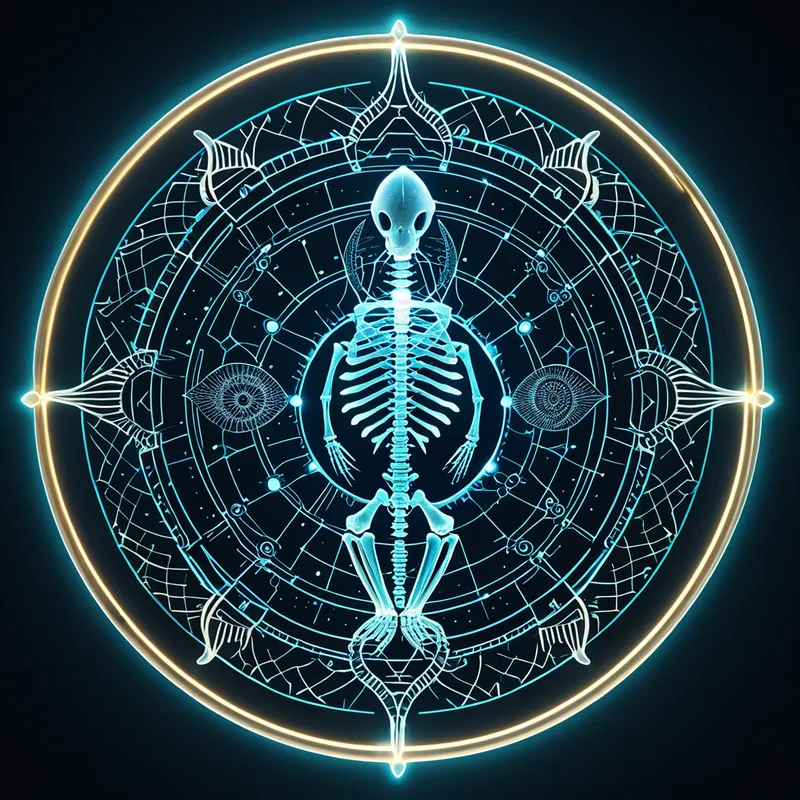
The Dreamer’s Resonance
When this myth surfaces in modern dreams, it often signals a profound somatic and psychological process of receiving essential nourishment during a time of existential or creative “drought.” Dreaming of a radiant, talking fish may indicate that a deep, instinctual part of the psyche is offering a solution, a sustenance that the conscious mind has been too proud or too desperate to see.
The somatic feeling is often one of receiving—a dream-meal that actually feels nourishing, or water that truly quenches. Conversely, dreams of being asked to sacrifice something precious (like the dreamer’s own “fish”) may reflect the psyche’s preparation to give of oneself in a meaningful, perhaps life-altering way. The key is the element of sacred exchange, not loss.
If the dream involves polluting the water or wasting the gift, it points to a modern malady: consuming insights, relationships, or resources without the sacred return of gratitude and integration. The psyche warns that this breaks the covenant and leads back to spiritual drought.

Alchemical Translation
For the individual on the path of individuation, the Spirit Fish myth models the critical stage of psychic transmutation where a dominant content of the unconscious is made conscious and is “sacrificed” to serve the growth of the entire personality.
The “drought” is the stagnation of the conscious attitude. We dance our old dances (ego-driven efforts), but no rain falls. The breakthrough comes only when the ego (Still Water) approaches the depths in a state of humble despair, ready to listen. The Spirit Fish is a content of [the Self](/myths/the-self “Myth from Jungian culture.”/)—the archetype of wholeness—that offers itself. This is the brilliant idea, the burst of creative inspiration, the compassionate impulse that arises unbidden.
Individuation requires the courage to consume the sacred offering—to fully integrate this new content into one’s life—and the wisdom to return its essence to the unconscious through conscious ritual. This ritual is reflection, art, prayer, or service; it is the act of giving the experience back as meaning, which fertilizes the unconscious for future guidance.
To “eat the fish but return the bones” is to use the gift without being possessed by it. We take the nourishment of an insight, but we do not arrogantly claim to be the source of all fish. We remain in respectful, cyclical relationship with the deeper Self. This completes the alchemical cycle: [solve et coagula](/myths/solve-et-coagula “Myth from Alchemical culture.”/)—dissolve the old form (the isolated ego, the famine) and coagulate the new (the nourished, connected self living in covenant). The rain that follows is the affective state of renewal, the feeling of life flowing again, now sourced from a conscious partnership between the individual and the vast, nurturing depths within.
Associated Symbols
Explore related symbols from the CaleaDream lexicon: