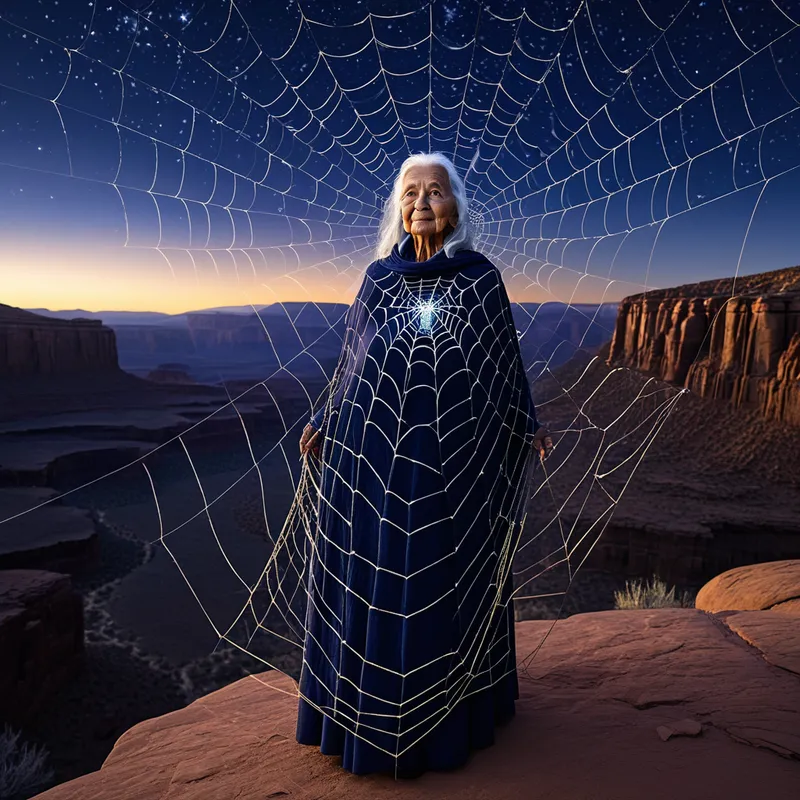
Spider Grandmother/Anansi Myth Meaning & Symbolism
A cosmic weaver, both creator and trickster, who spins the world from thought and story, teaching that wisdom and order emerge from cunning chaos.
The Tale of Spider Grandmother/Anansi
In the time before time, when the world was dark water and whispering winds, there was only thought. And thought took the form of a vibration, a hum in the void. From this hum, Spider Grandmother emerged. Not with a crash, but with the patient, deliberate click of legs on the fabric of potential. She was the first mind, the first weaver. She spun a line of her own being, a thread of consciousness, and sang to it. The song was a story of land and sky. She cast the thread into the darkness, and where it touched, the First World solidified—a damp, subterranean realm of muted colors and soft echoes.
She saw the people there, stumbling in the gloom, and her heart, a tiny drum of creation, beat with purpose. From the substance of her web and the breath of her stories, she formed two beings: Monster Slayer and Child-Born-of-Water. “You will lead them,” she whispered, her voice the sound of silk sliding over stone. She wove a ladder of sunbeams and storm clouds, and up they climbed, through a great reed, into the Second World, then the Third. Each time, the people grew, and each time, imperfection or danger forced them onward. Spider Grandmother was always ahead, her web a glowing map in the spiritual firmament, her stories the instructions for survival.
Finally, they burst into the Fourth World, our world. It was vast, blindingly bright, and chaotic. The people trembled before the unchecked sun and roaming monsters. Spider Grandmother did not create order from nothing. She taught them to weave it. She showed the women how to weave blankets that held the patterns of the constellations, stories made tangible. She taught the men the web of kinship and hunting grounds. She did not command; she demonstrated. The world was not given, but crafted, strand by deliberate strand, story by sacred story, from the chaos of the emerging dawn.
Across the great water, in the forests and villages where the rain is a living entity, another weaver operated. Here, the world existed, but it was hoarded. All the stories, all the wisdom, the very art of storytelling itself, belonged to Nyame, the Sky God, who kept them locked in a wooden box next to his golden throne. The world below was a quieter, duller place for it.
But in the damp undergrowth, Anansi, the spider, schemed. He desired the stories, not to own, but to spread. He climbed the silken thread to the sky and stood before Nyame. “I wish to buy your stories,” Anansi said, his voice a faint rustle. Nyame laughed, a sound of thunder. “The price is impossible. Bring me Osebo the leopard-of-the-terrible-teeth, Mmoatia the dwarf-with-the-seven-ghosts, and Onini the stingless-one-who-swallows-men.”
Anansi did not flinch. He returned to the earth and began to spin—not webs of capture, but webs of thought. To catch Osebo, he dug a pit, covered it with web, and debated aloud whether a leopard was stronger than a spider. The vain leopard, coming to investigate, fell in. To trap Onini the python, he tricked the snake into stretching out along a branch to settle a argument about length, then bound him fast with silken cords. For Mmoatia, he carved a wooden doll, smeared it with sticky sap, and left it with a bowl of yam paste. The dwarf, tricked into a fight with the “child,” was stuck fast.
One by one, Anansi delivered the impossible creatures to Nyame. The Sky God was stunned into silence. He had no choice. He handed down the wooden box. Anansi, the small, the seemingly weak, the cunning, opened it over the world. Stories of foolishness and wisdom, of creation and trickery, of heroes and cowards, fluttered out like a thousand butterflies, taking root in every human mind. From that day, stories were never again owned by one, but belonged to all, and were always called “Anansi stories.”

Cultural Origins & Context
The weaver archetype manifests in two primary, profound cultural streams. Spider Grandmother, known as Kokyangwuti or Na’ashjé’ii Asdzą́ą́, is a foundational deity of many Pueblo and Diné (Navajo) peoples of the American Southwest. Her myths are central to creation, emergence, and weaving ceremonies. These stories are not mere folklore but are integral to ritual, identity, and the transmission of practical and spiritual knowledge. They are told by elders and medicine people, often during specific seasons or ceremonies, binding the community to the land and its sacred history.
Anansi tales originate with the Akan people of Ghana and were carried across the Atlantic during the transatlantic slave trade. In the Caribbean and the American South, Anansi became a crucial figure of resistance and cultural preservation. Enslaved Africans used Anansi stories, told in hushed tones in quarters and fields, to encode lessons about outwitting more powerful oppressors, the value of cleverness over brute strength, and maintaining a sense of identity and agency. The stories were dynamic, adapting to new environments, ensuring the survival of a worldview.
Symbolic Architecture
At its core, this dual myth presents the archetype of the Trickster-Creator. This is not a contradiction but a profound unity. Creation is not a singular, authoritarian act, but an ongoing, cunning process of arranging existing chaos into meaningful patterns.
The spider does not create the thread; she secretes it from her own body. Creation is an act of inner transformation made manifest.
Spider Grandmother symbolizes the World Soul or Anima Mundi, the conscious, weaving intelligence within nature itself. Her web is the interconnectedness of all life, the invisible lines of relationship, cause and effect, and story. She represents wisdom that is not shouted but demonstrated, emerging from patience and attentive craft.
Anansi embodies the psyche’s cunning—the intellect and guile necessary for the weak, the small, or the oppressed to navigate a world of disproportionate power. He is the principle of mental agility. His quest for the stories symbolizes the individuation drive: the need to claim one’s own narrative from the distant, ruling “gods” of parental complexes, societal expectations, or internalized oppression.
The web itself is the ultimate symbol. It is a trap for sustenance, a map of the cosmos, a network of consciousness, and the fragile, beautiful structure of the self, spun from one’s own experiences and thoughts.
The Dreamer’s Resonance
When the Spider archetype spins its way into modern dreams, it signals a profound process of psychic weaving or entanglement. To dream of a benevolent, majestic spider weaving a beautiful, intricate web often coincides with a period of synthesis. The dreamer is unconsciously connecting disparate life experiences, ideas, or relationships into a coherent whole. It can feel like a hidden order is revealing itself.
Conversely, to dream of being trapped in a web, or of a threatening spider, points to the shadow of the weaver: a feeling of being ensnared by one’s own creations—perhaps a web of lies, a tangled network of responsibilities, or the sticky threads of obsessive thought patterns. The dream presents the trap as self-made, urging the dreamer to see their own agency in both their confinement and their potential liberation. The somatic sensation is often one of constriction or subtle vibration, a feeling of being “caught” in a situation of one’s own making.
Alchemical Translation
The alchemical journey modeled by Spider Grandmother and Anansi is the opus of weaving the Self from the raw silk of the unconscious. It is the path of the Individuation.
The first stage is emergence (Spider Grandmother leading from the First World). We must recognize we are in a dark, confined psychic space—a complex, a repetitive pattern, an immature state. The call is to climb, guided by the faint, self-generated thread of intuition or insight.
The second stage is the impossible task (Anansi’s quest). The ruling consciousness (Nyame, the dominant attitude) hoards the “stories”—our full potential, our authentic voice. To claim them, we must use cunning (shadow work, introspection, therapy) to capture and integrate the terrifying, elusive, or inflated aspects of our own psyche: the predatory leopard (raw aggression), the elusive dwarf (repressed magic), the swallowing python (primal fear).
The treasure is always guarded by a dragon, and the dragon is always a part of ourselves we have not yet dared to face.
The final stage is dispersion. Once the stories are won, they must be shared, lived, and told. The individuated person does not hoard their hard-won wisdom but, like Anansi releasing the stories, allows it to become part of the human conversation. They become a weaver in their own right, spinning the threads of their unique life into a pattern that connects them meaningfully to the wider web of existence. The goal is not to become a god on a mountain, but to become a conscious, creative node in the great, shimmering web of being.
Associated Symbols
Explore related symbols from the CaleaDream lexicon: